Samiya Khaliq
King Abdullah University of Science and Technology, KSA
Scientific Tracks Abstracts: J Biomed Sci
With an increasing demand for radiation detection devices in diverse sectors such as healthcare, industrial safety, and environmental monitoring, there is an urgent need for portable and affordable personal dosimeters. We demonstrate a Mn-doped Cs3Cu2I5 metal halide portable personal dosimeter for X-ray detection. The device is specifically tailored for individuals working in medical and security environments, providing a crucial safety measure when exposed to scattered X-ray beams. The portable dosimeter has a compact size of 20 x 20 mm and is highly sensitive to X-ray radiation. Equipped with photocurrent readout circuitry and advanced signal processing, our device ensures precise real-time monitoring of X-ray radiation, achieving a low-dose detection capability of 0.1 nGy/s. The device surpasses state-of-the-art personal dosimeters with its fast, low-dose detection and easy readout using a mobile phone app, ensuring accurate measurements at minimum radiation levels. The device’s compact size and low power consumption make it ideal for dosimetry applications. Recent Publications 1. Khaliq S (2025) Copper halide-based portable personal dosimeter for real-time X-ray monitoring. Cell Reports Physical Science. 2025;6(5).
Samiya Khaliq is currently a PhD candidate in Electrical Engineering at King Abdullah University of Science and Technology (KAUST), where her research focuses on advanced radiation detection systems, particularly the integration of perovskite-based scintillators with real-time signal processing and wearable technologies. She earned her M.Sc. in Electrical Engineering from KAUST in 2022. Her recent work, published in Cell Reports Physical Science, demonstrates her capability to take a radiation detection concept from material synthesis to a fully functional, real-time monitoring device. The paper demonstrates the integration of Mn-doped Csā??Cuā??Iā?? scintillator with an electronic readout system (including PCB design, amplification stages, and embedded firmware), and wireless data transmission to a mobile application. This expertise positions her to advance next-generation detectors, where sensitive materials and intelligent electronics converge to achieve accurate, real-time radiation monitoring.
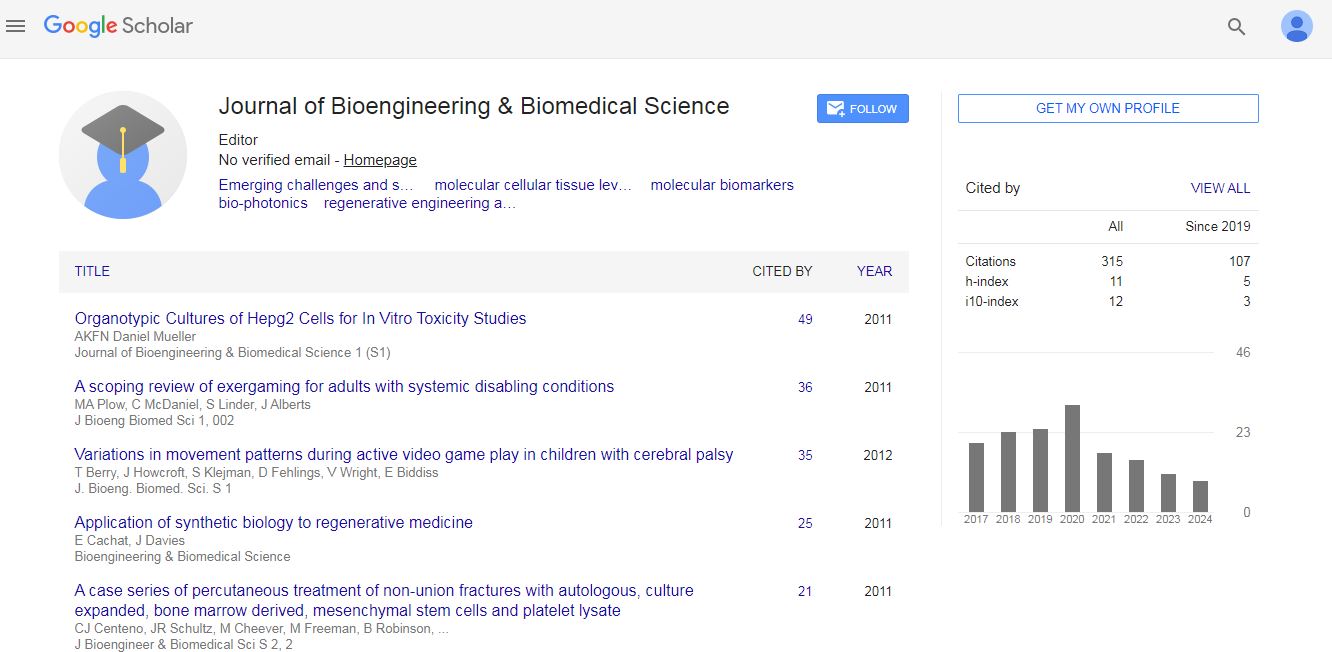
Journal of Bioengineering & Biomedical Science received 307 citations as per Google Scholar report
 Spanish
  Chinese
  Russian
  German
  French
  Japanese
  Portuguese
  Hindi
Hindi 