Olayide A Arodola and Mahmoud E S Soliman
University of KwaZulu-Natal, South Africa
Scientific Tracks Abstracts: Med chem
Introduction/Aims: Cathepsin D, one of the attractive targets for the treatment of breast cancer, has been implicated in HIV neuropathogenesis since it increases intracellular viral replication. However, its mechanism of action has neither been fully explored nor well understood. This study aims at developing a predictive quality approach to understanding the mechanism of action of Cathepsin D in the treatment of HIV and breast cancer. Methods: Herein, we employed diverse computational methodologies including 2D-QSAR, 3D-QSAR, hybrid QM/MM, accelerated molecular dynamics, MM-PBSA, Principal component analysis, residue interaction network, cross-correlation, potential energy analysis, RMSD, RMSF to investigate the stability, fluctuation and detailed binding modes between Cathepsin D and 78 pepstatin A analogues. Results: The 3D-QSAR model shows good predictive ability with R2 of 0.780 and Q2 of 0.574 while 2D-QSAR model has R2 of 0.821 and Q2 of 0.365. Cross-correlation provided insight into atomic motions with respect to their biological function. RMSD and potential energy analyses showed the stability of the 5 compounds in the enzyme and RMS deviation of C-alpha were not more than 1Ã?Â?. PCA analysis showed that the two Eigen-vectors account for >37.1% of all motions in all the complexes analyzed in this study. Conclusions: The insight gained from this study offer theoretical references, which could provide an incentive to understanding the mechanism of action of Cathepsin D. It could also aid in the designing of potent, clinically relevant drugs with improved pharmacokinetic and pharmaco-dynamics properties that could aid the treatment of HIV-1 and breast cancer co-infection in Africa.
Olayide A Arodola graduated as a Master of Medical Science (Pharmaceutical Chemistry) with a Summa Cum Laude from University of KwaZulu-Natal, Durban, South Africa. She continued her PhD study in Pharmaceutical Chemistry at the University of KwaZulu-Natal. She is currently an awardee of the Golden Key International Honor Society as a result of her outstanding academic achievement in 2014 – Master’s degree (Summa Cum Laude). Her future endeavors will be focused on clinical research where her analytical and computational skills can add value to pharmacodynamics and pharmacokinetic research. She has published 5 papers in high-ranked peer reviewed journals and 3 papers have been submitted and under reviews.
Email: olayide.arodola@gmail.com
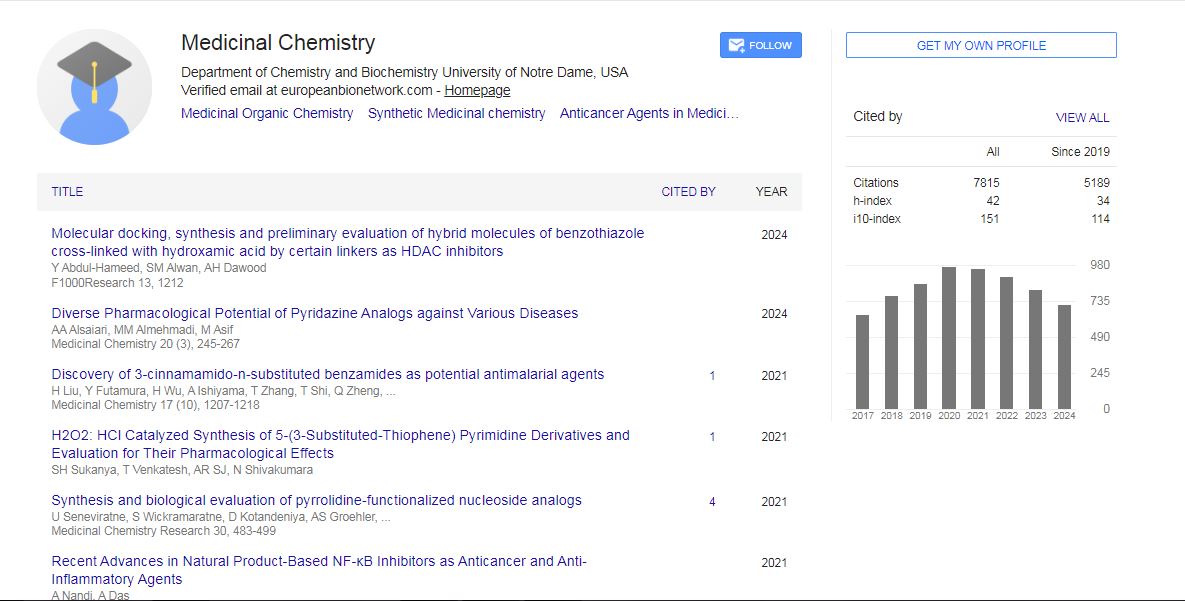
Medicinal Chemistry received 6627 citations as per Google Scholar report
 Spanish
  Chinese
  Russian
  German
  French
  Japanese
  Portuguese
  Hindi
Hindi 