Commentary - (2025) Volume 14, Issue 4
Received: 01-Jul-2025, Manuscript No. iem-26-179807;
Editor assigned: 03-Jul-2025, Pre QC No. P-179807;
Reviewed: 04-Jul-2025, QC No. Q-179807;
Revised: 22-Jul-2025, Manuscript No. R-179807;
Published:
29-Jul-2025
, DOI: 10.37421/2169- 0316.2025.14.309
Citation: Kowalska, Natalia. Workforce Management for Industrial Engineers: Strategy, Optimization, Innovation. J Ind Eng Manag 14
(2025):309.
Copyright: © 2025 Kowalska N. This is an open-access article distributed under the terms of the Creative Commons Attribution License, which permits unrestricted use,
distribution and reproduction in any medium, provided the original author and source are credited.
Effective workforce management is a critical aspect of modern industrial engineering, ensuring that organizations can achieve their strategic objectives through optimized human capital. The strategic deployment of talent, coupled with a focus on skill development and continuous improvement, forms the bedrock of successful engineering organizations [1].
In industrial engineering, the ability to efficiently allocate tasks and manage resources is paramount to maintaining productivity and project timelines. Dynamic assignment models that consider engineer expertise and project urgency can significantly enhance team performance and reduce operational overhead [2].
The advent of advanced analytics has revolutionized workforce decision-making, enabling industrial engineers to proactively forecast staffing needs and identify skill gaps. Predictive modeling and machine learning offer data-driven insights for more agile and effective workforce planning [3].
Continuous professional development is essential for industrial engineers to remain competitive in a rapidly evolving technological landscape. Frameworks for identifying emerging skill requirements and implementing targeted training are crucial for adapting to industry demands [4].
Managing a diverse workforce presents both challenges and opportunities in industrial engineering. Strategies that foster inclusivity and leverage diverse perspectives can drive innovation and improve overall organizational performance [5].
Implementing robust performance management systems tailored for industrial engineers is key to enhancing motivation and productivity. Clear objectives, constructive feedback, and recognition of high performance are vital components [6].
The integration of lean principles into workforce management can streamline processes and reduce waste within industrial engineering operations. Lean methodologies offer practical approaches to optimize workflow and improve operational effectiveness [7].
Leadership styles play a significant role in the productivity and morale of industrial engineering teams. Understanding the impact of different approaches, such as transformational or servant leadership, can lead to more effective team management [8].
Technology and automation are transforming workforce management in industrial engineering. Digital tools, AI, and IoT offer avenues to improve efficiency, safety, and data collection, requiring engineers to adapt their practices [9].
Fostering innovation and creativity within industrial engineering teams is crucial for developing novel solutions. The work environment, team dynamics, and management support all contribute to an engineer's ability to generate innovative ideas [10].
The strategic planning of the workforce within engineering organizations is a multifaceted endeavor that requires a holistic approach. This involves carefully aligning the capabilities of the workforce with the overarching goals of the organization, with a strong emphasis on fostering continuous improvement and optimizing performance. Key strategies include the judicious deployment of talent, leveraging data analytics to inform decision-making processes, and adopting flexible work models to enhance both productivity and employee satisfaction within the demanding industrial setting [1].
Optimizing the productivity of engineers hinges on the efficient allocation of tasks and effective resource management. The implementation of models that dynamically assign tasks based on an engineer's specific expertise and the urgency of a project, alongside strategies designed to minimize bottlenecks, can dramatically improve project outcomes. Enhanced resource utilization directly contributes to shorter project timelines and a reduction in operational costs within the field of industrial engineering [2].
The impact of advanced analytics on decision-making processes related to the workforce in industrial engineering is profound. Predictive modeling and machine learning techniques are instrumental in forecasting future staffing requirements, identifying critical skill gaps within teams, and optimizing the design of training programs. The insights derived from data-driven approaches contribute to the development of more agile and responsive workforce management strategies, ensuring engineering departments are well-prepared for emerging challenges [3].
Continuous professional development is a cornerstone for maintaining a competitive edge in the engineering workforce. Developing frameworks that precisely identify emerging skill requirements and facilitate the implementation of targeted training initiatives is essential. Investing in the upskilling and reskilling of engineers is indispensable for effectively adapting to rapid technological advancements and the ever-changing demands of the industry [4].
Managing a diverse workforce within industrial engineering settings presents a unique set of challenges and opportunities. Implementing strategies that cultivate inclusivity, encourage collaborative efforts among engineers from varied backgrounds, and harness the power of diverse perspectives can significantly stimulate innovation. A strong business case exists for diversity, demonstrating its positive influence on problem-solving capabilities and overall organizational performance [5].
Establishing and maintaining effective performance management systems specifically designed for industrial engineers is crucial. These systems should encompass methods for setting clear and measurable objectives, providing constructive and timely feedback, and implementing mechanisms for recognizing and rewarding high performance. A direct correlation exists between effective performance management and employee motivation, retention rates, and overall productivity within engineering environments [6].
The integration of lean principles into the framework of workforce management for industrial engineers offers substantial benefits. Applying lean methodologies can lead to the streamlining of operational processes, the reduction of waste in all its forms, and a marked enhancement in the overall efficiency of engineering teams. Practical examples illustrate how lean thinking can optimize workflows and elevate operational effectiveness [7].
The influence of leadership styles on the productivity and morale of industrial engineering teams is a critical area of study. Examining different leadership approaches, such as transformational, transactional, and servant leadership, and assessing their effectiveness in motivating engineers, fostering a climate of innovation, and ultimately achieving project success is vital. Adaptive leadership strategies, tailored to the specific requirements of engineering environments, are strongly advocated [8].
The application of technology and automation is increasingly central to enhancing workforce management practices for industrial engineers. Digital tools, artificial intelligence, and the Internet of Things offer powerful means to improve operational efficiency, bolster safety protocols, and refine data collection processes within engineering operations. Consequently, it is imperative for engineers to embrace and integrate these technological advancements into their management paradigms [9].
Investigating strategies to cultivate innovation and creativity within industrial engineering teams is of paramount importance for generating novel solutions. The interplay between the work environment, the dynamics within teams, and the level of management support significantly impacts engineers' capacity for creative problem-solving. Methods aimed at establishing a culture that champions experimentation and rewards innovative thinking are proposed [10].
This collection of articles explores various facets of workforce management for industrial engineers. Key themes include strategic workforce planning, dynamic task allocation and resource optimization, and the use of advanced analytics for informed decision-making. Continuous professional development and managing diversity and inclusion are highlighted as crucial for a competitive workforce. The impact of performance management systems, lean principles, leadership styles, and technology/automation on engineer productivity and innovation are also discussed. Fostering creativity and innovation within engineering teams is emphasized as a driver for novel solutions.
None
None
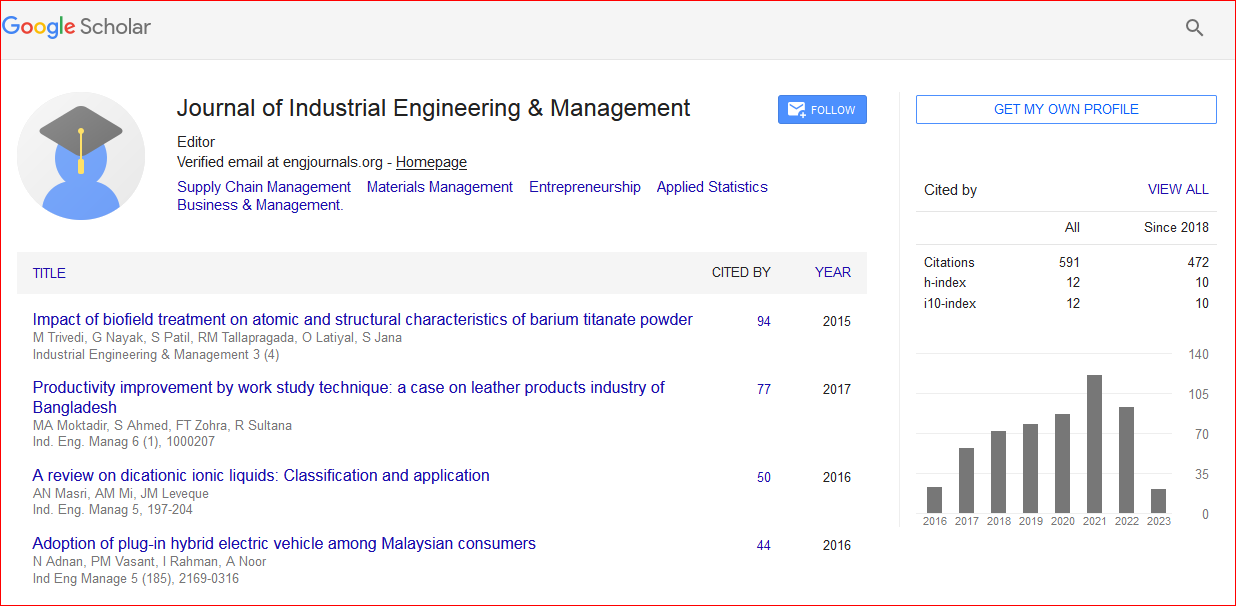
Industrial Engineering & Management received 739 citations as per Google Scholar report