Opinion - (2025) Volume 13, Issue 6
Received: 01-Dec-2025, Manuscript No. jcdd-25-177696;
Editor assigned: 03-Dec-2025, Pre QC No. P-177696;
Reviewed: 17-Dec-2025, QC No. Q-177696;
Revised: 22-Dec-2025, Manuscript No. R-177696;
Published:
29-Dec-2025
, DOI: 10.37421/2329-9517.2025.13.703
Citation: Natalie Fischer. ”Women’s Cardiovascular Health:
Tailored Care Imperative.” J Cardiovasc Dis Diagn 13 (2025):703.
Copyright: © 2025 F. Natalie This is an open-access article distributed under the terms of the Creative Commons Attribution License, which permits unrestricted use,
distribution and reproduction in any medium, provided the original author and source are credited.
Research delves into the significant sex differences observed across the spectrum of cardiovascular diseases, from underlying pathophysiology to clinical presentation and outcomes. It highlights how these distinctions necessitate sex-specific approaches in diagnosis, treatment, and prevention to improve cardiovascular health in women [1].
A narrative review focuses on the unique risk factors contributing to cardiovascular disease in women, distinguishing them from those in men. It discusses how factors like autoimmune conditions, pregnancy complications, and specific hormonal changes can elevate cardiovascular risk, emphasizing the need for tailored screening and management strategies [2].
A comprehensive review examines the nuances of ischemic heart disease (IHD) in women, covering its distinct pathophysiology, diagnostic challenges, and optimal management strategies. It underscores that women often present with atypical symptoms and non-obstructive coronary artery disease, requiring different diagnostic pathways and therapeutic approaches compared to men [3].
One study investigates the sex differences in the clinical manifestations of acute myocardial infarction (AMI), revealing that women frequently experience different or 'atypical' symptoms compared to men. Understanding these distinct presentations is crucial for prompt and accurate diagnosis in women, potentially reducing diagnostic delays and improving outcomes [4].
An article highlights the prevalence and clinical significance of coronary microvascular dysfunction (CMD) in women presenting with chest pain, often in the absence of obstructive coronary artery disease. It emphasizes that CMD is a common cause of symptoms in women and requires specific diagnostic tools and targeted therapies to manage effectively [5].
A comprehensive paper discusses the continuum of cardiovascular disease risk in women, spanning from pregnancy through menopause. It addresses how hormonal changes, pregnancy-related complications like preeclampsia, and other sex-specific factors significantly influence long-term cardiovascular health, advocating for a life-course approach to prevention and care [6].
A review outlines critical sex-specific cardiovascular risk factors in women and evaluates their impact on current guideline recommendations. It highlights how conditions like polycystic ovary syndrome, gestational diabetes, and early menopause are potent predictors of future cardiovascular events, often overlooked in standard risk assessment tools, underscoring the need for tailored clinical guidelines [7].
An article discusses the distinct sex differences observed in heart failure with preserved ejection fraction (HFpEF), a condition more prevalent in women. It explores the unique pathophysiological mechanisms contributing to HFpEF in women and emphasizes the implications for diagnosis, prognosis, and the development of sex-specific therapeutic strategies [8].
An update addresses the current state of awareness regarding heart disease in women, indicating that despite efforts, awareness remains suboptimal. It highlights the persistent gaps in public and professional understanding of women's specific risk factors and symptoms, advocating for continued education to improve early detection and prevention [9].
This article particularly focuses on the critical period of postpartum cardiovascular health, emphasizing its profound implications for a woman's future risk of heart disease. It discusses how pregnancy complications serve as early indicators of future cardiovascular events and stresses the importance of long-term follow-up and targeted interventions to mitigate these risks [10].
Cardiovascular diseases exhibit significant sex differences across their entire spectrum, encompassing underlying pathophysiology, clinical presentation, and patient outcomes. These inherent distinctions necessitate the adoption of sex-specific approaches in diagnosis, treatment, and prevention to effectively improve cardiovascular health, particularly for women [1].
Women also experience unique risk factors that distinguish their cardiovascular disease profile from men. These include conditions like autoimmune diseases, complications during pregnancy, and specific hormonal fluctuations. Such factors contribute to an elevated cardiovascular risk, highlighting a critical need for tailored screening protocols and management strategies [2].
Ischemic heart disease (IHD) in women presents with distinct pathophysiological characteristics, posing significant diagnostic challenges and requiring specialized management approaches. It's often observed that women experience atypical symptoms and frequently have non-obstructive coronary artery disease, which calls for different diagnostic pathways and therapeutic interventions compared to men [3]. Similarly, acute myocardial infarction (AMI) manifests differently in women, who commonly report atypical symptoms. Recognizing these distinct presentations is paramount for prompt and accurate diagnosis, ultimately helping to reduce diagnostic delays and improve outcomes for women [4]. Furthermore, coronary microvascular dysfunction (CMD) is notably prevalent among women who present with chest pain, even when obstructive coronary artery disease is absent. CMD represents a common cause of symptoms in women and mandates specific diagnostic tools and targeted therapies for effective management [5].
The continuum of cardiovascular disease risk for women spans their entire reproductive life, from pregnancy through menopause. Hormonal changes, coupled with pregnancy-related complications such as preeclampsia, significantly influence long-term cardiovascular health. This highlights the importance of a life-course approach to prevention and care, starting early in a woman's life [6].
Crucially, several sex-specific cardiovascular risk factors in women, including polycystic ovary syndrome, gestational diabetes, and early menopause, act as potent predictors of future cardiovascular events. These factors are frequently overlooked by standard risk assessment tools, underscoring the urgent need for tailored clinical guidelines that incorporate these unique risks [7]. Heart failure with preserved ejection fraction (HFpEF) also demonstrates distinct sex differences, being more prevalent in women. Understanding the unique pathophysiological mechanisms that contribute to HFpEF in women is vital for improving diagnosis, refining prognoses, and developing sex-specific therapeutic strategies [8]. Despite ongoing efforts to raise awareness, understanding of heart disease in women remains suboptimal. There are persistent gaps in both public and professional knowledge regarding women's specific risk factors and symptom presentations. Continuous education is essential to enhance early detection and improve prevention strategies [9]. The postpartum period represents a critical window for cardiovascular health, with profound implications for a woman's future risk of heart disease. Pregnancy complications often serve as early indicators of subsequent cardiovascular events, emphasizing the necessity of long-term follow-up and targeted interventions to mitigate these risks effectively [10].
Cardiovascular diseases present significant sex differences, affecting pathophysiology, clinical presentation, and outcomes. These distinctions necessitate tailored approaches in diagnosis, treatment, and prevention to improve women's cardiovascular health. Women face unique risk factors, including autoimmune conditions, pregnancy complications, and specific hormonal changes, which elevate their cardiovascular risk, emphasizing the need for specialized screening and management strategies. Ischemic heart disease in women often involves distinct pathophysiology, diagnostic hurdles, and specific management needs, as women frequently exhibit atypical symptoms and non-obstructive coronary artery disease. The clinical manifestations of acute myocardial infarction also vary by sex, with women often experiencing 'atypical' symptoms, making prompt and accurate diagnosis critical to reduce delays. Coronary microvascular dysfunction is prevalent in women presenting with chest pain, often without obstructive coronary artery disease, requiring targeted diagnostic tools and therapies. The continuum of cardiovascular risk in women spans from pregnancy through menopause, with hormonal shifts and complications like preeclampsia significantly impacting long-term heart health. Sex-specific risk factors such as polycystic ovary syndrome, gestational diabetes, and early menopause are potent predictors of future cardiovascular events, frequently overlooked in standard risk assessments. This points to a clear need for tailored clinical guidelines. Heart failure with preserved ejection fraction is more common in women, with unique pathophysiological mechanisms that influence diagnosis, prognosis, and therapeutic strategies. Despite ongoing efforts, awareness of heart disease in women remains suboptimal, indicating persistent gaps in public and professional understanding of women's specific risk factors and symptoms. Continued education is vital for early detection and prevention. Furthermore, postpartum cardiovascular health is a critical period, where pregnancy complications serve as early indicators of future heart disease, stressing the importance of long-term follow-up and targeted interventions.
Indexed at, Google Scholar, Crossref
Indexed at, Google Scholar, Crossref
Indexed at, Google Scholar, Crossref
Indexed at, Google Scholar, Crossref
Indexed at, Google Scholar, Crossref
Indexed at, Google Scholar, Crossref
Indexed at, Google Scholar, Crossref
Indexed at, Google Scholar, Crossref
Indexed at, Google Scholar, Crossref
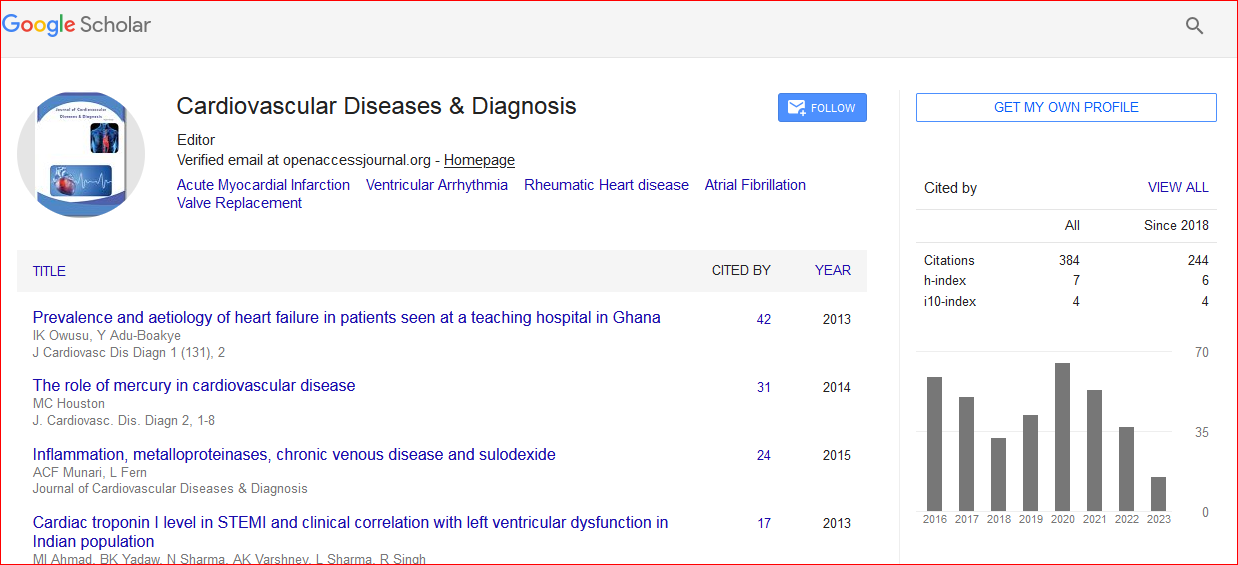
Cardiovascular Diseases & Diagnosis received 427 citations as per Google Scholar report