Research Article - (2025) Volume 14, Issue 2
Received: 11-Oct-2024, Manuscript No. IJEMS-24-150041;
Editor assigned: 14-Oct-2024, Pre QC No. IJEMS-24-150041 (PQ);
Reviewed: 28-Oct-2024, QC No. IJEMS-24-150041;
Revised: 04-Apr-2025, Manuscript No. IJEMS-24-150041 (R);
Published:
11-Apr-2025
, DOI: 10.37421/2162-6359.2025.14.779
Copyright: © 2025 Ekong UM, et al. This is an open-access article distributed under the terms of the creative commons attribution license which permits unrestricted use, distribution and reproduction in any medium, provided the original author and source are credited.
This study investigates the impact of climate change on cocoa crop production in Nigeria from 1980 to 2022 using country specific data on climate change factors like rainfall, temperature, and gas emissions; and cocoa crop output. We relied on the translog analytical technique of Christensen, Jorgenson and Lau that allows for greater flexibility in measuring environmental relationships compared to other traditional measurement techniques. Our finding suggests that at their individual levels, rainfall and carbon(IV)oxide exhibited positive output pressure on cocoa production. Within the same measures, a single percentage rise in the temperature level and gas flared quantity will negatively affect cocoa output to the value of 51% and 76% loss respectively that are statistically significant. However, deepening temperature and carbon(IV)oxide simultaneously deepen cocoa output positively within the region of 5% and 84% rise and statistically significant at one percent level of significance. Also, we found that rainfall and temperature combined, produces an insignificant positive impact on cocoa output of nearly 87% at every 10%rise in combined rainfall and temperature and the combined effect of rainfall and gas flared of say 10% increase had a combined impact of at least 20% increase in cocoa output that is not significant. This paper recommends cocoa production ranging to mitigate our country specific climate aided impact of gas flaring from oil production areas added to climate related planning for Nigeria in years following this report.
Cocoa crop • Climate change • Translog function • Correlation • Cash crops
Since the introduction of Theobroma cacao (cocoa) to the African subregion in 1822, its importance has grown over the years across the African rain forest. In Nigeria, its emergence in 1874 has quickly spread through the south-south to the south-west and south-eastern part of the country. That its spread in the Nigerian territory was astronomical is attested to by the fact that by the years preceding country’s independence, Nigeria was already the second largest producer and possibly exporter in the world by 1965. Today, Nigeria is currently placed fourth in world cocoa production after Côte d’Ivoire, Ghana and Indonesia, with production capacity of 300-350 metric tons annually and 41.6% exports strength to the country’s total export.
Such production capacity must have undoubtedly inform any sound mind that cocoa production has contributed to the economic life of the country. Aside from providing employment for nearly 300,000 to 400,000 small householder farmers scattered across the cocoa belt to keep current unemployment level at 33% (2022 estimate) with other unquantifiable absorption in the cocoa value chain, cocoa production generates foreign exchange earnings to the Nigerian region. For instance, in the year 2020 alone, cocoa export earned Nigeria about $510.8 million lower from $567.7 million and $602.6 million seen in 2018 and 2019 respectively. The year 2021 saw Nigeria’s cocoa export earnings rise to$624.35 million and lower than the $659.9 million that was obtained in 2010. We are sure that the rising foreign income from cocoa may have contributed to maintain Nigeria’s current external reserves position at 36.7 billion for February 2023 even when it has been on a decline since 2018.
The role of cocoa crop production in health economics value chain in also worthy of mention at this point. One of the recent authors to recast this role in recent history is Weidong and Yapo and Tardzenyuy, Jianguo, Akyene and Mbuwel. In their study, they identify the presence of minerals such as magnesium, iron, copper, phosphorus, calcium, and manganese in cocoa beans. Potassium, selenium, and zinc are all abundant. Tardzenyuy, Jianguo, Akyene and Mbuwel stressed that cocoa beans play a major role in constipation, cholesterol, obesity, high blood pressure, cancer, bronchial asthma, diabetes, neurodegenerative disease, and chronic fatigue syndrome treatments. It improves cardiovascular, cutaneous, and cognitive health as well as wound healing. It can also be used to treat copper deficiency. It contains anti-neurotoxic effects and boosts mood. Aside from these benefits, cocoa cultivation promotes economic growth and the well-being of rural residents [1].
Cocoa crop production has also serve as necessary ingredient in manufacturing industry value chain. By providing raw cocoa pods for the processing and production of confectioneries and general candies, cocoa crop sustains industrial development. One of the derivative of cocoa crop is chocolate. Today, chocolate is one of the most staple food across all cultures in the world. According to Zion Market Research it had been estimated that global chocolate market will grow to about USD 161.56 billion in revenue by 2024 from its value of USD 103.28 billion in 2017, this expanded market share will only be achievable if global cocoa production of which Nigeria is a major player is sustained [2].
Recently, it has been identified that revenue income from cocoa crop production is generational. Cocoa crop farming provides long term income to cocoa farmers and their families. If properly maintained, cocoa income provides a pensionable base for present generation and generations yet unborn. Now that many economies (particular the developing ones) are finding it challenging to cope with pension and gratuity payments, cocoa income can serve mitigate this challenge for our local economy.
Declining world production of cocoa by Nigeria and a shift in world production position from second to fourth is enough information that all is not well with this cash crop cultivation. Oyekale, Bodaji and Olowa asserted that when this happen, it could be that the natural and/or manmade factors that influence cocoa production has been tempered with. Oyekale and Abbott, Wilcox and Muir have independently showed that the natural factors (of which climate factors are most prominent) are the most dominant factors in declining cocoa cultivation. Our concern is that the continued decline in cocoa production is also declining dividend to cocoa stakeholders in the cocoa production value chain that needs to be addressed. Thus we set out to investigate the impact of the natural climatic factors in cocoa crop production in Nigeria with data set from 1980 to 2022. The literature for the sub-region argued strongly for three elements of climate (rainfall, temperature and carbon(iv)oxide) known to have exerted seemingly pressure in crop production [3]. We however extend the literature by including country specific element (gas flaring) that is believed to have mingled with other environmental factors to alter crop production in the sub-region in recent years. We pay specific attention to their impact on cocoa output if their effect is deepened and what happens in their romance with each other.
History of cocoa production in Nigeria
Cocoa was first developed as a crop by the South American with the Aztecs and Mayans as the indigenous populations [4]. Its importance at the time underscores currency usage, exchange rate valuation and national honors for outstanding performance.
It was the colonization of the equatorial Americas by the Spanish Conquistadors that added renewed acceptance to the cocoa crop by the introduction of drink spices notably sugar. However, the advent of industrial revolution broaden the scope of cocoa usage further so much so that by 1850, solid chocolate had flourished the world markets.
This spread may have led the cocoa seed plants to the African tropics in 1822 by the Portuguese. In Africa, the cocoa plant first settled in San Thome (present day Sao Tome and Principe) West of Gabon in the West African sub region. Although there are strong arguments that what settled in West Africa emanated from dual origin; with one originating from Brazil and the other emanating from the West Indies [5], Nigeria’s cocoa seed plant is strongly believed to have charted the Brazilian route enroute Fernando Po 1874. Howes stressed that a man named Squiss Banego first introduced the cocoa seed to the Bonny district and by ten years after, cultivation of cocoa plants was undertaken by European companies, the Royal Niger Company at Abutshi and Onitsha. It must have been migration from these regions that spread cocoa seed plants to Ibadan and Egba in 1890 and llesha in 1896 and other parts of western Nigeria as adjudged by regular authors [6].
In the early history of Nigerian growth and independence, cocoa crop production and sales was the main revenue earner for Nigeria. Its prominence grew in Nigeria such that by 1965, Nigeria was already the second largest producer of cocoa in the world and leading cash and export crop especially in the southern part of Nigeria accounting for over 50% and 60% of the total nonoil exports in the 1970’s, and 1980’s respectively. Today, although the production of cocoa crop has weaned over the years due to the advent of crude oil in Nigeria, it is still produce by over 18 states at reasonable quantities of recognition.
Cocoa and the Nigerian economy
The contribution of cocoa to the Nigerian economy is in no mean disputed. Experts are of the opinion the in the last thirty years, cocoa production has improved foreign earnings of the country to as much as $313 million dollars of the country’s GDP [7]. Cocoa shells has been converted into biofuel products in Nigeria, and other chocolate waste products forms additional fuel sources for rural dwellers. Olukunle showed that cocoa possess a high capacity of renewable energy capable of solving the country’s energy needs and the ecosystem maintenance. For instance, he showed that cocoa pod husk is a renewable source of green energy as well as an important source of bioactive compound that are vital ingredients for drugs production. Thus, cocoa production value chain is vest in employment generation. In the south-west Nigeria alone, about 2 million hands are engaged in the cocoa value chain. Whereas the 313 million US dollars’ contributions translate to 0.13% of GDP, and the 40% contributions of cocoa export to total agricultural export translate to 1.04% contributions to export earnings, the Nigerian cocoa sector employed small-farm-holders numbering 300,000-350,000 [8], overall its employment contributions translate to 3.33% of the gross employment in Nigeria.
Figure 1 presents the percentage contribution of cocoa to non-oil export in Nigeria from 2010 to 2021. As Figure 1 shows, cocoa engagement in non-oil export grew from at least as 30% in 2010 to as much as 60% in 2013. From 2013 to 2016, cocoa contributions to non-oil export grew at a declining rate, stabilizing at 29% in 2016. However, from 2016 onward, the growth has been upward and steady. For instance, cocoa contributions grew from 29% in 2016 to 36% in 2017, and nearly 49% in 2018. The contribution of cocoa to non-oil export growth was 67% in 2019 and moderated at over 70% in 2021. This experiences can only allow us to imagine the foreign exchange gains to the country. For instance, Nigeria’s net cocoa beans export value from 2000 to 2005 stood at 1.73 billion dollars; the value increased to 3.15 billion dollars between 2006 to 2010 period. The value further increased to 5.397 billion dollars in 2010-2014 periods before declining slightly to 3.193 billion dollars in 2015-2020 periods. In 2014 alone, the export value of cocoa was 627.03 million dollars. In 2022 first quarter alone, Nigeria earned a whopping 122.9 billion naira from cocoa export according to NBS.
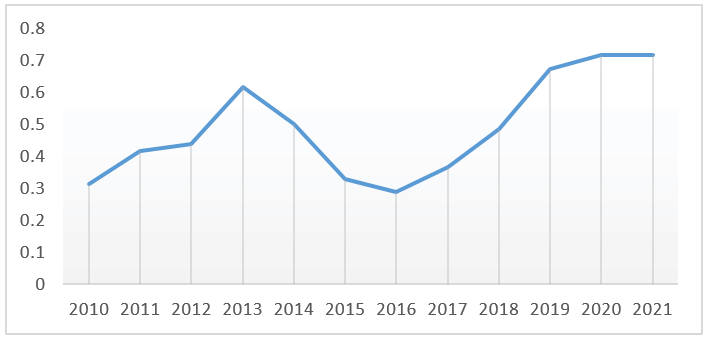
Figure 1. Cocoa export contributions in non-oil export (percentages).
Mclvor and Habibi reviewed several climate change papers on cocoa production in Nigeria. In all, they showed that climate change influenced negatively cocoa production in Nigeria. This may be as a result of farmer’s unawareness. As a result, Falola and Fakayode decided to undertake a study of farmer’s awareness of the effect of climate change in six local governments [9,10] of Ondo state Nigeria in 2012. They sampled over 120 farmers’ household using structured questionnaires and purposive technique, added to the generated secondary data. Relying on simple percentages and measures of dispersion for their analysis, they found that irregular rainfall impacted on cocoa output by 59 percent and temperature variations affected cocoa by over 28 percent resulting in a general drought level of 5.0 percent increase. Such effect leads to loss time in production by 21 percent and poor output by nearly 54 percent. Thus, they called for increase climate awareness information to cocoa farmers in Ondo state. In some cases, the farmer’s awareness of climate change impact may be there but the farmers themselves may lack the impetus to link adaptation stratergies to accurate climate change information services. This was the instance that prompted Kosoe and Ahmed to investigate such deficiencies among cocoa farmers in Ghana. In their study, 150 farmers were examined using structured questionnaires and focused group discussions. Their outcome revealed that climate services was inadequate in farmer’s penetration in Ghana hence the missing link in farmer’s adaptation in climate change. Be that as it may, farmers were able to garner that cultivation date alteration and crop diversification salvage the possibility of output loss in cocoa production.
Such adaptation involves that, among other things, seedlings improvement is of high essence for further output. Wongnaa, Jelilu, Apike, Djokoto and Awunyo-Vitor examined the role of improved cocoa seedlings in cocoa yield and income for Ghanaian farmers. They used cross-sectional data extracted from 150 household farmers in Wassa Amenfi West district of Ghana. Applying the stochastic frontier profit function and propensity score matching analysis, they showed that hybrid cocoa seedlings adaptation farmers are 10.1% more profit oriented than farmers who did not change their stratergies. This form the basis for their recommendation that farmers should adopt hybrid cocoa seedlings in their cocoa farms for profit maximization. And, because the cocoa plantation is typically region specific, adaptation strategies may likely be similar or closely related. Thus, in a study of adaption strategies for local cocoa farmers, Anning, Ofori-Yeboah, Baffour-Ata, Owusu cited similar alternatives to farmers in Adansi South district of Ghana and Oyekale for Ahafo Ano North District of Ashanti region, Ghana.
Equally, Owoeye and Sekumade independently also conducted similar study in the same region. In theiry study, they examined the temperature and rainfall pattern of the area from 1992 to 2012 to really see the effect it has on cocoa yield of cocoa farmers in Ondo state. A multistage sampling of over 180 rural cocoa farmers of Akure South, Idanre, and Ondo East Local Government Area was investigated combined with tobit regression analysis. In their finding, they showed that generally, climate fluctuations decreased coca production of farmers by 63 percent in Ondo state. Interestingly, this result in increased incidence of cocoa disease at an alarming rate (80) percent or even death of cocoa trees by 75 percent. Thus farmers were left with chemicalization and crop diversification as mitigation stratergies to cushion the impact.
Nwachukwu, Ezeh and Emerole considered the effect of climate change on cocoa production in Nigeria from 1961 to 2010. The climatic variables use in the study was rainfall and temperature related on cocoa yield of farmers in Nigeria. The analysis was such that the deepening effect of climate change on cocoa output were also investigated. In their result, they showed that a 1% increase in rainfall increased cocoa crop yield by only a margin (0.091%) within the short run. However, if rainfall increase as time passes, a 1% increase in rainfall in increase cocoa crop output by nearly 9%. Conversely, in the short run, a rise in temperature by 1% increase cocoa output by 2.9% approximately and as time increases, increasing temperature approximately reduced cocoa output by nearly 5%. Clearly, the impact of climate change on cocoa crop production is evident in Nigeria.
Kimengsi and Tosam examined the impact of climate change fluctuations on cocoa production of the Kumba, Mbonge and Konye subregions of Meme in Cameroon using climate variables from rainfall and temperature for 21 years from 1990 to 2010. The secondary data was also supplemented with primary respondents of 155 farmer participants from the region. Analyzed under the confined of coefficient of variation principle, they showed that rainfall and temperature variability greatly alter the production of cocoa in the Meme division of Cameroon. Cocoa output per hectare dropped significantly leading to reduced income as well. Their poly options dwells on farmer’s consciousness to climate alteration and government funding for resilient seedlings development.
Weidong and Yapo investigated the cross border effect of climate change on the yield of cocoa production in West Africa but dwelling on the region of Cote D’lvoire using time series data from 1990 to 2020. The study relied on autoregressive distributed lag model in her analysis. Their result shows that rainfall produces positive significant growth on the yield of cocoa in Cote D’lvoire but as rainfall increases, cocoa yield decreases significantly over time. In the case of temperature, early rise in temperature discourage early cocoa yield. However, in the long run, the negative effect of temperature smoothens out and the yield from cocoa increases significantly. They agitated for cocoa farmers’ information on the effect of climate change on cocoa yield for climate impact mitigation.
Oyekale, Bodaji and Olowa assessed the effect of climate change and the vulnerability of Nigerians to such impact paying particular attention to Ondo East local government area. They relied on the rainfall, temperature and sunshine as climate factors in their analysis. Combining both primary estimates and secondary inputs in a tobit regression, they found that low rainfall contributed to a loss in cocoa production by 58.6%. Hence, cocoa farmers had to rely on irrigation to supplement the loss to the tune of 38% and statistically significant dependence at that. More generally, they conclude that the overall climate effect of cocoa yield was 74.7% deficient.
Ofori-Boateng and Baba investigated the impact of climate change on cocoa crop production in three countries Nigeria, Ghana and Cote D’lvoire of West Africa using time series data from 1969 to 2009. Specified under the translog production model and analyzed with error correction model, they found that different country exhibited different level adjustment to climate impact with Cote D’lvoire, Nigeria and Ghana adjusting at the rate 83%, 67% and 43% respectively to climate change elements. They therefore agitated to country specific climate adaption strategy based on local content specific. Perhaps owing to such high adjustment rate and the duration to attain long run stability in Cote D’lvoire, Koissy and N’Zué expresses the need to worry on climate change impact on cocoa crop production in Cote D’ivoire. Utilizing time series data from 1961 to 2016 in a transcendental autoregressive distributed lag model specification, they showed that within the short run, rising temperature and rainfall exhibited opposing impact on cocoa output that runs from negativity from the former to positivity in the later. In the long run, the effect clearly changes in the opposite direction imposing cause for worry. Just as there was need to worry, Coulibaly, Terence, Erbao, and Bin argued that this may have attendant effect on Cote D’lvoire’s export strength. In a study to determine the effect of climate change impact on the export of Cote D’lvoire using annual data from 1966 to 2011, they found that the long run effect of precipitation on cocoa export of Cote D’lvoire was negative and statistically significant. This outcome continues from the short run up into the long run. They, therefore concluded that any change in precipitation affect cocoa output which in turn dipped revenue growth in the Cote D’lvoire region.
At the global scale, Bunn, Lundy, Läderach and Castro collaborated global climate change impact on world cocoa output with a world databases of 88857 cocoa occurrence locations and clustering occurrence of 4263 sampled climate clusters captured from West Africa region, Colombia’s Arauca region, and Central America’s Pacific coast, Central American Atlantic coast, the Brazilian Amazonas basin, the Congo Basin and the Philippines and analyzed under the Random Forest classification algorithm process. They found a rising temperature beyond the historically experienced levels with high level of uncertainty with areas of high forestation at great risk. Thus, researchers and policy makers should focus on the impacts of high temperatures on quality and vitality of cocoa plant and the management of increased drought risk.
Study area
This study is conducted in Nigeria. Nigeria is located at latitude 40 and 140 North of the Equator and longitude 30 and 150 East of the Greenwich meridian. The country has a land area of 923,768 kilometers square, of which only 70.8 million hectares are cultivable. As at 2013, the total land area under cocoa cultivation was about 1,363.60 million hectares [11]. The country falls into the tropical climate broadly divided into two seasons: Rainy season that begins around April and ends around October; and dry season that normally begins from November and ends around March every year. The region also has a natural soil texture sustainably adaptable to cocoa production. The literature have identified four types of cocoa production soil [12]. The favourable sub-regions for cocoa cultivation in Nigeria are the south-western region, the south-south region and parts of the south-eastern region. Notable states in the production hub includes Ondo, Akwa Ibom, Cross River, Ekiti, Delta, Oyo, Osun, Ogun, Edo, Abia, Taraba, Bayelsa, Lagos, Imo, Adamawa, Kwara, Rivers and Kogi states.
Estimation technique
To examine the effect of climate change on cocoa crop production in Nigeria, a transcendental logarithmic (translog) functions is used. The translog functional form has been widely used, around the world in empirical research, since its introduction by Christensen, Jorgenson and Lau. The choice of this specification is to allow for clarity in the combined effects of the structural component of climate change on cocoa crop production in the region. Thus, the model allows for greater flexibility in measuring environmental relationships compared to other traditional measurement techniques and have the ability to provide formulas for variables elasticities, in a more convenient manner.
We specify the translog functional model as

Where, Yt=Value of cocoa output; Xt=independent regressors and Xi ≠ Xj; ∂=unknown parameters; Ut=error term; ∂1, ∂2 and ∂3 are unknown system parameters to be estimated.
The joint impact of climate change on the productivity performance of cocoa output in Nigeria will be determined by ∂3. ∂2 captures the effect of correlation of climate change factors with itself over time, brought about by environmental acclimatization in the zone.
In determining the climate factors to include in our study, we relied heavily on the literature. According to Chilioke, Haile and Waschkeit, crop production in sub-Saharan Africa is directly affected by many aspects of climatic change, stemming primarily from average, change in rainfall amount and patterns, rising atmospheric concentration of CO2, change in climatic variability and extreme events and sea water rise. In Nigeria, three most predominant climatic effects are, temperature increase, atmospheric concentration of CO2 and change in rainfall. More recently, due to the degrading effect of oil exploration in the coastal areas of Nigeria, agricultural productivity is also affected by uncontrolled gas flaring, making the region susceptible to declining plants output including cocoa. We therefore include gas flaring as an important variable in our climatic consideration of the region.
Data for the study were obtained from verifiable sources. Cocoa crop production output was obtained from Afolayan; climate factor variables were obtained from www.indexmundi.com and www.countryeconomy.com; gas flaring data was sourced from Nigerian National Petroleum Corporation (NNPC) stat bulletin, and Ameachi, et al.
It was not difficult to determine the total parameters to be estimated in our climate change-cocoa crop production output equation if we rely on equation 2.0.
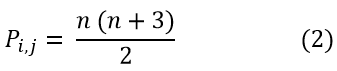
Where, Pi,j is the parameter estimate for variable i or j; and n is the number of variables in the system. Expanding equation 1.0 to our desired purpose, we have;

One key concern with the estimation of translog functions has to do with the issue of collinearity of the interacting variables. At the moment, the literature provides two options in dealing with the issue. First, Pavelescu and Gujarati suggested estimating single variable equation for all variables in the system. However, as variables increases, the single equations become too numerous to content. Second, Umar, Girei and Yakubu and Gujarati have showed that the issue of increasing single equations can be handled by Maximum Likelihood estimation (ML) and is applied in this study.
Translog specification of climate change on cocoa crop production allows us to determine the cumulative effect of change in a particular climate factor on cocoa output using the marginal product analysis thus;

Stationarity test
We employ the Kwiatkowski-Phillips-Schmidt-Shin (KPSS) test and the DF-GLS test to assess the stationarity of the variables. The KPSS test statistic is obtained by regressing the residuals of a regression on the independent variables of the original regression and is given as:

Where, St=Σts=1ês is a partial sum
ϖ2∞ is the HAC estimator of the variance of êt
The use of this test is predicted by its ability to mitigate low power statistic and size distortion problems inherent in other stationarity test procedures. In the KPSS, the null hypothesis is that the variable in question is stationary and the decision criteria is to accept the null only if the absolute value of the calculated statistic is below the critical value at the accepted level of significance [13].
The DF-GLS test also possess good size and power properties. The t statistic is generated from the parameters gotten from the following equation;

Where, ytd is the detrended data series; Δ is the difference operator; ϑ, δ1, δp are parameters to be estimated and μt is the error term.
The descriptive properties of our variables for the study, as presented in Table 1 shows that our variables were fairly stable. The variables exhibited positive measures of dispersions generally. However, some of the variables (notably temperature and gas flared) tends to be densely populated around the left hand side of the normal curve while others (cocoa output, rainfall and carbon(IV)oxide were mostly populated around the positive side of the normal curve. Perhaps such distribution led to the general flatter distribution curve seen for the distribution. Also, our sample for the study generally follows a normal distribution following the reports of the Jarque-Bera estimates. This general feelings of acceptable property distribution allows us to investigate further the other statistical properties of the variables like the stationarity properties of the distribution.
| Cocoa output | Rainfall | Temperature | CO2 | Gas flared | |
| Mean | 292360 | 124.9372 | 27.2414 | 93.84742 | 6387716 |
| Median | 270000 | 103.8 | 2.28 | 91.671 | 6190329 |
| Maximum | 525000 | 436.6 | 27.86 | 127.029 | 9529930 |
| Minimum | 100000 | 2.2 | 26.39 | 68.081 | 2549647 |
| Std. dev. | 111391.8 | 106.8312 | 0.319401 | 16.52683 | 2298529 |
| Skewness | 0.47149 | 1.033682 | -0.32197 | 0.149451 | -0.16592 |
| Kurtosis | 2.48728 | 3.667925 | 2.930389 | 1.924338 | 1.668747 |
| Jarque-Bera | 2.064165 | 8.456876 | 0.751633 | 2.233117 | 3.372539 |
| Probability | 0.536264 | 0.014575 | 0.686728 | 0.327405 | 0.815209 |
| Observations | 43 | 43 | 43 | 43 | 43 |
Table 1. Descriptive statistics of the variables.
The unit root test result of the variables for the study is reported on Table 2. When investigated under the Kwiatkowski-Phillips-Schmidt- Shin (KPSS) test, all variables exhibited staionarity at their levels at one percent level of statistical significance. However, investigated under the Dickey Fuller Generalized Least Squares test, apart from rainfall and temperature that were stationary at their levels, cocoa output, carbon(IV)oxide and gas flared could only attain that level of stationarity after a first difference (when judged at one percent level of significance). Overall, all our variables were stationary and so ready for our empirical analysis. We analyzed our variables, using the Maximum Likelihood estimation (ML) method, the K-class estimation and report the results in Table 2.
|
|
KPSS |
DF-GLS |
|
CO |
0.325080*** |
-1.556632 |
|
ΔCO |
|
-8.591859*** |
|
Rainfall |
0.152199*** |
-4.474373*** |
|
CO2 |
0.681946*** |
-2.939190* |
|
ΔCO2 |
|
-5.886728*** |
|
Temp |
0.100138*** |
-5.268544*** |
|
Gas Flared |
0.323961*** |
-1.690955* |
|
Δ Gas Flared |
|
-5.689279*** |
|
Note: Δ denotes the difference operator; ***, *denotes significance at 1 and 10 percent respectively |
||
Table 2. Unit root test.
Table 3 shows that at their individual levels, rainfall and carbon(IV)oxide exhibited positive output pressure on cocoa production. However, the strength of effect runs from carbon(IV)oxide with a more than 6-unit increase in cocoa output to a single rise in CO2 and statistically significant, to rainfall with fairly insignificant growth. Clearly, rising CO2 accelerates the photosynthetic process of cocoa plant causing greater energy and carbohydrates for cocoa root growth and development. Within the same measures, a single percentage rise in the temperature level and gas flared quantity will negatively affect cocoa output to the value of 51% and 76%loss respectively that are statistically significant. Deepening rainfall and gas flared further also deepen cocoa output loss further and statistically significant at one percent level of significance. However, deepening temperature and carbon(IV)oxide simultaneously deepen cocoa output positively within the region of 5% and 84% rise and statistically significant at one percent level of significance. Clearly, with global concentration of CO2 on the rise from the region of 280 ppm to around 400 ppm in recent years, our outcome may not be attributed to chance.
| Dependent variable: InCOt | |||
| Variables | Coefficient | t-ratio | Probs |
| InRaint | 0.0166 | 0.1769 | 0.8609 |
| InTempt | -5.0829 | -2.9289 | 0.0067*** |
| InCO2,t | 5.7563 | 3.5869 | 0.0013*** |
| InGasft | -7.6043 | -2.6036 | 0.0146** |
| InRain2t | -5.2606 | -0.5705 | 0.5729 |
| InTemp2t | 0.8444 | 3.2663 | 0.0029*** |
| InCO2,2t | 0.0051 | 2.8016 | 0.0091*** |
| InGasft2 | -2.7213 | -3.3064 | 0.0026*** |
| InRaintInTempt | 8.6405 | 0.7781 | 0.4431 |
| InRaintInCO2,t | -2.6305 | -1.153 | 0.2587 |
| InRaintInGasft | 2.041 | 1.1537 | 0.2587 |
| InTemptInCO2,t | -0.0391 | -3.1487 | 0.0039*** |
| InTemptInGasft | -1.1407 | -3.252 | 0.0030*** |
| InCO2,tInGasft | -1.1609 | -0.8266 | 0.4154 |
| C | 14.1393 | 2.7486 | 0.0104** |
| Adjusted R2 | 0.75 | R2 | 0.84 |
| Durbin watson | 1.7 | LILM min. eigenvalue | 1 |
| Note: ***, **denotes significance at 1 and 5 percent respectively | |||
Table 3. Estimated results.
As the correlative outcomes of the variables are examined, we found that rainfall and temperature combined, produces an insignificant positive impact on cocoa output of nearly 87% at every 10% rise in combined rainfall and temperature. In the same vein, the combined effect of rainfall and gas flared of say 10% increase had a combined impact of at least 20% increase in cocoa output that is not significant after all. This may be expected. Rising rainfall reduces a rigorous impact of gas flaring on plants generally although increasing the pollution surface area. However, the combined effect of rainfall and carbon(IV)oxide produces an insignificant negative impact on cocoa output of at least 26% at every 10% increase of the duo (rainfall and carbon(IV)oxide). Similarly, the combined effects of Temperature and Carbon(lV)oxide (InTemptInCO2,t), Temperature and Gas flared (InTemptInGasft), and Carbon(LV)oxide and Gas flared (InCO2,tInGasft) all produces various degrees of output dippening impacts on Cocoa output.
For instance, a 1% rise in Temperature and Carbon(lV)oxide (InTemptInCO2,t), will dipped cocoa output by say 4% and statistically significant; equally, a 10% rise in Temperature and Gas flared (InTemptInGasft) will dipped cocoa output by 11% and statistically significant; and a 10% rise in Carbon(LV)oxide and Gas flared (InCO2,tInGasft) dipped cocoa production output by almost 12% although not statistically significant.
Our report shows that between 75% and 84% of variation in cocoa output in Nigeria in the study period was caused by climate related changes. We also found that the in-sample romances between the independent variables were minimal with the DW test of 1.7. We also decided to test the population structure of our variables and reports the result in Table 4 With Breusch-Pagan-Godfrey test of heteroscedasticity, we show that, under the null hypothesis of variables homoscedasticity, the variances of the errors of our estimates were small and thus emanates from a similar population.
| Null hypothesis: The variables are homoskedastic | |||
| F-statistic | 0.526751 | Prob. F(14,28) | 0.8962 |
| Obs*R-squared | 8.964191 | Prob. Chi-Square(14) | 0.8333 |
| Scaled explained SS | 9.624542 | Prob. Chi-Square(14) | 0.7891 |
Table 4. Heteroskedasticity test.
The brief discussion of the impact of climate change on cocoa output in the Nigerian region above shows that climate variations changes the pattern of Cocoa output in the region. Our particular attention is drawn to the country specific variable included in the climate change discussion (gas flared). In most cases in the analysis, the country specific variable delivers declining effects on cocoa output. More worrisome is its effect on the correlative impact with other climate variables on cocoa output. A correlation of other climate factors with the country specific factor dipped cocoa output further. At this point what is imperative is policies that should minimize such correlative integration which to my mind should only come oil production related production function that will half gas flared.
The study also shows that a negative impact of climate factors increases as a climate variable impact increases (see the case of rainfall and gas flared). Although deepening temperature and carbon(IV)oxide in the study showed a positive impact on cocoa output, studies have also shown that beyond a certain threshold, such impact are output retrogressing. At this point an optimal policy option should be determining a threshold corridor under which, beyond this corridor, increased climate impact becomes detrimental to cocoa output.
More generally, declining cocoa output for the Nigerian region implies that not just the cocoa farmers, but the global population is at risk of chocolate extinction and cocoa health imperative shocks. Therefore, when a climate variable changes, the whole world suffers. This should draw the attention of all stakeholders in the climate and agriculture industries to the table on successful implementation of climate change mitigation strategies tenable in their domain.
Because climate variations are nature dictated phenomenon and can not necessarily be fine-tune under the control of man-made techniques, excerpt country-specific aided ones like the one identified for the Nigerian region, efforts at mitigating the risk have so far achieved reduced outcome. Nonetheless, many studies have proffered regional specific strategies for combating climate change, including, but not limited to resilient cocoa plant seedlings and extension services to enhance the maintenance of cocoa [14]; engaging in climate smart cocoa farming through old farm rehabilitation; subsidizing production incentives [15,16]; agricultural development planning through national climate monitoring centre (Kimengsi and Tosam among others. This paper aligns with the suggested strategies but extend the suggestions to cocoa production ranging to mitigate our country specific climate aided impact of gas flaring from oil production areas [17-20].
Generally, information on the effect of climate change on crop production like this should prompt the regulatory authorities on climate planning purposes. Therefore, this study proposes a planning consciousness on the governments on the effect of climate on cocoa production output in Nigeria. Such planning will impose on cocoa production stakeholders the need to utilize all local contents available on halving climate impact on cocoa output. We are hopeful that beyond this point cocoa output in Nigeria will be bountiful amidst changing climate conditions.