Commentary - (2025) Volume 16, Issue 6
Received: 01-Nov-2025, Manuscript No. hycr-25-175045;
Editor assigned: 03-Nov-2025, Pre QC No. P-175045;
Reviewed: 17-Nov-2025, QC No. Q-175045;
Revised: 24-Nov-2025, Manuscript No. R-175045;
Published:
01-Dec-2025
, DOI: 10.37421/2157-7587.2025.16.627
Citation: Baeza, Alicia. ”Wetlands: Vital, Threatened, and Needing Action.” Hydrol Current Res 16 (2025):627.
Copyright: © 2025 Baeza A. This is an open-access article distributed under the terms of the Creative Commons Attribution License, which permits unrestricted use, distribution
and reproduction in any medium, provided the original author and source are credited.
Wetlands are globally recognized as indispensable ecosystems, providing a multitude of services crucial for environmental stability and human well-being. A systematic review reveals increasing global research trends focusing on wetland ecosystem services, specifically their pivotal roles in maintaining biodiversity, regulating climate, and enhancing water quality. This research underlines the necessity for interdisciplinary strategies and sound methodologies to effectively evaluate and manage these essential services, while also identifying existing gaps in geographical scope and research themes [1].
The broader context of wetland conservation and restoration worldwide is critical. An extensive overview details various approaches, successes, and persistent challenges in preventing further wetland degradation and restoring their ecological functions. This work stresses the fundamental role of policy frameworks, active community involvement, and comprehensive scientific understanding as primary drivers for successful interventions [2].
Furthermore, the delicate balance of wetland biodiversity faces substantial threats from climate change. A systematic review explores this intricate relationship, illustrating how altered hydrological regimes, rising temperatures, and escalating extreme weather events detrimentally affect wetland flora and fauna. The findings emphasize an urgent need for climate-smart conservation approaches to safeguard these biologically rich ecosystems [3].
Beyond biodiversity, wetlands play a significant part in the global carbon cycle, offering considerable potential for climate change mitigation. Research synthesizes current knowledge on carbon sequestration processes across diverse wetland types, advocating for their preservation and restoration as natural climate solutions designed to reduce atmospheric carbon dioxide concentrations [4].
This includes an examination of the complexities of wetland governance and policy, which identifies significant obstacles to sustainable management. These challenges range from fragmented legislation and weak enforcement to conflicting land-use interests. However, opportunities exist for improvement through integrated policy frameworks, enhanced stakeholder collaboration, and capacity building to ensure effective wetland protection [5].
Innovations in wetland application extend to wastewater treatment. A review offers insights into recent advancements and future prospects for constructed wetlands in this domain. It delves into the effectiveness of various design configurations and plant species for pollutant removal, highlighting their cost-effectiveness and ecological advantages as sustainable global solutions for improving water quality [6].
Focusing on restorative efforts, a meta-analysis investigates soil carbon dynamics in wetlands that have undergone restoration. This research uncovers their significant capacity for carbon sequestration, demonstrating how practices such as rewetting and planting native vegetation can boost soil organic carbon accumulation, thereby contributing both to climate change mitigation and broader ecosystem recovery [7].
The profound impact of hydrological changes on wetland vegetation is also a global concern. A review details how modified water regimes, including intensified droughts and floods due to climate change, lead to shifts in species composition, a reduction in biodiversity, and functional impairments within wetland ecosystems. This underscores the necessity for adaptive management strategies [8].
Effective wetland management often hinges on local engagement. A review explores the crucial role of local community participation, pinpointing challenges like power imbalances and resource scarcity, alongside opportunities for successful involvement through integrating traditional knowledge and ensuring equitable benefit sharing. Such participation is vital for sustainable wetland conservation [9].
Finally, coastal wetlands represent another critical component in the global climate solution. A synthesis provides an updated understanding of blue carbon dynamics in these ecosystems, emphasizing their immense capacity for long-term carbon sequestration. It highlights the importance of protecting and restoring coastal wetlands for climate change mitigation, while also addressing challenges in accounting and policy implementation for blue carbon initiatives [10].
Wetlands are exceptionally dynamic ecosystems, performing critical functions that sustain both natural processes and human societies. They act as essential regulators of the global climate by participating actively in the carbon cycle and providing unique habitats for vast biodiversity [1]. Understanding the intricate web of services wetlands provide, such as water purification, flood control, and groundwater recharge, is pivotal for developing effective conservation strategies [1]. The urgency to protect these vital systems is consistently emphasized across recent research, which highlights their multifaceted value and the increasing focus on their crucial roles in supporting ecological balance.
A significant body of work focuses on the threats confronting wetlands and the multifaceted efforts to counteract them. Climate change emerges as a major stressor, directly impacting wetland biodiversity through altered hydrological regimes, increased temperatures, and extreme weather events that lead to undesirable shifts in flora and fauna composition [3]. These climatic shifts also manifest as profound hydrological changes, including more frequent droughts and floods, which further degrade wetland vegetation, reduce overall biodiversity, and impair ecological functions [8]. In response, global overviews detail the critical importance of wetland conservation and restoration, outlining successful approaches and persistent challenges. These efforts often hinge on robust policy frameworks, genuine community involvement, and a deep scientific understanding to drive effective interventions [2]. Crucially, targeted restoration initiatives specifically aim at enhancing key ecosystem functions, such as soil carbon sequestration, through practices like rewetting and the strategic planting of native vegetation [7].
Beyond mitigating direct climate impacts, wetlands play a crucial role in the global carbon cycle, offering significant potential for climate change mitigation. Research synthesizes how various wetland types effectively sequester carbon, positioning their conservation and strategic restoration as viable natural climate solutions to reduce atmospheric carbon dioxide concentrations [4]. Coastal wetlands, in particular, are recognized for their immense capacity in blue carbon dynamics, showcasing their potential for long-term carbon sequestration that is critical for global climate change mitigation efforts [10]. However, integrating these blue carbon initiatives into effective policy faces considerable challenges related to accurate accounting and practical implementation [10]. Therefore, the comprehensive management of these natural carbon sinks requires careful consideration, innovative strategies, and robust planning.
Effective wetland management is not solely about ecological science but also involves complex governance and policy considerations that present both obstacles and opportunities. Sustainable management of wetlands is frequently hindered by issues such as fragmented legislation, weak enforcement mechanisms, and conflicting land-use interests among various stakeholders [5]. Despite these inherent challenges, clear opportunities exist for substantial improvement through the development of integrated policy frameworks, fostering enhanced stakeholder collaboration, and building essential capacity among all parties responsible for wetland protection [5]. Crucially, local community participation is identified as fundamental to successful wetland management. While power imbalances and resource limitations can present significant hurdles, integrating traditional knowledge and ensuring equitable benefit sharing can foster successful engagement, making informed local involvement absolutely vital for sustainable wetland conservation [9].
Finally, technological applications also contribute significantly to enhancing wetland functionality, particularly in the realm of water quality improvement. Constructed wetlands, for instance, are increasingly recognized for their efficacy in wastewater treatment. Recent advancements highlight the performance of various design configurations and the specific plant species that are most effective in pollutant removal from diverse waste streams. These engineered systems offer not only cost-effective solutions but also ecological benefits, representing a sustainable and viable approach to improving water quality globally and managing valuable water resources [6].
Wetlands are vital ecosystems, globally recognized for their critical roles in biodiversity, climate regulation, and water quality. Research highlights their significant capacity for ecosystem services, emphasizing the urgent need for interdisciplinary approaches to assess and manage them effectively. These environments are pivotal in the global carbon cycle, acting as natural solutions for climate change mitigation through carbon sequestration in both inland and coastal systems, particularly blue carbon. Restoration efforts, involving rewetting and native vegetation, significantly enhance soil carbon accumulation, further contributing to climate action. However, wetlands face substantial threats, with climate change being a primary concern. Altered hydrological regimes, increased temperatures, and extreme weather events lead to reduced biodiversity and functional impairment of these ecosystems. The impact of hydrological changes on wetland vegetation, including droughts and floods, necessitates adaptive management strategies. Effective wetland protection involves complex governance and policy challenges, such as fragmented legislation and conflicting land-use interests. Overcoming these requires integrated policy frameworks, robust stakeholder collaboration, and capacity building. Local community participation is also crucial, demanding the integration of traditional knowledge and equitable benefit sharing to achieve sustainable management. Beyond natural processes, constructed wetlands offer sustainable, cost-effective solutions for wastewater treatment, contributing to global water quality improvement. Overall, the collective research underscores the indispensable value of wetlands and the necessity for comprehensive, collaborative strategies to ensure their long-term conservation and restoration amidst environmental pressures.
None
None
Indexed at, Google Scholar, Crossref
Indexed at, Google Scholar, Crossref
Indexed at, Google Scholar, Crossref
Indexed at, Google Scholar, Crossref
Indexed at, Google Scholar, Crossref
Indexed at, Google Scholar, Crossref
Indexed at, Google Scholar, Crossref
Indexed at, Google Scholar, Crossref
Indexed at, Google Scholar, Crossref
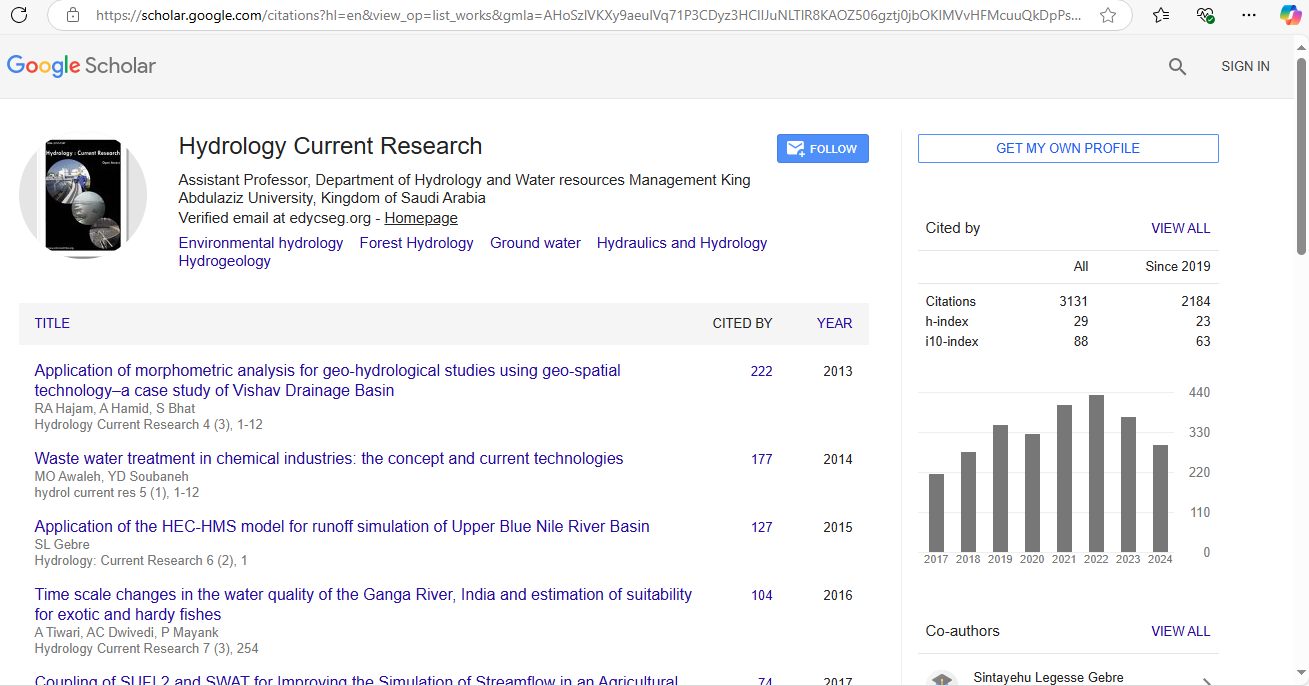
Hydrology: Current Research received 2843 citations as per Google Scholar report