Short Communication - (2025) Volume 16, Issue 5
Received: 01-Sep-2025, Manuscript No. jpm-26-179464;
Editor assigned: 03-Sep-2025, Pre QC No. P-179464;
Reviewed: 17-Sep-2025, QC No. Q-179464;
Revised: 22-Sep-2025, Manuscript No. R-179464;
Published:
29-Sep-2025
, DOI: 10.37421/2090-0902.2025.16.560
Citation: Álvarez, Miguel. ”Wavelets and Multiscale Methods: A Scientific Revolution.” J Phys Math 16 (2025):560.
Copyright: © 2025 Álvarez M. This is an open-access article distributed under the terms of the Creative Commons Attribution License, which permits unrestricted use, distribution and reproduction in any medium, provided the original author and source are credited.
Wavelets and multiscale methods have emerged as powerful tools for analyzing complex data across various scientific disciplines, offering a unique perspective on signals and systems at different scales. This review delves into the foundational principles underpinning these techniques and their diverse applications, particularly in modeling physical phenomena. The inherent ability of wavelets to decompose signals into various frequency components allows for a granular examination of systems, a capability that traditional Fourier methods often struggle to provide, especially for non-stationary and localized features common in physical modeling [1].
In the realm of computational science, adaptive wavelet methods have shown significant promise in tackling challenging problems such as solving partial differential equations (PDEs) that govern fluid dynamics. The efficiency and accuracy of wavelets in representing solutions with localized features, like shocks or turbulent eddies, have led to improved computational performance and reduced memory footprints compared to conventional grid-based approaches [2].
Materials science also benefits immensely from the application of multiscale analysis. Wavelets enable the characterization of complex materials by identifying hierarchical structures and heterogeneities. This approach is crucial for understanding material properties at different length scales, from the microstructural level to macroscopic behavior, aiding in the design and development of new materials [3].
A critical application of wavelets lies in signal processing, particularly for denoising in geophysical applications. By exploiting the distinct frequency and localization properties of wavelet coefficients, researchers have developed novel frameworks that effectively separate signal from noise, leading to significant improvements in the quality of data such as seismic records [4].
The integration of wavelets with machine learning techniques is revolutionizing predictive modeling, especially in fields like climate science. Wavelet decomposition serves as an effective feature extraction tool, enabling the identification of relevant patterns within large climate datasets that can then be used to train more accurate predictive models, enhancing our ability to forecast climate patterns [5].
Astrophysics routinely deals with vast amounts of time-series data, and multiscale decomposition using wavelets offers unique advantages for analysis. These methods can identify transient events and subtle periodic signals within astronomical observations, providing deeper insights into phenomena such as stellar evolution and galactic dynamics, often outperforming traditional spectral methods [6].
In scientific imaging, wavelet-based approaches have introduced novel methods for image compression. By effectively exploiting the spatial correlations inherent in images, wavelets can achieve high compression ratios while meticulously preserving essential visual features, demonstrating their utility in fields like medical imaging and remote sensing [7].
The modeling of complex biological systems is another area where multiscale methods, particularly wavelets, are proving invaluable. These techniques can accurately capture dynamic processes and spatial variations present in biological data, such as gene expression patterns or cellular behavior, thereby facilitating a deeper understanding of intricate biological mechanisms [8].
Inverse problems in physics, which are often characterized by their ill-posed nature, can be effectively addressed using wavelet transforms. These methods provide a robust framework for regularization, leading to stable and accurate solutions for problems like seismic inversion and electromagnetic imaging, crucial for subsurface exploration and analysis [9].
Finally, the complex and often chaotic nature of turbulent flows necessitates advanced modeling techniques. Multiscale modeling, with wavelets at its core, offers a powerful means to capture the intermittent and hierarchical characteristics of turbulence across various scales, driving progress in computational fluid dynamics and pointing towards exciting future research avenues [10].
The foundational principles of wavelets and multiscale methods are explored in detail, emphasizing their application in modeling physical phenomena. These techniques decompose complex signals into different frequency components, enabling the analysis of systems across various scales. The advantages of wavelets over traditional Fourier methods are highlighted, particularly for non-stationary and localized features prevalent in physical modeling [1].
The use of adaptive wavelet methods for solving partial differential equations (PDEs) in fluid dynamics is investigated. This research demonstrates how wavelets provide efficient and accurate representations of solutions with localized features, such as shocks or turbulence, showcasing improved computational performance and reduced memory requirements compared to grid-based methods [2].
Multiscale analysis is applied to characterize complex materials. This research explains how wavelets can identify hierarchical structures and heterogeneities in materials science problems, such as porous media or composite materials, illustrating the effectiveness of this approach in understanding material properties at different length scales [3].
A novel wavelet-based framework for signal denoising in geophysical applications is presented. This article details methods for separating signal from noise by exploiting the different frequency and localization properties of wavelet coefficients, demonstrating significant improvements in signal quality for seismic data processing [4].
The integration of wavelets with machine learning for predictive modeling in climate science is explored. This study highlights how wavelet decomposition can extract relevant features from large climate datasets, which are then used to train predictive models, showcasing enhanced accuracy in forecasting climate patterns [5].
The effectiveness of multiscale decomposition for analyzing time-series data in astrophysics is examined. This paper explains how wavelets can identify transient events and periodic signals in astronomical observations, offering insights into stellar evolution and galactic phenomena and comparing wavelet-based analysis with traditional spectral methods [6].
A novel wavelet-based approach for image compression in scientific imaging is introduced. This article details how wavelets exploit the spatial correlation in images to achieve high compression ratios while preserving essential features, evaluating the performance of the proposed method for medical and remote sensing images [7].
The application of multiscale methods to model complex biological systems is discussed. This paper explains how wavelets can capture dynamic processes and spatial variations in biological data, such as gene expression or cellular behavior, demonstrating the utility of this approach in understanding biological mechanisms [8].
The use of wavelets for inverse problems in physics, such as seismic inversion or electromagnetic imaging, is explored. This research highlights how wavelet transforms can regularize ill-posed problems and provide stable and accurate solutions, showcasing the application in subsurface imaging [9].
An overview of multiscale modeling techniques for analyzing turbulent flows is provided. This article discusses how wavelets and related methods can capture the intermittent and hierarchical nature of turbulence across different scales, reviewing applications in computational fluid dynamics and highlighting future research directions [10].
This collection of research explores the versatility and power of wavelet and multiscale methods across diverse scientific domains. Wavelets offer advanced signal decomposition capabilities, outperforming traditional methods for analyzing non-stationary data, which is critical in physical modeling and geophysical signal processing. Their application extends to efficient solutions for complex PDEs in fluid dynamics and precise characterization of materials by identifying hierarchical structures. In data science, wavelets are integrated with machine learning for enhanced predictive modeling in climate science, and they provide critical insights into transient events in astrophysical time-series data. Furthermore, wavelets are instrumental in scientific imaging for high-fidelity image compression and in biological modeling for understanding dynamic processes. Their utility in solving inverse problems in physics and analyzing turbulent flows underscores their broad applicability and significant impact on scientific advancement.
None
None
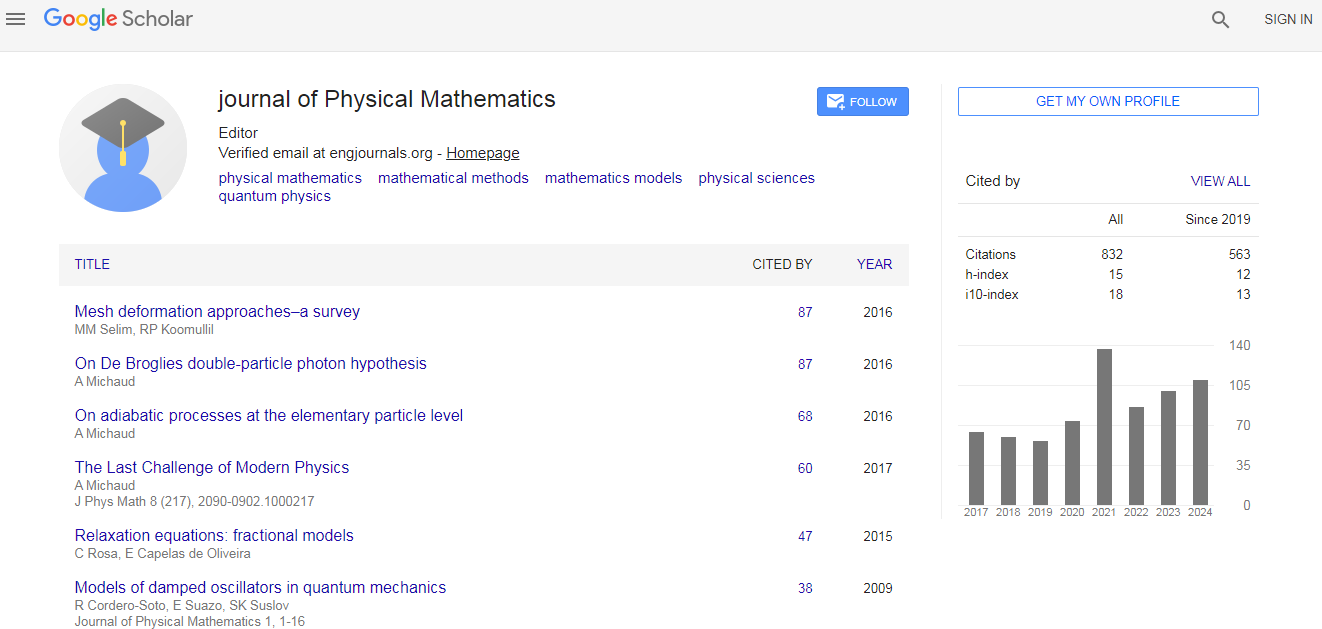
Physical Mathematics received 686 citations as per Google Scholar report