Brief Report - (2025) Volume 16, Issue 3
Received: 01-May-2025, Manuscript No. jpm-26-179401;
Editor assigned: 05-May-2025, Pre QC No. P-179401;
Reviewed: 19-May-2025, QC No. Q-179401;
Revised: 22-May-2025, Manuscript No. R-179401;
Published:
29-May-2025
, DOI: 10.37421/2090-0902.2025.16.531
Citation: Grant, Oliver. ”Wave Propagation In Complex And Heterogeneous Media.” J Phys Math 16 (2025):531.
Copyright: © 2025 Grant O. This is an open-access article distributed under the terms of the Creative Commons Attribution License, which permits unrestricted use, distribution and reproduction in any medium, provided the original author and source are credited.
The intricate behavior of wave propagation through complex and heterogeneous media is a fundamental challenge across numerous scientific disciplines. Understanding these phenomena necessitates robust mathematical frameworks that can accurately capture the effects of scattering, absorption, and dispersion. These effects are paramount in fields such as geophysical exploration, where seismic waves interact with diverse subsurface structures, and in medical imaging, where ultrasonic or electromagnetic waves probe biological tissues. Material science also benefits immensely from these models, enabling the characterization of novel materials and their wave interaction properties. Developing advanced numerical methods is therefore crucial for simulating these complex wave dynamics and for advancing our predictive capabilities in these critical areas [1].
The wave equation, a cornerstone of classical physics, often requires sophisticated numerical techniques when applied to scenarios involving irregular interfaces and spatially varying material properties. The presence of discontinuities in material composition or anisotropic behavior introduces significant challenges to standard solution methods. To address these complexities, researchers have explored advanced numerical approaches, including the finite-difference time-domain (FDTD) method and spectral element methods. These techniques aim to achieve a balance between computational efficiency and the accuracy required to resolve intricate wave phenomena, making them invaluable tools for detailed wave simulations [2].
Beyond the realm of irregular interfaces, the unique characteristics of fractal media present another frontier in wave propagation research. Fractal structures, with their self-similar and statistically homogeneous properties, exhibit distinct wave behaviors, particularly in the long-wavelength limit. Asymptotic analysis provides a powerful lens through which to develop analytical approximations that capture these scaling laws and their implications for wave attenuation and dispersion. Such insights are particularly relevant for understanding wave transport in natural porous media, which often exhibit fractal geometries [3].
Wave scattering from objects embedded in complex environments is another area of significant interest, with applications ranging from acoustic cloaking to radar cross-section prediction. Arbitrarily shaped objects and complex background media pose considerable modeling difficulties. Hybrid methods, such as the combination of finite element method (FEM) and boundary element method (BEM), offer an efficient way to handle the interaction between different material domains and geometries. This hybrid approach leverages the strengths of both methods to provide accurate and computationally feasible solutions for wave scattering problems [4].
Real-world media are rarely uniform, and often exhibit random fluctuations in their material properties. The impact of such spatial randomness on wave propagation can be profound, affecting signal coherence and travel times. Stochastic differential equations and Monte Carlo simulations are key tools for quantifying these effects. By incorporating probabilistic descriptions of material heterogeneity, researchers can better understand wave behavior in environments like turbulent fluids or disordered solids, which are ubiquitous in nature and engineering [5].
Computational efficiency remains a major bottleneck in simulating wave propagation, especially in complex geometries. The advent of machine learning has opened new avenues for accelerating these simulations. Techniques such as convolutional neural networks (CNNs) and graph neural networks (GNNs) are being explored to learn the intricate mappings between material properties and resulting wave fields. This data-driven approach has the potential to drastically reduce computational costs while maintaining high fidelity in the simulations [6].
Conversely, the inverse problem of inferring material properties from measured wave fields is equally critical. This is fundamental for applications such as seismic imaging, where the goal is to reconstruct subsurface geological structures, and in non-destructive testing, where internal material defects need to be identified. Advanced inversion techniques, including full waveform inversion (FWI) and Bayesian inference, are employed to accurately reconstruct these properties from the observed wave data [7].
The study of nonlinear waves adds another layer of complexity to wave propagation phenomena. In dissipative media, nonlinear waves can exhibit behaviors such as shock formation and the interaction of solitons. These phenomena are observed in diverse fields, including fluid dynamics, nonlinear optics, and the mechanics of solids. Characterizing these complex nonlinear behaviors often requires a combination of analytical and advanced numerical methods to accurately model their evolution and interaction [8].
Metamaterials, engineered materials with properties not found in nature, offer exciting possibilities for manipulating wave propagation. Acoustic metamaterials, in particular, with their complex microstructures, allow for tailored acoustic responses. Techniques like homogenization, which averages properties over a microstructure, combined with finite element analysis, are essential for predicting the effective wave propagation characteristics of these novel materials, paving the way for new acoustic device designs [9].
Finally, understanding seismic wave propagation in porous and saturated media is vital for subsurface characterization and reservoir engineering. Poroelasticity theory provides a framework for modeling the coupled effects of fluid flow within the pores and the deformation of the solid matrix. This coupled behavior significantly influences wave attenuation and dispersion, making its accurate modeling essential for geophysical surveys and resource management [10].
Mathematical frameworks for modeling wave propagation through heterogeneous and complex media are essential for understanding diverse phenomena. Techniques that account for scattering, absorption, and dispersion are critical in geophysical exploration, medical imaging, and material science. The development of robust numerical methods is paramount for simulating these intricate wave behaviors and advancing predictive capabilities in these fields [1].
Advanced numerical methods are investigated for solving the wave equation in scenarios with irregular interfaces and varying material properties. Challenges posed by discontinuities and anisotropy are addressed by proposing finite-difference time-domain (FDTD) and spectral element methods as effective solutions. The emphasis is on achieving computational efficiency without compromising accuracy in these simulations [2].
Research into asymptotic analysis of wave propagation in fractal media focuses on developing analytical approximations. These approximations capture long-wavelength behavior and scaling laws characteristic of fractal structures. The implications for wave attenuation and dispersion in natural porous media are explored, highlighting the unique wave dynamics in such complex materials [3].
A novel approach for modeling wave scattering from arbitrarily shaped objects in complex backgrounds is presented using a hybrid boundary element-finite element method (FEM-BEM). This method efficiently handles interactions between different material domains, with applications explored in acoustics and electromagnetics, offering a versatile tool for scattering analysis [4].
The impact of random fluctuations in material properties on wave propagation is investigated through stochastic differential equations and Monte Carlo simulations. These methods quantify the effects of spatial randomness on signal coherence and travel times, providing insights relevant to wave behavior in turbulent fluids and disordered solids [5].
Machine learning techniques are examined for accelerating wave propagation simulations in complex geometries. Convolutional neural networks and graph neural networks are explored to learn the mapping between material properties and wave fields, aiming to significantly reduce computational cost and improve simulation speed [6].
The inverse problem of inferring material properties from measured wave fields is addressed using techniques like full waveform inversion and Bayesian inference. These methods reconstruct subsurface structure for applications in seismic imaging and non-destructive testing, enabling detailed material characterization from wave data [7].
The propagation of nonlinear waves in dissipative media is explored, investigating phenomena such as shock formation and soliton interactions. These complex behaviors, critical in fluid dynamics, optics, and solid mechanics, are characterized using a combination of analytical and numerical methods [8].
A novel approach for modeling acoustic metamaterials with complex microstructures is presented, utilizing homogenization techniques combined with finite element analysis. This enables the prediction of effective wave propagation properties, facilitating the design of materials with tailored acoustic responses [9].
Seismic wave propagation through porous and saturated media is analyzed by incorporating poroelasticity theory. This models the coupled effects of fluid flow and solid deformation on wave attenuation and dispersion, crucial for subsurface characterization and reservoir engineering applications [10].
This collection of research explores various facets of wave propagation in complex and heterogeneous media. It covers advanced mathematical and numerical modeling techniques, including finite-difference time-domain and spectral element methods, for handling irregularities and material variations. The studies also delve into asymptotic analysis for fractal media, hybrid FEM-BEM methods for scattering problems, and stochastic approaches for random media. Furthermore, the research highlights the application of machine learning to accelerate simulations, inverse problems for material characterization, nonlinear wave phenomena, and the modeling of acoustic metamaterials and poroelastic media. These efforts collectively aim to enhance our understanding and simulation capabilities for wave phenomena across diverse scientific and engineering domains.
None
None
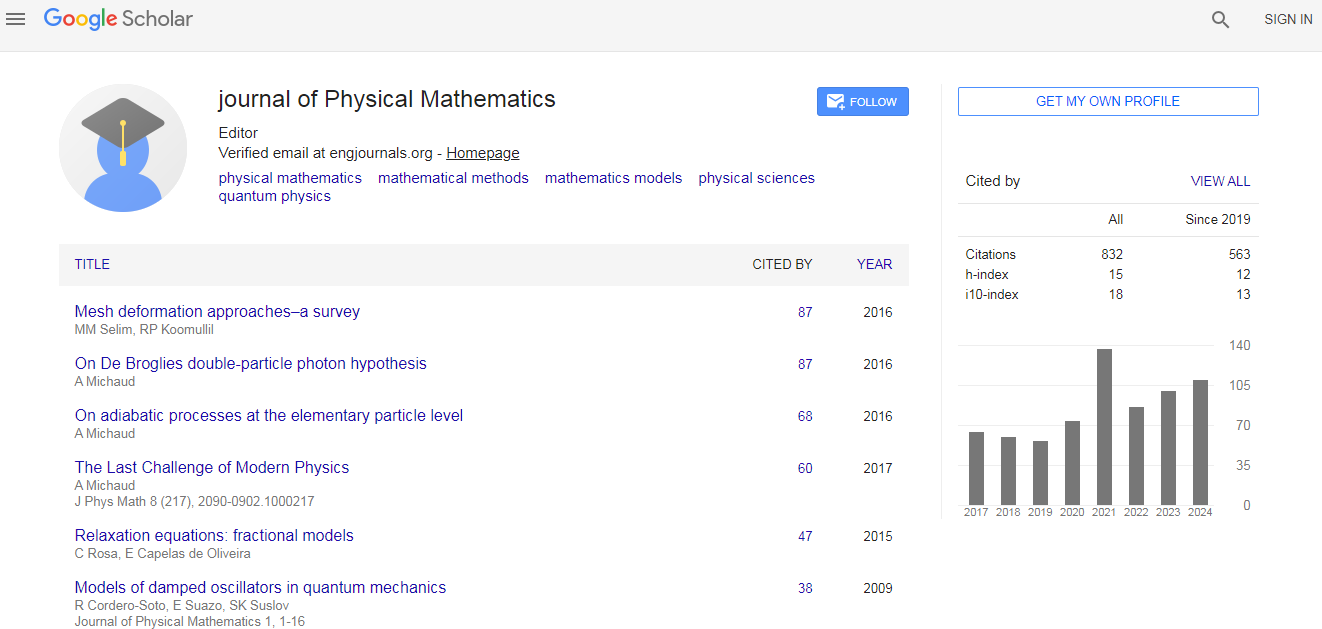
Physical Mathematics received 686 citations as per Google Scholar report