Perspective - (2025) Volume 16, Issue 5
Received: 01-Sep-2025, Manuscript No. hycr-25-175006;
Editor assigned: 03-Sep-2025, Pre QC No. P-175006;
Reviewed: 17-Sep-2025, QC No. Q-175006;
Revised: 22-Sep-2025, Manuscript No. R-175006;
Published:
29-Sep-2025
, DOI: 10.37421/2157-7587.2025.16.622
Citation: Chatterjee, Rahul. ”Water Balance: Global Impact and
Sustainability Imperative.” Hydrol Current Res 16 (2025):622.
Copyright: © 2025 Chatterjee R. This is an open-access article distributed under the terms of the Creative Commons Attribution License, which permits unrestricted use,
distribution and reproduction in any medium, provided the original author and source are credited.
The intricate relationship between fluid intake, exercise-induced dehydration, and subsequent endurance performance stands as a critical area of physiological research. One study meticulously explores these dynamics, emphasizing the body's sophisticated water balance mechanisms and highlighting the undeniable importance of timely rehydration. This process is not just about recovery, but it's crucial for sustained physical capability in athletes, shaping how individuals can maintain peak performance after intense exertion [1].
Beyond individual physiology, understanding water balance extends to large-scale ecological systems. For instance, a detailed study employed a robust water balance model to scrutinize the profound hydrological shifts occurring in a watershed following clearcutting and subsequent forest regrowth. This investigation offered significant insights into how fundamental land use changes drastically alter patterns of water runoff, evaporation rates, and the overall availability of water within these complex forest ecosystems, demonstrating a direct link between land management and water resources [2].
In the agricultural sector, the challenge of water scarcity underpins significant research efforts. Researchers have diligently pursued improved methodologies for water balance modeling within irrigated agriculture, particularly in the face of diverse climate change scenarios. This work stresses the absolute necessity of developing highly accurate and adaptable models. These tools are indispensable for achieving sustainable water resource management and for formulating resilient adaptation strategies that safeguard global food production in a changing climate [3].
A macro-level perspective reveals the global scale of water balance issues. A comprehensive analysis meticulously tracked global terrestrial water balance dynamics over a span of four decades. This extensive research pinpointed key climatic shifts and significant anthropogenic drivers that contribute to these changes. The findings offer a crucial understanding of how variations in precipitation, evolving evaporation patterns, and increasing human activities are collectively reshaping freshwater availability across the entire world, impacting ecosystems and societies alike [4].
Urban planning is increasingly integrating ecological solutions, particularly through green infrastructure. A pivotal review synthesizes existing knowledge on how these systems fundamentally influence urban water balance. This synthesis powerfully highlights their proven effectiveness in adeptly managing stormwater runoff, significantly reducing the volume of surface water, and enhancing natural infiltration processes. Ultimately, green infrastructure contributes substantially to fostering more resilient and sustainable urban water cycles, mitigating the impacts of urbanization [5].
Agricultural vulnerability to environmental stress is another critical focus. A thorough meta-analysis delved into the pervasive and detrimental effects of drought stress specifically on maize crops. This analysis zeroed in on the intricate alterations in plant water balance, the subsequent inhibition of growth, and the resulting diminished crop yield. These crucial findings are directly applicable to developing more drought-resistant crop varieties and improving agricultural practices, which is essential for ensuring food security [6].
Technological advancements are revolutionizing hydrological monitoring. An innovative study showcased a cutting-edge approach to estimate global terrestrial water balance with unprecedented accuracy. This was achieved by integrating diverse multi-source remote sensing data with sophisticated machine learning algorithms. The methodology provides significantly enhanced accuracy and spatial resolution, making it an invaluable tool for monitoring critical hydrological components on a vast, planetary scale [7].
Addressing water scarcity in arid regions is paramount. Research specifically focused on assessing groundwater balance in an arid basin through the combined power of remote sensing and numerical modeling. This investigation offered profound insights into the complex interplay of groundwater recharge and discharge mechanisms in these water-stressed environments. Such understanding is absolutely crucial for formulating effective and sustainable aquifer management strategies to preserve vital water resources [8].
High-mountain ecosystems, particularly glaciers, are vital water reservoirs. A detailed study meticulously investigated the spatio-temporal dynamics of glacier mass balance and its substantial hydrological contribution to the overall water balance in these challenging environments. This research starkly underlines the severe vulnerability of these crucial water sources to the accelerating effects of climate change, emphasizing their far-reaching implications for dependent downstream communities who rely on them for survival [9].
Finally, the intricate dynamics of catchment water balance in mountainous regions, profoundly influenced by evolving land use patterns and the overarching force of climate change, forms another key area of investigation. This research provides exceptionally critical insights necessary for developing sound regional water resource management plans and for crafting effective adaptation strategies amidst continuous and significant environmental shifts, securing resources for future generations [10].
The concept of water balance is a cornerstone in understanding various systems, from the physiological responses of the human body to the vast dynamics of global ecosystems. In human health, for instance, detailed research explores the critical aspects of fluid intake after exercise-induced dehydration and its direct consequences on subsequent endurance performance. This investigation specifically elucidates the body's sophisticated water balance mechanisms and emphasizes the undeniable role of timely rehydration, not just for immediate athletic recovery but also for ensuring sustained physical capability over time [1]. Extending to natural environments, studies meticulously analyze the hydrological dynamics of forest watersheds in response to significant disturbances like clearcutting and the subsequent phases of forest regeneration. Such work provides crucial insights into how large-scale land use changes profoundly impact fundamental hydrological processes, including water runoff, evaporation rates, and the overall availability of water within these vital forest ecosystems [2]. Furthermore, the intricate and dynamic changes observed in catchment water balance within mountainous regions are found to be intricately influenced by evolving land use patterns and the pervasive effects of climate change. This line of inquiry offers exceptionally critical insights necessary for informed regional water resource management and for developing robust adaptation strategies amidst continuous environmental shifts and pressures, securing resources for future generations [10].
Climate change presents increasingly complex challenges to water resource management globally, making advanced modeling tools indispensable. Researchers are actively dedicated to exploring and implementing methods that significantly enhance water balance modeling, particularly within the context of irrigated agriculture and under a spectrum of varying climate change scenarios. This important work stresses the absolute necessity of developing and deploying highly accurate and adaptable models. These sophisticated tools are crucial for achieving sustainable water resource management and for formulating resilient adaptation strategies that are essential for global food production systems in a changing climate [3]. On a macro scale, a comprehensive analysis has meticulously tracked global terrestrial water balance dynamics over four decades, successfully identifying key climatic and significant anthropogenic drivers that contribute to these observed changes. This extensive research provides a crucial understanding of how variations in precipitation patterns, evolving evaporation processes, and increasing human activities are collectively reshaping freshwater availability across the entire world, impacting ecosystems and human societies alike [4]. Furthermore, the unique vulnerabilities of high-mountain environments, particularly their glaciers, are a critical focus. One study meticulously investigates the spatio-temporal dynamics of glacier mass balance and its substantial hydrological contribution to the overall water balance in these challenging regions, powerfully highlighting the severe vulnerability of these crucial water sources to the accelerating effects of climate change and outlining their far-reaching implications for dependent downstream communities who rely on them for survival [9].
Recent technological advancements, particularly in remote sensing and machine learning, are fundamentally transforming our capacity to monitor, assess, and manage global water resources with unprecedented precision and scale. An innovative study demonstrates a cutting-edge approach to accurately estimate global terrestrial water balance by seamlessly integrating diverse multi-source remote sensing data with sophisticated machine learning algorithms. This pioneering methodology not only offers significantly enhanced accuracy but also provides improved spatial resolution, making it an invaluable tool for comprehensively monitoring critical hydrological components on a vast, planetary scale [7]. Complementing this global perspective, specific regional challenges, such as assessing groundwater balance in arid basins, are also benefiting immensely from these combined technological applications. Research in these water-stressed regions leverages both remote sensing and numerical modeling to shed light on the complex and delicate interplay of groundwater recharge and discharge mechanisms. Such detailed understanding is absolutely crucial for formulating effective, long-term, and sustainable aquifer management strategies to preserve vital underground water resources, which are often the sole source of water in extremely dry environments [8]. These advanced tools are therefore not just academic innovations but practical necessities for comprehensive environmental understanding and proactive intervention.
Addressing specific environmental contexts and agricultural practices reveals unique water balance challenges that necessitate highly targeted research and innovative solutions. For instance, a thorough meta-analysis meticulously delved into the pervasive and detrimental effects of drought stress specifically on maize crops. This comprehensive analysis zeroed in on the intricate alterations in plant water balance, the subsequent significant inhibition of growth, and the resulting substantial diminution of crop yield. The crucial findings from this research are directly applicable and invaluable for guiding the development of more resilient, drought-resistant crop varieties and for improving existing agricultural practices, which is fundamentally essential for ensuring global food security in an era of increasing climate variability [6]. Simultaneously, urban areas are increasingly adopting green infrastructure as a progressive and effective solution to manage their complex water cycles. A pivotal review synthesizes existing knowledge on how these integrated systems fundamentally influence urban water balance. This synthesis powerfully highlights their proven effectiveness in adeptly managing stormwater runoff, significantly reducing the volume of surface water, and enhancing natural infiltration processes within built environments. Ultimately, green infrastructure contributes substantially to fostering more resilient and sustainable urban water cycles and provides a clear pathway for sustainable urban development in the face of ongoing environmental changes and growing population pressures [5]. These diverse applications underline the breadth of water balance research, from micro-level plant responses to macro-level urban planning strategies.
Research across various disciplines consistently highlights the critical importance of water balance. Studies explore how fluid intake impacts athletic endurance post-dehydration, emphasizing intricate human water balance mechanisms for recovery and sustained physical capability [1]. Ecologically, investigations reveal how land use changes, like clearcutting and forest regeneration, profoundly alter watershed hydrology, affecting water runoff and availability [2]. Climate change scenarios drive efforts to enhance water balance modeling in irrigated agriculture, crucial for sustainable water management and food production [3]. A global perspective showcases how climatic and anthropogenic factors over four decades are reshaping terrestrial freshwater availability worldwide [4]. Urban environments benefit from green infrastructure systems, which are effective in managing stormwater, reducing runoff, and boosting infiltration to foster resilient urban water cycles [5]. Agricultural resilience is addressed through meta-analyses on drought stress effects on maize, focusing on plant water balance, growth, and yield, vital for developing drought-resistant crops [6]. Methodologically, global terrestrial water balance estimation is advancing through multi-source remote sensing and machine learning, offering enhanced accuracy for planetary hydrological monitoring [7]. Groundwater management in arid basins is improved by combining remote sensing and numerical modeling to assess recharge-discharge dynamics for sustainable aquifer use [8]. High-mountain regions, particularly glaciers, are studied for their mass balance and hydrological contribution, revealing their vulnerability to climate change and implications for downstream communities [9]. Lastly, research on catchment water balance in mountainous areas under land use and climate change provides critical insights for regional water resource management and adaptation [10]. Collectively, these studies underscore water balance as a fundamental concept impacting human health, natural ecosystems, agriculture, and urban sustainability amidst global environmental shifts.
None
None
Indexed at, Google Scholar, Crossref
Indexed at, Google Scholar, Crossref
Indexed at, Google Scholar, Crossref
Indexed at, Google Scholar, Crossref
Indexed at, Google Scholar, Crossref
Indexed at, Google Scholar, Crossref
Indexed at, Google Scholar, Crossref
Indexed at, Google Scholar, Crossref
Indexed at, Google Scholar, Crossref
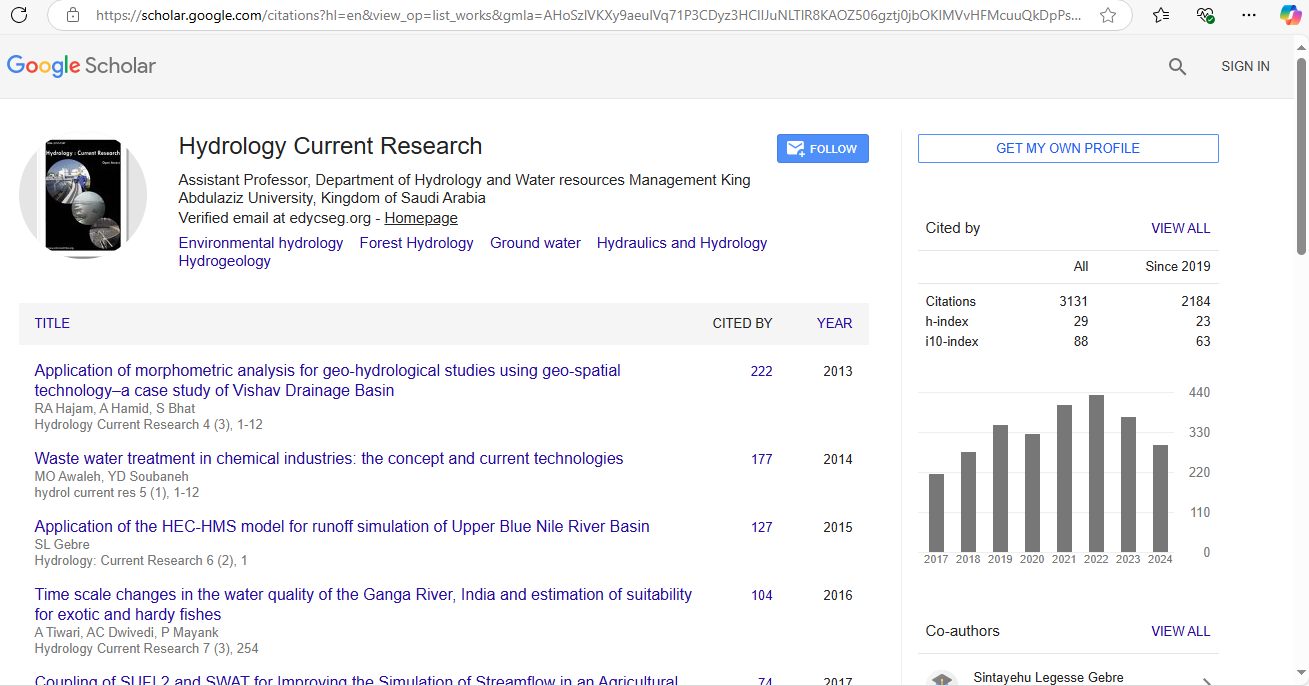
Hydrology: Current Research received 2843 citations as per Google Scholar report