Brief Report - (2025) Volume 14, Issue 5
Received: 01-Oct-2025, Manuscript No. jnc-25-173980;
Editor assigned: 03-Oct-2025, Pre QC No. P-173980;
Reviewed: 17-Oct-2025, QC No. Q-173980;
Revised: 22-Oct-2025, Manuscript No. R-173980;
Published:
29-Oct-2025
, DOI: 10.37421/2167-1168.2025.14.728
Citation: Romano, Isabella. ”Vital Patient & Peer Support in Healthcare.” J Nurs Care 14 (2025):728.
Copyright: © 2025 Romano I. This is an open-access article distributed under the terms of the Creative Commons Attribution License, which permits unrestricted use, distribution and reproduction in any medium, provided the original author and source are credited.
A scoping review explores the breadth of peer support interventions for adults managing chronic conditions, highlighting diverse delivery models and emphasizing benefits in self-management, psychological well-being, and health outcomes. This review indicates that while peer support shows promise, consistency in intervention design and outcome measurement remains a challenge [1].
A systematic review investigates how online patient support groups affect psychological well-being and disease management. Findings suggest these digital communities offer significant benefits, including reduced feelings of isolation, improved coping strategies, and enhanced adherence to treatment plans; however, user engagement and moderation quality are key factors influencing their effectiveness [2].
A qualitative study explores the profound impact of support groups on cancer patients, revealing how shared experiences foster emotional support, reduce feelings of isolation, and enhance coping mechanisms. Participants reported improved quality of life through the acquisition of practical advice and a sense of community, suggesting support groups are vital components of holistic cancer care [3].
A scoping review emphasizes the distinct and crucial function of patient support groups for individuals with rare diseases. It highlights how these groups provide invaluable access to specialized information, facilitate advocacy efforts, and offer emotional solidarity in the face of unique diagnostic and treatment challenges, filling significant gaps left by conventional healthcare systems [4].
A systematic review explores the landscape of digital health interventions designed to foster peer support among individuals with chronic conditions. It identifies various digital platforms and their features, highlighting their potential to overcome geographical barriers and enhance accessibility. The review points out the need for robust evaluation methods and better integration with clinical care to maximize their impact [5].
Another systematic review and meta-analysis assesses the effectiveness of peer support groups for individuals with serious mental illness. The evidence suggests that participation significantly improves recovery outcomes, enhances well-being, and reduces symptoms. The study highlights the therapeutic value of shared lived experiences and the empowerment derived from peer relationships in mental health recovery pathways [6].
A qualitative study explores the experiences of family caregivers of chronic illness patients who participate in support groups. It reveals these groups provide a crucial outlet for emotional expression, a source of practical advice, and a sense of shared burden, alleviating stress and improving coping strategies. The findings underscore the importance of such support systems for caregiver well-being [7].
A scoping review examines the often-overlooked economic benefits associated with patient support groups. It identifies potential cost savings through reduced hospitalizations, improved medication adherence, and a decrease in healthcare utilization stemming from better self-management and emotional well-being. This review highlights the need for more rigorous economic evaluations to fully quantify these benefits [8].
A mixed-methods study investigates strategies to boost patient engagement within online support groups. It uncovers that features promoting active participation, such as structured discussions and peer moderation, alongside a safe and inclusive digital environment, are crucial for sustaining involvement. The findings offer practical insights for designing more effective and engaging online communities [9].
Lastly, a qualitative study explores the multifaceted challenges and latent opportunities inherent in establishing and maintaining patient support groups. It identifies barriers like funding limitations, recruitment difficulties, and lack of professional oversight, while also highlighting opportunities for leveraging technology, fostering community partnerships, and developing sustainable leadership models. Understanding these dynamics is crucial for their long-term success [10].
Patient and peer support groups consistently demonstrate significant value across various health domains. For adults managing chronic conditions, these interventions are crucial, offering diverse models of delivery that enhance self-management, improve psychological well-being, and lead to better health outcomes [1]. The insights indicate that while the promise of peer support is clear, there's a need for more consistent design in interventions and standardized outcome measurement to fully realize their potential [1]. Beyond traditional settings, online patient support groups have emerged as powerful tools, positively impacting psychological well-being and disease management. These digital communities effectively reduce feelings of isolation, help individuals develop improved coping strategies, and boost adherence to treatment plans [2]. The effectiveness of these online platforms, however, is significantly influenced by factors such as user engagement and the quality of moderation present within the groups [2].
The impact extends to specific patient populations, where support groups play a vital role. For cancer patients, shared experiences within these groups are instrumental in fostering emotional support, alleviating feelings of isolation, and strengthening coping mechanisms [3]. Participants often report a marked improvement in their quality of life, gaining practical advice and a strong sense of community, underscoring the necessity of support groups as a key component of holistic cancer care [3]. Similarly, individuals grappling with rare diseases find indispensable assistance through patient support groups. These groups are uniquely positioned to provide specialized information, facilitate crucial advocacy efforts, and offer emotional solidarity, effectively addressing significant gaps left by conventional healthcare systems [4].
Digital health interventions further broaden the reach of peer support, particularly for those with chronic conditions. Various digital platforms, with their unique features, effectively overcome geographical barriers and enhance accessibility to vital support networks [5]. Nevertheless, maximizing their impact requires robust evaluation methods and a more integrated approach with existing clinical care frameworks [5]. The effectiveness of peer support groups is also evident in the realm of mental health, especially for individuals with serious mental illness. Participation demonstrably improves recovery outcomes, enhances overall well-being, and reduces symptoms [6]. The therapeutic benefit of shared lived experiences and the sense of empowerment gained through peer relationships are foundational to mental health recovery pathways [6].
Support groups are not just for patients; they are equally crucial for family caregivers of individuals with chronic illnesses. These groups provide a much-needed outlet for emotional expression, a practical source of advice, and a sense of shared burden, all of which contribute to alleviating stress and improving caregivers' coping strategies [7]. The well-being of caregivers is significantly bolstered by such support systems [7].
Beyond the direct health and social benefits, patient support groups also present tangible economic advantages. Research reveals potential cost savings derived from reduced hospitalizations, improved medication adherence, and a decrease in overall healthcare utilization. These benefits often stem from better self-management and enhanced emotional well-being among participants [8]. However, there is a recognized need for more rigorous economic evaluations to fully quantify these financial benefits [8]. Enhancing patient engagement, particularly in online support groups, is also a critical area of focus. Studies indicate that features promoting active participation, like structured discussions and peer moderation, alongside a safe and inclusive digital environment, are pivotal for sustained involvement and the overall effectiveness of these digital communities [9].
Finally, the establishment and long-term sustainability of patient support groups face distinct challenges and opportunities. Barriers commonly include funding limitations, difficulties in recruitment, and a lack of professional oversight [10]. Yet, there are significant opportunities to leverage technology, forge community partnerships, and develop sustainable leadership models to ensure their continued success [10]. Understanding these complex dynamics is essential for strengthening and expanding the reach of these invaluable support networks.
Patient and peer support groups play a vital role in healthcare, offering substantial benefits across various conditions and contexts. They significantly improve self-management, psychological well-being, and health outcomes for adults managing chronic conditions by fostering shared experiences and providing emotional support. These groups help reduce feelings of isolation, enhance coping strategies, and encourage adherence to treatment plans, whether in traditional or digital settings. For cancer patients, support groups are crucial for improving quality of life, offering practical advice and a sense of community. Similarly, individuals with rare diseases benefit from specialized information and advocacy efforts that bridge gaps left by conventional healthcare systems. Digital health interventions are increasingly facilitating peer support, overcoming geographical barriers and improving accessibility, though consistent evaluation methods are still needed. Peer support groups are particularly effective for those with serious mental illness, improving recovery and well-being through the therapeutic value of shared lived experiences. Family caregivers of chronic illness patients also find solace and practical guidance in these groups, which alleviate stress and improve their own coping mechanisms. However, challenges persist in establishing and sustaining these groups, including funding, recruitment, and professional oversight. To enhance their effectiveness, especially in online formats, active participation features, peer moderation, and a safe digital environment are key. These insights highlight the indispensable, multifaceted value of patient and peer support in modern healthcare.
None
None
1. M. KKP, V. HN, B. EGO. "Peer support for adults with chronic conditions: A scoping review".J Clin Nurs 31 (2022):3553-3568.
Indexed at, Google Scholar, Crossref
2. J. MS, L. KJ, R. BC. "Impact of Online Patient Support Groups on Psychological Well-Being and Disease Management: A Systematic Review".J Med Internet Res 23 (2021):e26890.
Indexed at, Google Scholar, Crossref
3. A. RG, C. LD, E. FB. "The Role of Support Groups in Improving Quality of Life and Coping Strategies Among Cancer Patients: A Qualitative Study".Psychooncology 29 (2020):428-436.
Indexed at, Google Scholar, Crossref
4. S. NP, D. WJ, K. EM. "The Unique Role of Patient Support Groups in Rare Diseases: A Scoping Review".Orphanet J Rare Dis 18 (2023):101.
Indexed at, Google Scholar, Crossref
5. B. CL, A. MK, J. RW. "Digital Health Interventions to Facilitate Peer Support in Chronic Conditions: A Systematic Review".Digit Health 8 (2022):20552076221081541.
Indexed at, Google Scholar, Crossref
6. E. SR, F. GM, G. HL. "Effectiveness of Peer Support Groups on Recovery and Well-being in Individuals with Serious Mental Illness: A Systematic Review and Meta-Analysis".Psychiatr Serv 72 (2021):444-453.
Indexed at, Google Scholar, Crossref
7. K. LE, M. PH, N. OC. "Support Group Participation Among Family Caregivers of Patients with Chronic Illness: A Qualitative Study".J Adv Nurs 76 (2020):966-976.
Indexed at, Google Scholar, Crossref
8. R. TW, S. UG, T. VB. "Economic Benefits of Patient Support Groups: A Scoping Review".Health Aff (Millwood) 38 (2019):950-957.
Indexed at, Google Scholar, Crossref
9. V. XA, W. YB, X. ZC. "Enhancing Patient Engagement in Online Support Groups: A Mixed-Methods Study".JMIR Hum Factors 9 (2022):e34567.
Indexed at, Google Scholar, Crossref
10. Z. BM, A. CH, B. DK. "Challenges and Opportunities in Implementing and Sustaining Patient Support Groups: A Qualitative Study".BMC Health Serv Res 23 (2023):341.
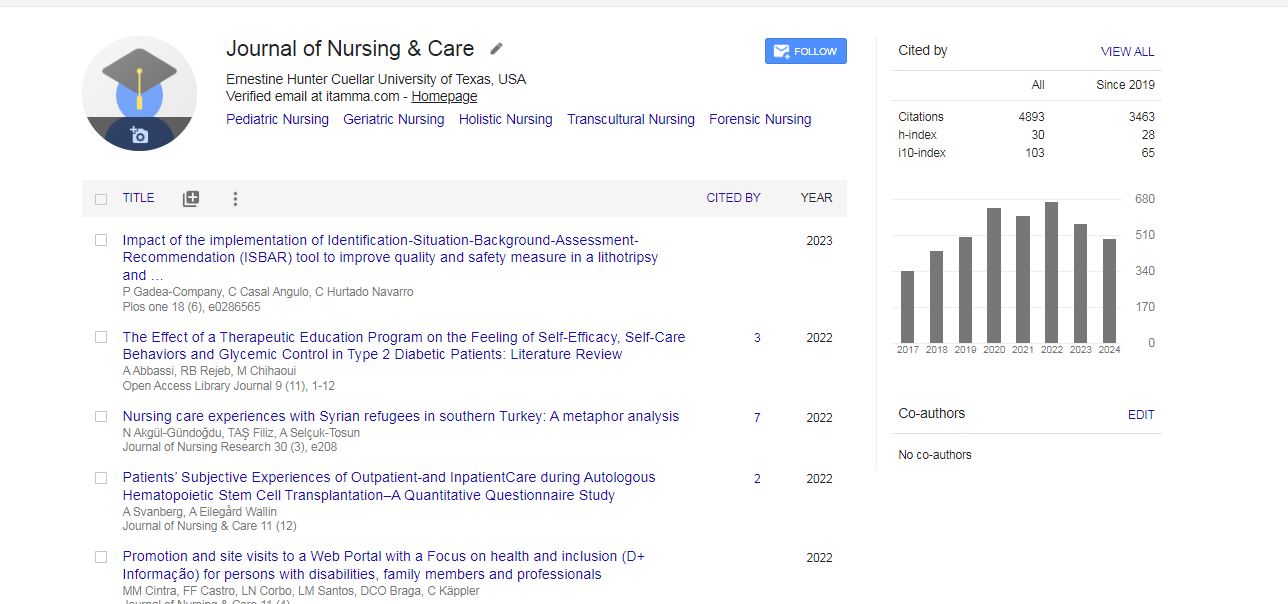
Journal of Nursing & Care received 4230 citations as per Google Scholar report