Commentary - (2025) Volume 14, Issue 2
Received: 01-Apr-2025, Manuscript No. jeom-26-188162;
Editor assigned: 03-Apr-2025, Pre QC No. P-188162;
Reviewed: 17-Apr-2025, QC No. Q-188162;
Revised: 22-Apr-2025, Manuscript No. R-188162;
Published:
29-Apr-2025
, DOI: 10.37421/2169-026X.2025.14.525
Citation: Thompson:, David. ”Visionary Resilience Drives Startup Growth Through Adaptability.” J Entrepren Organiz Manag 14 (2025):525.
Copyright: © 2025 Thompson: D. This is an open-access article distributed under the terms of the Creative Commons Attribution License, which permits unrestricted use, distribution and reproduction in any medium, provided the original author and source are credited.
Entrepreneurial leadership is a critical determinant of success for start-up ventures, demanding a unique blend of personal attributes and strategic acumen to navigate the inherent complexities and uncertainties of emerging markets. These leaders are characterized by their resilience, the ability to bounce back from setbacks and learn from failures, a trait that enables them to persevere through the challenging early stages of a company's lifecycle [8].
Adaptability is another cornerstone, allowing them to swiftly pivot strategies in response to market feedback and competitive pressures, ensuring the venture remains relevant and agile [4].
A strong vision is paramount, providing a clear and compelling direction that guides the team through ambiguity and inspires commitment [1].
Effective leaders foster a culture of innovation, encouraging creative thinking, providing resources for experimentation, and embracing calculated risks necessary for market disruption and the development of novel solutions [7].
They empower their employees, creating environments where individuals feel trusted and capable, leading to higher engagement and enhanced problem-solving capabilities through delegation and skill development [5].
This empowerment is intrinsically linked to the concept of psychological safety, where experimentation and even failure are viewed as integral parts of the innovation process, fostering a learning-oriented approach within the team [2].
Visionary leadership extends beyond strategic goal-setting to articulating a future that motivates stakeholders and informs resource allocation. This often involves building robust networks and nurturing relationships crucial for organizational survival and growth [3].
The dynamic nature of start-ups necessitates leaders who can manage ambiguity effectively, inspire commitment, and embrace a learning-oriented approach, encouraging experimentation and creating psychological safety for failure [2].
Decision-making in start-ups is frequently rapid and high-stakes, requiring leaders to balance intuition with data analysis, prioritizing speed without compromising critical considerations, which can be a significant competitive advantage [6].
Ultimately, entrepreneurial leaders must balance directive and participative approaches, adapting to the venture's specific needs while fostering an environment where team members can contribute optimally [9].
The inherent volatility of the start-up ecosystem demands leaders who are not only visionaries but also pragmatists, capable of translating grand ideas into actionable strategies. Their resilience enables them to withstand the inevitable storms of entrepreneurship, transforming potential failures into valuable learning experiences [8].
This resilience is often coupled with an unwavering belief in their vision, a guiding star that illuminates the path forward through periods of doubt and challenge [1].
The ability to adapt is not merely a reactive measure but a proactive stance, allowing leaders to anticipate market shifts and preemptively adjust their course [4].
This adaptability is fueled by a deep understanding of the market and a willingness to challenge conventional wisdom, thereby fostering a culture that thrives on innovation and continuous improvement [7].
Empowerment of the team is a powerful lever for start-up success. When leaders instill trust and provide autonomy, they unlock the full potential of their employees, leading to greater ownership and a more proactive approach to problem-solving [5].
This extends to fostering an environment where psychological safety is paramount, allowing team members to voice concerns, propose new ideas, and take calculated risks without fear of reprisal [2].
The articulation of a compelling vision is a hallmark of visionary leadership, capable of galvanizing stakeholders and aligning efforts towards a shared future [3].
This vision, however, must be grounded in a realistic assessment of resources and market opportunities, demanding astute decision-making capabilities [6].
In turbulent environments, entrepreneurial leaders are the lynchpin of organizational performance. Their agility in decision-making, coupled with a capacity for bold yet informed choices, can be the difference between stagnation and exponential growth [1].
The importance of building and managing robust networks cannot be overstated; these connections provide access to crucial resources, knowledge, and opportunities that are vital for a start-up's competitive edge [10].
The blend of traitsâ??resilience, adaptability, vision, empowerment, and strategic decision-makingâ??collectively defines the entrepreneurial leader, equipping them to steer their ventures toward sustained success [1, 4, 5, 6, 8]. Moreover, the leadership style often adopted is a dynamic one, capable of shifting between directive guidance and participatory collaboration as the situation demands [9].
This contextual understanding of leadership effectiveness is crucial in the fluid landscape of start-ups. The capacity to inspire commitment from a team, even amidst high levels of ambiguity, is a testament to the leader's ability to foster trust and a shared sense of purpose [2].
The iterative nature of start-up development means that learning is a continuous process, and leaders who champion this mindset, encouraging experimentation and embracing the lessons from both successes and failures, are more likely to guide their organizations towards groundbreaking innovation [7].
The strategic alignment of resources is a direct outcome of strong visionary leadership. By clearly articulating a compelling future, leaders can effectively direct the allocation of limited resources towards achieving key objectives, maximizing their impact [3].
This strategic foresight is indispensable in a landscape where competition is fierce and market dynamics can change overnight. The emphasis on empowering teams is not just about delegation; it is about cultivating a sense of shared responsibility and fostering an environment where each team member feels valued and motivated to contribute their unique skills and perspectives [5].
In essence, the journey of a start-up is profoundly shaped by the leadership at its helm. The ability to navigate the unknown requires a leader who is both resilient in the face of adversity and adaptive to changing circumstances [4, 8]. Their vision acts as a compass, while their ability to empower teams creates a robust and engaged workforce capable of overcoming challenges [1, 5]. The constant need for informed and rapid decision-making further underscores the critical role of the entrepreneurial leader in securing a competitive advantage [6].
The interconnectedness of these leadership qualities creates a synergistic effect, enabling start-ups to not only survive but thrive. A leader who fosters an innovative culture, coupled with the capacity to build strong networks, creates a fertile ground for growth and sustained competitive advantage [7, 10]. This comprehensive approach to leadership is what distinguishes successful entrepreneurial ventures from those that falter, highlighting the indispensable nature of these leadership attributes in the modern business landscape. The overarching theme is that entrepreneurial leadership is not a monolithic concept but a multifaceted discipline that requires a dynamic interplay of personal fortitude, strategic foresight, and team-centric management. The capacity to inspire, adapt, and innovate, all while maintaining a clear vision and making timely decisions, forms the bedrock of entrepreneurial leadership in start-ups, setting the stage for long-term success [1, 2, 3, 4, 5, 6, 7, 8, 9, 10].
Entrepreneurial leadership in start-ups is fundamentally about navigating uncertainty and fostering growth through a combination of personal resilience and strategic agility. Leaders must possess the capacity to withstand setbacks and learn from failures, a quality that is essential for sustained progress in the volatile world of new ventures [8].
Complementing this resilience is adaptability, the ability to quickly adjust strategies in response to market feedback and competitive pressures, ensuring the start-up remains responsive and relevant [4].
A strong and clearly articulated vision serves as a guiding force, providing direction and inspiring the team to persevere through challenging times [1].
Fostering an innovative culture is a key responsibility of these leaders, who encourage creative thinking, allocate resources for experimentation, and embrace calculated risks to drive market disruption and the development of novel solutions [7].
Furthermore, empowering team members by creating an environment of trust and capability is crucial for boosting engagement and enhancing problem-solving [5].
This empowerment is closely linked to the concept of psychological safety, where team members feel secure to experiment and even to fail, which is an integral part of the learning and innovation process in start-ups [2].
Visionary leadership extends beyond merely setting goals; it involves painting a compelling picture of the future that motivates all stakeholders and guides the strategic allocation of resources. This often necessitates the cultivation of strong networks and the nurturing of relationships that are vital for the start-up's survival and growth [3].
The dynamic nature of start-ups demands leaders who are adept at managing ambiguity and inspiring unwavering commitment from their teams, often by promoting a learning-oriented approach and embracing experimentation [2].
Decision-making in start-ups is frequently characterized by its rapid pace and high stakes. Entrepreneurial leaders must adeptly balance intuition with data analysis, prioritizing speed without sacrificing critical considerations, thereby establishing a significant competitive advantage [6].
Effective entrepreneurial leaders exhibit a nuanced approach to leadership, balancing directive guidance with participative engagement, adapting their style to the specific needs of the venture and its team. This adaptability ensures that clear direction is provided while simultaneously fostering an environment where team members can contribute their utmost [9].
The ability to build and effectively manage networks is another critical function. These networks provide indispensable access to resources, knowledge, and opportunities that are crucial for a start-up's expansion and its ability to compete effectively in the market [10].
The combination of resilience and adaptability allows entrepreneurial leaders to navigate the inherent unknown of early-stage ventures, maintaining team morale and focus even amidst significant disruption [4, 8]. Their vision acts as a beacon, illuminating the path forward and enabling the team to maintain momentum towards achieving ambitious goals [1].
The empowerment of individuals within the team translates into higher engagement and more effective problem-solving, as employees feel a sense of ownership and value [5].
This dynamic leadership is essential for driving innovation, as leaders must be willing to foster an environment where novel ideas can be explored and developed [7].
Psychological safety plays a pivotal role in enabling teams to embrace experimentation and learn from their experiences. Leaders who champion this value create a foundation for continuous improvement and innovation, which is vital for a start-up's ability to adapt and evolve [2].
The effectiveness of a start-up's strategy is often directly tied to the leader's ability to articulate a compelling vision and align resources accordingly, ensuring that efforts are focused on the most promising opportunities [3].
This strategic foresight is complemented by the ability to make swift, informed decisions, a trait that can provide a critical competitive edge in fast-paced markets [6].
The leadership style adopted must be flexible, capable of adapting to different situations and team dynamics. By striking a balance between providing clear direction and encouraging collaborative input, leaders can maximize the contributions of their team members [9].
The development of strong professional networks is not merely beneficial but often essential for a start-up's survival, providing access to critical support systems and market intelligence [10].
The leadership of a start-up is a continuous process of learning and adjustment. Leaders who embody resilience are better equipped to handle inevitable setbacks, transforming them into opportunities for growth and development [8].
This resilience, combined with a clear vision, provides the stability needed for the team to navigate market shifts and pursue ambitious objectives [1, 4]. In essence, the success of a start-up is inextricably linked to the quality of its entrepreneurial leadership. The ability to inspire, adapt, empower, and innovate, all while maintaining a clear strategic direction and making effective decisions, forms the core of this leadership paradigm [2, 5, 7, 6]. These multifaceted qualities are not merely desirable but are foundational to the sustained performance and competitive advantage of new ventures [1, 3, 4, 8, 9, 10].
Entrepreneurial leadership in start-ups is defined by resilience, adaptability, and a strong vision that guides teams through uncertainty. Effective leaders foster innovation and empower employees, driving growth and navigating market shifts through agile decision-making. They create environments that encourage experimentation and psychological safety, essential for learning and innovation. Visionary leadership involves articulating a compelling future and building strong networks critical for survival and growth. Key leadership traits include the ability to manage ambiguity, inspire commitment, and make rapid, informed decisions. Empowering teams leads to higher engagement and better problem-solving. Leaders must balance directive and participative approaches, adapting to the venture's needs. Building and managing networks provides access to vital resources and opportunities. Resilience is crucial for overcoming setbacks and learning from failures, while adaptability allows for swift strategic pivots. Overall, entrepreneurial leadership is a dynamic interplay of personal attributes and strategic acumen essential for start-up success.
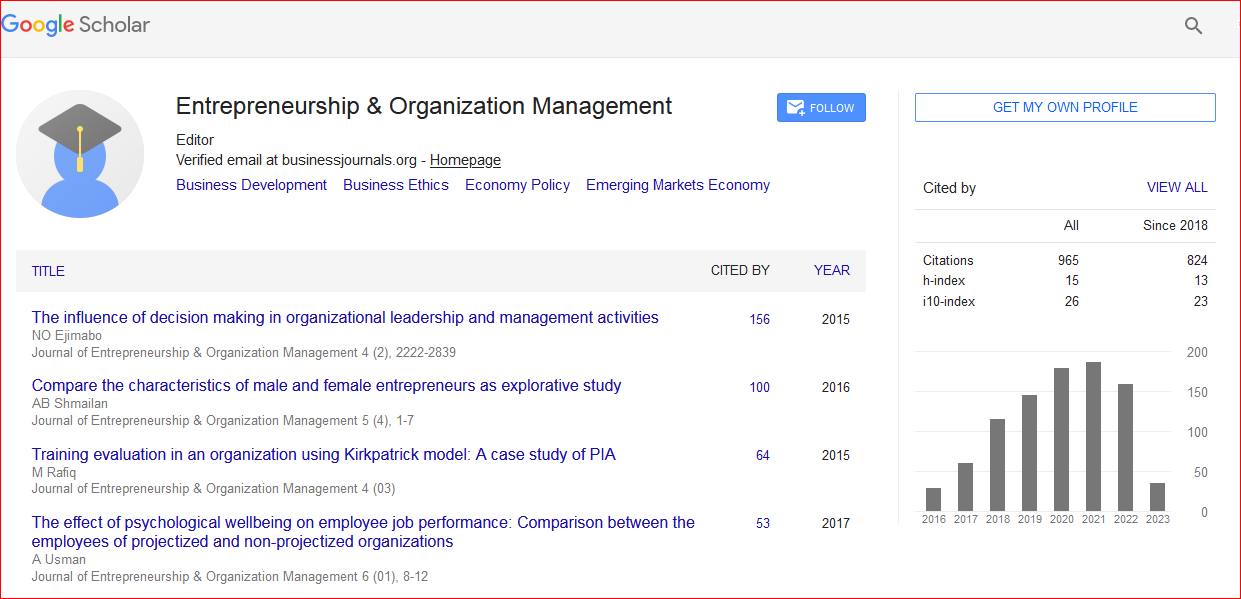
Entrepreneurship & Organization Management received 1115 citations as per Google Scholar report