Brief Report - (2025) Volume 16, Issue 6
Received: 01-Dec-2025, Manuscript No. jvst-26-188138;
Editor assigned: 03-Dec-2025, Pre QC No. P-188138;
Reviewed: 17-Dec-2025, QC No. Q-188138;
Revised: 22-Dec-2025, Manuscript No. R-188138;
Published:
29-Dec-2025
, DOI: 10.37421/2157-7579.2025.16.330
Citation: Okafor, Chinedu. ”Veterinary Science: Advancing Animal
Health and Welfare.” J Vet Sci Techno 16 (2025):330.
Copyright: © 2025 Okafor C. This is an open-access article distributed under the terms of the Creative Commons Attribution License, which permits unrestricted use,
distribution and reproduction in any medium, provided the original author and source are credited.
The field of veterinary science is continuously evolving, driven by advancements aimed at enhancing the health and welfare of animals across diverse species and settings. Significant progress has been made in diagnostic technologies, therapeutic interventions, and preventative strategies, collectively contributing to improved animal well-being. These developments are crucial for companion animals, livestock, and wildlife alike, reflecting a growing understanding of their multifaceted needs and the interconnectedness of animal health with broader ecological and human health concerns.
One prominent area of advancement lies in the application of sophisticated diagnostic tools and novel therapeutic approaches designed to address a wide spectrum of animal health issues. The integration of cutting-edge technologies is revolutionizing how veterinarians diagnose and treat diseases, leading to more accurate prognoses and effective management plans. This holistic approach extends to companion animals, livestock, and wildlife, acknowledging the unique challenges and considerations for each group. The dairy cattle industry, in particular, faces ongoing challenges related to udder health and the responsible use of antimicrobial agents. Novel antimicrobial stewardship programs have emerged as a critical strategy to combat antibiotic resistance and optimize udder health, aligning with the principles of a One Health approach that recognizes the inseparable link between animal, human, and environmental health. In the realm of poultry farming, controlling economically significant viral diseases remains a paramount concern for maintaining flock health and agricultural productivity. Modern vaccination strategies, encompassing a range of innovative vaccine technologies, are instrumental in achieving herd immunity and preventing widespread outbreaks. The welfare of sheep is increasingly being addressed through the adoption of precision livestock farming techniques. These data-driven approaches leverage sensor technologies and advanced analytics to monitor individual animal behavior and physiological status, enabling early detection of health issues and proactive welfare interventions. For companion animals, the focus on enhancing their quality of life and overall health has led to the exploration of nutritional interventions. Nutraceuticals and functional foods are being investigated for their potential to support immune function and promote health, offering a proactive approach to well-being. Surgical interventions for companion animals are also undergoing transformation, with a growing emphasis on minimally invasive techniques. These procedures offer significant benefits in terms of reduced recovery times and pain, thereby improving the overall patient experience and welfare. In research settings, the welfare of laboratory rodents is a critical ethical and scientific consideration. Environmental enrichment strategies, which aim to provide stimulating and comfortable living conditions, are proving effective in mitigating stress and improving the physiological and behavioral well-being of these animals. Livestock welfare is also being enhanced through advancements in genetic selection and breeding programs. By focusing on traits such as disease resistance, these programs aim to produce healthier animals, reduce the reliance on medical interventions, and improve overall productivity and well-being. Finally, the overarching commitment to animal welfare is underscored by the development of comprehensive pain management strategies. Recognizing and alleviating pain is an ethical imperative, and veterinary medicine is advancing its understanding and application of both pharmacological and non-pharmacological approaches to achieve this goal.Veterinary interventions encompass a broad spectrum of activities designed to improve animal health and welfare across domestic, agricultural, and wild populations. Recent advancements in diagnostic technologies, such as advanced imaging, molecular diagnostics, and point-of-care testing, allow for more precise and timely identification of diseases. Therapeutic approaches have also seen significant innovation, with the development of new pharmaceuticals, biologics, and surgical techniques that offer improved efficacy and reduced side effects. Preventative strategies, including vaccination protocols and biosecurity measures, are essential for maintaining herd health and preventing disease outbreaks, ultimately contributing to enhanced animal welfare. The integration of technology, from electronic health records to telemedicine, is further transforming veterinary practice and improving access to care.
The dairy cattle sector, a significant contributor to global food production, is particularly focused on improving udder health and mitigating the risks associated with antimicrobial use. The implementation of robust antimicrobial stewardship programs is crucial for addressing the growing threat of antibiotic resistance. These programs emphasize judicious antimicrobial use, focusing on prevention, early diagnosis, and appropriate treatment. A One Health perspective is vital in this context, recognizing that the health of dairy cattle is intrinsically linked to human health and the environment, necessitating coordinated efforts to manage infectious diseases and antimicrobial resistance. Specific intervention protocols, often involving detailed monitoring of milk quality and somatic cell counts, are key to assessing the efficacy of these programs. Poultry production, a major source of protein worldwide, is susceptible to various viral diseases that can cause significant economic losses and impact animal welfare. Vaccination strategies play a pivotal role in controlling these diseases. Modern vaccine technologies, including subunit and recombinant vaccines, offer improved safety and efficacy compared to traditional whole-cell vaccines. These advancements enable the development of more targeted and effective vaccines that can elicit strong immune responses and contribute to achieving herd immunity within large populations. Challenges in vaccine delivery and monitoring in extensive production systems require continuous innovation and careful implementation to ensure optimal disease prevention. Precision livestock farming represents a paradigm shift in managing animal welfare, particularly for sheep. This approach utilizes sensor technologies, such as wearable sensors and automated monitoring systems, to collect real-time data on individual animal behavior, physiology, and environmental conditions. Data analytics then transform this raw data into actionable insights, allowing farmers to detect early signs of distress or illness, optimize feeding and housing conditions, and implement proactive welfare interventions. The economic implications of precision livestock farming are also a significant consideration, as improved welfare can lead to increased productivity and reduced losses. For companion animals, maintaining optimal health and well-being is a primary concern for their owners and veterinary professionals. Nutraceuticals and functional foods are gaining increasing attention as complementary strategies to support immune function and overall health. These products contain specific bioactive compounds, such as omega-3 fatty acids, prebiotics, and antioxidants, which have demonstrated benefits in reducing inflammation, improving gut health, and modulating the immune system. By enhancing the animal's intrinsic defenses and promoting physiological balance, these nutritional interventions contribute to a better quality of life. In the field of small animal surgery, minimally invasive techniques, such as laparoscopy and arthroscopy, are revolutionizing patient care. These procedures involve smaller incisions, leading to less pain, reduced trauma, and faster recovery times compared to traditional open surgery. The benefits extend beyond physical recovery; by minimizing discomfort and stress, these techniques significantly enhance the patient's welfare and quality of life. The widespread adoption of these techniques reflects a growing commitment to patient-centered care in veterinary surgery. The welfare of laboratory animals is a critical ethical and scientific consideration, as their health and well-being directly impact the validity and reliability of research findings. Environmental enrichment strategies are employed to create more stimulating and naturalistic living conditions, thereby reducing stress and improving overall well-being. This can include providing novel objects for exploration, varied bedding materials, opportunities for social interaction where appropriate, and complex cage environments. These measures help to mitigate the negative effects of confinement and promote species-appropriate behaviors. Livestock production aims for both efficiency and high welfare standards. Genetic selection and breeding programs are powerful tools for achieving these goals by focusing on traits that enhance disease resistance. By identifying and promoting genes associated with robust immune systems and reduced susceptibility to common diseases, breeders can develop herds and flocks that require fewer veterinary interventions. This not only improves animal well-being by reducing illness and suffering but also contributes to more sustainable and productive agricultural systems. Pain management in veterinary medicine is an essential component of ethical animal care. Recognizing and alleviating pain is a fundamental responsibility of veterinarians. This involves a comprehensive understanding of pain pathways, assessment tools, and therapeutic modalities. Pharmacological approaches include analgesics like NSAIDs and opioids, while non-pharmacological methods such as physical therapy, acupuncture, and environmental modification can also play a significant role. Effective pain management directly contributes to improved animal welfare by reducing suffering and promoting recovery. Artificial intelligence (AI) and machine learning (ML) are emerging as transformative technologies in veterinary diagnostics. These advanced computational techniques can analyze large datasets from imaging, laboratory tests, and clinical observations to identify subtle patterns and predict disease with greater accuracy and speed than traditional methods. AI-powered diagnostic tools can assist veterinarians in making earlier and more informed decisions, leading to more effective interventions and ultimately improving animal health and welfare across a wide range of species and conditions.This compilation of research highlights the critical role of veterinary science in advancing animal health and welfare across various species and contexts. Key areas of focus include the impact of modern diagnostic and therapeutic techniques on animal well-being, the development of antimicrobial stewardship programs to combat resistance in livestock, and the implementation of vaccination strategies for disease control in poultry. The application of precision livestock farming for sheep welfare, the use of nutraceuticals for companion animal health, and the benefits of minimally invasive surgery are also explored. Furthermore, the importance of environmental enrichment for laboratory animals, genetic selection for disease resistance in livestock, and effective pain management strategies are emphasized. The integration of AI and machine learning into veterinary diagnostics promises to further enhance the accuracy and speed of disease detection and intervention, collectively contributing to a higher standard of animal care.
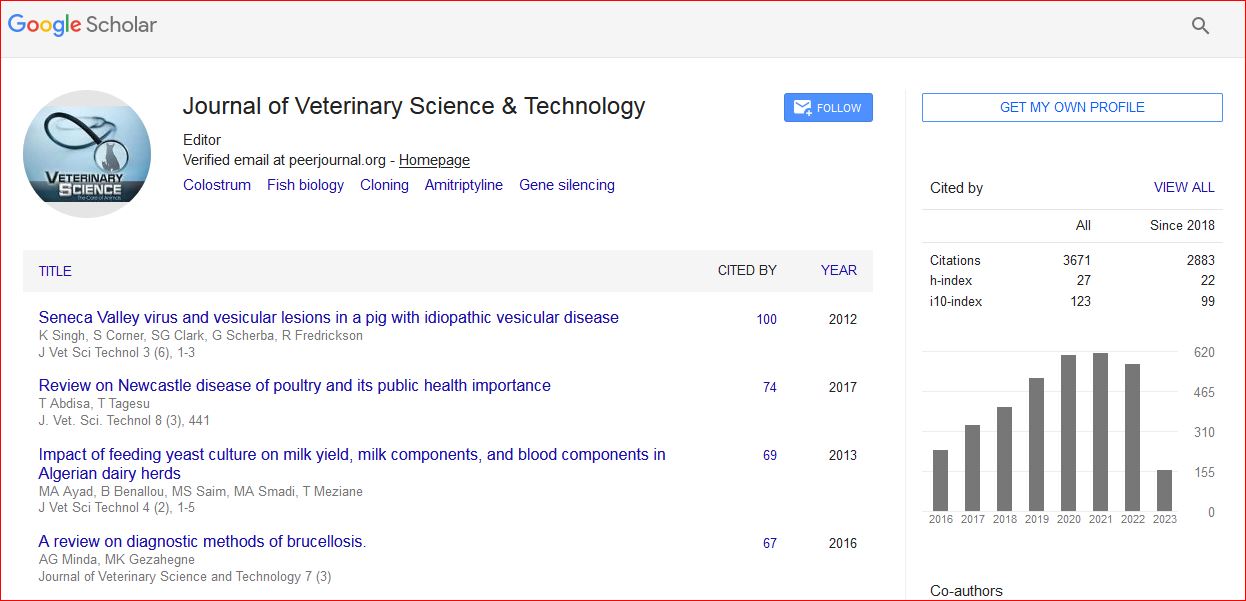
Veterinary Science & Technology received 4472 citations as per Google Scholar report