Short Communication - (2025) Volume 16, Issue 6
Received: 01-Dec-2025, Manuscript No. jvst-26-188142;
Editor assigned: 03-Dec-2025, Pre QC No. P-188142;
Reviewed: 17-Dec-2025, QC No. Q-188142;
Revised: 22-Dec-2025, Manuscript No. R-188142;
Published:
29-Dec-2025
, DOI: 10.37421/2157-7579.2025.16.334
Citation: Petrov, Pavel. ”Veterinary Medicine’s Tech Revolution:
Enhanced Animal Care.” J Vet Sci Techno 16 (2025):334.
Copyright: © 2025 Petrov P. This is an open-access article distributed under the terms of the Creative Commons Attribution License, which permits unrestricted use, distribution
and reproduction in any medium, provided the original author and source are credited.
The field of veterinary medicine is undergoing a rapid transformation, driven by technological innovations that enhance diagnostic capabilities, treatment efficacy, and overall animal welfare. These advancements are not only improving the lives of individual animals but also contributing to public health and the sustainability of animal agriculture. The integration of cutting-edge technologies requires a multidisciplinary approach, involving veterinarians, researchers, and technology developers to ensure their effective and ethical application.
Diagnostic imaging has seen significant progress, with technologies like Magnetic Resonance Imaging (MRI), Computed Tomography (CT), and ultrasound becoming more sophisticated and accessible. These tools are crucial for visualizing internal structures, identifying abnormalities, and guiding interventions, thereby improving the accuracy and speed of diagnoses, which directly translates to better treatment outcomes for animals. The continuous evolution of these imaging modalities promises even greater diagnostic precision in the future [1].Telemedicine and remote monitoring systems are revolutionizing how veterinary care is delivered, especially for animals with chronic conditions or those located in remote areas. These technologies offer numerous benefits, including enhanced owner convenience, improved practice efficiency, and ultimately, better management of animal health through continuous oversight. However, the successful implementation of these systems necessitates careful consideration of technical infrastructure, data security, and the preservation of the vital veterinarian-client-patient relationship [2].
Artificial intelligence (AI) and machine learning (ML) are emerging as powerful tools in veterinary diagnostics and treatment planning. By analyzing vast datasets of medical images and clinical records, AI algorithms can assist veterinarians in identifying subtle patterns indicative of disease, predicting treatment responses, and optimizing therapeutic strategies. The potential for AI to augment veterinary decision-making and personalize care is substantial and continues to expand [3].
Minimally invasive surgical techniques have significantly advanced veterinary surgical practice. Procedures such as laparoscopy, thoracoscopy, and endoscopy allow for reduced patient trauma, faster recovery times, and decreased pain management requirements compared to traditional open surgeries. The successful adoption of these advanced surgical methods relies on specialized equipment and extensive training for veterinary surgeons to ensure optimal patient safety and outcomes [4].
Modern veterinary medicine increasingly relies on advanced laboratory diagnostics and point-of-care testing. The availability of rapid diagnostic kits and automated analyzers allows for quicker disease detection, more precise treatment monitoring, and more effective management of disease outbreaks. Maintaining rigorous quality control and ensuring accurate interpretation of results are paramount to leveraging these diagnostic advancements for superior patient care [5].
Wearable sensor technology is opening new avenues for monitoring animal health and behavior in real-time. Devices capable of tracking physiological parameters like heart rate, temperature, and activity levels provide invaluable data for early disease detection, stress assessment, and overall welfare evaluation. This technology holds the promise of transforming proactive animal healthcare and improving animal husbandry practices [6].
Robotic assistance is increasingly being integrated into veterinary surgery, offering enhanced precision and enabling the performance of complex procedures through smaller incisions. Robotic systems can improve surgeon ergonomics and patient outcomes by providing greater control and dexterity. The economic feasibility and necessary training for veterinary teams are key factors in the widespread adoption of robotic surgery [7].
Digital radiography and 3D printing are revolutionizing diagnostic imaging and surgical planning in veterinary practice. Digital radiography offers improved image quality and reduced radiation exposure for patients and staff, while 3D printing facilitates the creation of patient-specific surgical guides, implants, and anatomical models. These tools are invaluable for enhancing diagnostic accuracy and preparing for complex surgical interventions [8].
Blockchain technology presents a novel approach to veterinary record management, offering enhanced data security, integrity, and interoperability. Its decentralized ledger system can improve the traceability of animal health records, streamline data sharing among veterinary professionals and regulatory bodies, and support public health initiatives through robust data management [9].
Augmented reality (AR) and virtual reality (VR) are transforming veterinary education and training. These immersive technologies provide realistic simulations for complex surgical procedures, detailed anatomical studies, and diagnostic interpretation, thereby improving learning outcomes and equipping future veterinarians with the skills needed to navigate challenging clinical scenarios effectively [10].
The landscape of veterinary medicine is being continually reshaped by technological advancements aimed at improving animal health and well-being. From sophisticated imaging techniques to remote patient monitoring and artificial intelligence, these innovations offer unprecedented opportunities for diagnosis, treatment, and preventative care. The adoption of these technologies is not merely about upgrading equipment; it represents a paradigm shift in how veterinary professionals approach patient management and clinical practice. Advances in diagnostic imaging, including MRI, CT, and ultrasound, have dramatically enhanced the ability of veterinarians to visualize internal pathologies with remarkable clarity. These technologies allow for earlier and more accurate diagnoses, leading to more targeted and effective treatment plans. The continuous refinement of imaging hardware and software contributes to improved resolution, faster scan times, and the development of novel imaging techniques that further expand diagnostic capabilities in veterinary science [1].
Telemedicine and remote monitoring are expanding the reach and accessibility of veterinary care. By enabling remote consultations and continuous patient observation, these systems facilitate better management of chronic diseases, provide crucial support for post-operative recovery, and offer convenience to pet owners. Addressing the technical challenges and ethical considerations, such as data privacy and the maintenance of the human-animal bond, is essential for the responsible integration of these technologies into routine practice [2].
The integration of artificial intelligence (AI) and machine learning (ML) into veterinary diagnostics and treatment planning is poised to revolutionize clinical decision-making. AI algorithms can process and interpret complex datasets, including radiographic images and patient histories, to assist veterinarians in identifying diseases, predicting prognosis, and customizing treatment protocols. This fusion of human expertise and machine intelligence promises to elevate the standard of veterinary care [3].
Minimally invasive surgical (MIS) techniques, encompassing laparoscopy, thoracoscopy, and endoscopy, are becoming increasingly prevalent in veterinary surgery. These advanced procedures result in reduced patient discomfort, shorter recovery periods, and fewer complications compared to traditional open surgeries. The successful implementation of MIS requires specialized surgical equipment and comprehensive training for veterinary surgeons to master these intricate techniques [4].
Advanced laboratory diagnostics and point-of-care testing are vital components of modern veterinary clinical practice. The availability of rapid diagnostic assays and automated analyzers allows for swift and accurate identification of diseases, monitoring of therapeutic responses, and effective control of infectious outbreaks. Adherence to strict quality control measures and proficient interpretation of results are critical for optimizing patient outcomes [5].
Wearable sensor technology offers a novel approach to continuous health and behavior monitoring in animals. These devices can track key physiological indicators and activity patterns, providing early warnings of potential health issues and facilitating proactive interventions. The application of wearable sensors extends beyond clinical settings to research and animal husbandry, enhancing our understanding of animal physiology and welfare [6].
Robotic-assisted surgery is emerging as a significant advancement in veterinary surgical procedures. Robotic systems enhance surgical precision, enable the execution of complex maneuvers through minimal incisions, and improve the ergonomic comfort of surgeons. The consideration of economic viability and specialized training is crucial for the successful adoption and widespread use of robotic surgery in veterinary clinics [7].
Digital radiography and 3D printing are transforming diagnostic imaging and surgical planning in veterinary medicine. Digital radiography provides high-quality images with reduced radiation exposure, facilitating more accurate diagnoses. 3D printing allows for the creation of patient-specific surgical guides and anatomical models, which are invaluable for pre-surgical planning and enhancing surgical precision [8].
Blockchain technology is being explored for its potential to enhance the security, integrity, and interoperability of veterinary health records. Its decentralized nature can improve data traceability, facilitate secure data sharing among authorized parties, and contribute to robust public health surveillance systems by ensuring the reliability of animal health information [9].
Augmented reality (AR) and virtual reality (VR) are powerful tools for veterinary education and training. These immersive technologies offer realistic simulations for practicing surgical skills, exploring complex anatomical structures, and developing diagnostic interpretation abilities, thereby preparing veterinary students and professionals for diverse clinical challenges [10].
Veterinary medicine is experiencing a technological revolution with significant advancements in diagnostic imaging, telemedicine, artificial intelligence, minimally invasive surgery, advanced laboratory diagnostics, wearable sensors, robotic surgery, digital radiography, 3D printing, blockchain technology, and augmented/virtual reality. These innovations are collectively enhancing diagnostic accuracy, treatment efficacy, patient care, and educational methods, ultimately improving animal welfare and the practice of veterinary medicine. The integration of these technologies requires skilled professionals and careful consideration of their practical, ethical, and economic implications.
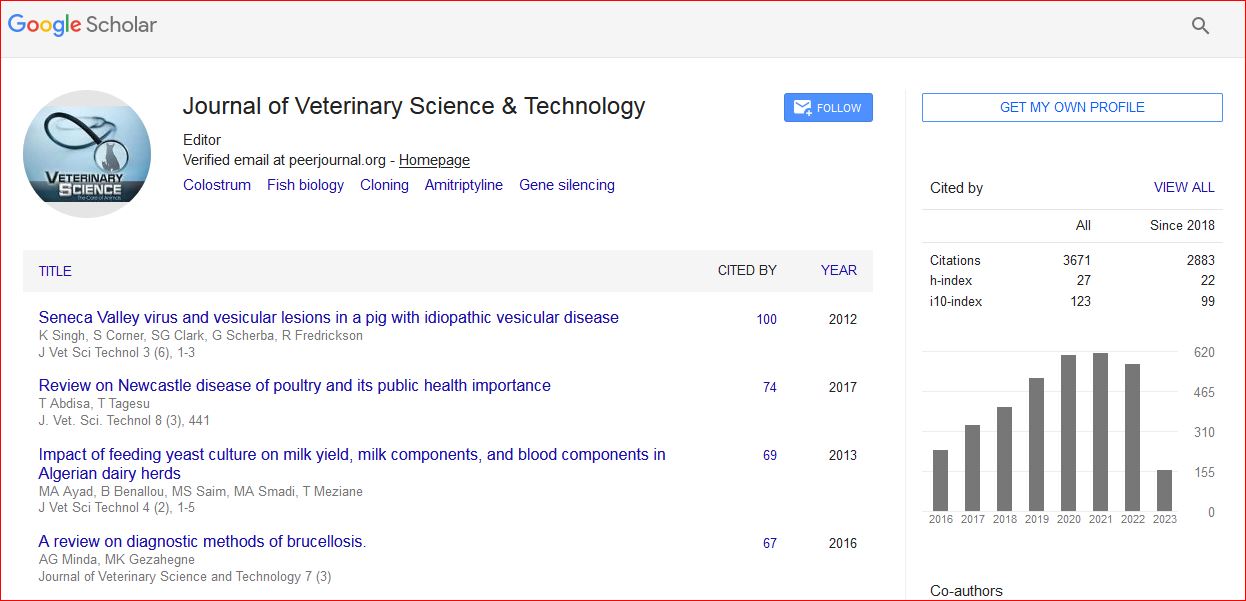
Veterinary Science & Technology received 4472 citations as per Google Scholar report