Commentary - (2025) Volume 16, Issue 6
Received: 01-Dec-2025, Manuscript No. jvst-26-188147;
Editor assigned: 03-Dec-2025, Pre QC No. P-188147;
Reviewed: 17-Dec-2025, QC No. Q-188147;
Revised: 22-Dec-2025, Manuscript No. R-188147;
Published:
29-Dec-2025
, DOI: 10.37421/2157-7579.2025.16.336
Citation: Tran, Linh. ”Veterinary Medicine Innovations: Advancing
Animal and Public Health.” J Vet Sci Techno 16 (2025):336.
Copyright: © 2025 Tran L. This is an open-access article distributed under the terms of the Creative Commons Attribution License, which permits unrestricted use, distribution
and reproduction in any medium, provided the original author and source are credited.
The field of veterinary science has witnessed remarkable advancements in recent years, driven by technological innovation and a deeper understanding of animal physiology and pathology. These developments are crucial for improving animal health, welfare, and productivity, as well as for managing diseases that can impact public health. [1]
Recent research has highlighted significant progress in diagnostic technologies, encompassing both molecular and imaging techniques. These new tools offer greater precision and speed in identifying a wide range of conditions affecting animals, from infectious diseases to chronic ailments. The integration of these advanced diagnostics is transforming how veterinary professionals approach disease detection and monitoring, leading to more effective interventions and improved patient outcomes.[2] The evolution of therapeutic strategies has also been a focal point, with a growing emphasis on targeted and personalized treatments. This includes the development of novel pharmaceuticals, advanced surgical techniques, and innovative approaches to managing complex health issues. The aim is to enhance treatment efficacy, minimize adverse effects, and improve the overall quality of life for animals.[3] Artificial intelligence (AI) is emerging as a powerful ally in veterinary medicine, particularly in the interpretation of diagnostic data. AI algorithms are being developed to assist in analyzing medical images, such as radiographs and scans, thereby enhancing the accuracy and efficiency of diagnoses. This technological integration promises to augment the capabilities of veterinarians, especially in areas requiring complex data interpretation.[4] Molecular diagnostics, such as PCR-based assays, are playing an increasingly vital role in identifying pathogens with speed and specificity. These assays enable rapid and accurate detection of infectious agents, which is critical for timely treatment and effective disease control, particularly in cases of zoonotic diseases and those affecting companion animals and livestock.[5] Gene editing technologies, such as CRISPR-Cas, are opening new frontiers in veterinary medicine, offering the potential to address genetic disorders and enhance disease resistance in livestock. While still in its nascent stages, this technology holds promise for improving animal health, productivity, and the safety of food animals.[6] Point-of-care diagnostic devices are also contributing to improved animal healthcare by enabling rapid testing at the point of service. These devices reduce the time between sample collection and diagnosis, allowing for quicker treatment decisions and potentially mitigating disease progression, which is particularly beneficial for common and acute conditions.[7] Telemedicine is another area experiencing significant growth, expanding access to veterinary care, especially in remote or underserved regions. This technology facilitates remote consultations, follow-up care, and client education, thereby enhancing the reach and efficiency of veterinary services.[8] The development of advanced biosensors is enabling early detection of disease biomarkers, which is critical for proactive health management in animal populations. This proactive approach can lead to earlier interventions, reduced economic losses due to disease outbreaks, and improved herd health strategies.[9] Nanotechnology is also making inroads into veterinary pharmaceuticals, with the development of novel drug delivery systems designed to improve drug efficacy and reduce side effects. This innovative approach to drug formulation promises to enhance treatment outcomes for a variety of conditions, including chronic and life-threatening diseases.[10]The recent advancements in veterinary diagnostics are multifaceted, spanning from sophisticated imaging interpretations aided by artificial intelligence to rapid molecular detection methods. AI's role in interpreting veterinary radiographs, for instance, has shown potential in improving diagnostic accuracy for conditions like canine osteoarthritis and feline lung disease, often matching or exceeding human expert performance. This integration of AI in diagnostic imaging signifies a paradigm shift in how veterinary professionals assess and diagnose conditions, potentially leading to earlier and more precise interventions. [1]
Molecular diagnostics, particularly PCR-based assays, have been developed and validated for the rapid and accurate detection of common tick-borne pathogens in companion animals. These new assays are crucial for timely diagnosis, which directly translates to improved treatment outcomes and better management of these prevalent diseases in dogs and cats. The specificity and speed of these molecular tools are invaluable in clinical settings. [2] Beyond infectious diseases, gene editing technologies like CRISPR-Cas are being explored for their potential in livestock, aiming to enhance disease resistance and improve production traits through genetic modification. This technology opens up avenues for proactive disease prevention at a genetic level, although it also brings ethical considerations and necessitates further research into its long-term implications. [3] In the realm of point-of-care diagnostics, novel devices are being evaluated for their performance in detecting specific disease antigens, such as canine parvovirus antigen in fecal samples. High sensitivity and specificity make these devices suitable for rapid field diagnostics, thereby reducing diagnostic delays and enabling prompt management of acute infections. [4] Telemedicine has emerged as a significant tool in expanding access to veterinary services, particularly in areas with limited resources. Its effectiveness in remote consultations, follow-up care, and client education has been established through meta-analyses, demonstrating its potential to bridge geographical barriers and improve veterinary care delivery. [5] Advanced biosensors are being developed for the early detection of biomarkers associated with specific diseases, such as bovine respiratory disease. This early detection capability is vital for proactive herd health management, allowing for timely interventions that can minimize economic losses and prevent widespread outbreaks. [6] Nanotechnology is revolutionizing drug delivery in veterinary pharmaceuticals by creating systems that aim to enhance drug efficacy and minimize adverse effects. These systems, including targeted delivery mechanisms for agents like anti-cancer drugs and antibiotics, represent a significant step forward in optimizing therapeutic interventions. [7] The application of AI in interpreting veterinary imaging, specifically radiographs for musculoskeletal and thoracic diseases, has demonstrated its capacity to improve diagnostic accuracy and efficiency. The development and validation of AI models that perform comparably to, or even better than, experienced radiologists underscore the transformative potential of this technology in diagnostic imaging. [8] Regenerative medicine, utilizing stem cell therapy and tissue engineering, is advancing veterinary applications for treating a range of conditions, including orthopedic injuries, wound healing, and organ regeneration. This approach offers innovative solutions for conditions that were previously difficult to manage, highlighting the growing sophistication of veterinary therapeutics. [9] Genomic surveillance plays a critical role in tracking the evolution and spread of antimicrobial resistance genes in veterinary pathogens. This integrated monitoring approach is essential for developing effective control strategies against the growing threat of antibiotic resistance in animal populations and for public health. [10]This collection of research highlights significant advancements across veterinary medicine. Innovations in diagnostic technologies, including molecular assays and AI-assisted imaging interpretation, are improving disease detection accuracy and speed. Therapeutic strategies are advancing with the development of gene editing, nanotechnology-based drug delivery, and regenerative medicine approaches. Point-of-care devices and telemedicine are enhancing accessibility and efficiency in veterinary care delivery. Furthermore, biosensors are enabling early disease detection for proactive herd health, while genomic surveillance is crucial for combating antimicrobial resistance. These developments collectively aim to improve animal health, welfare, and public health outcomes.
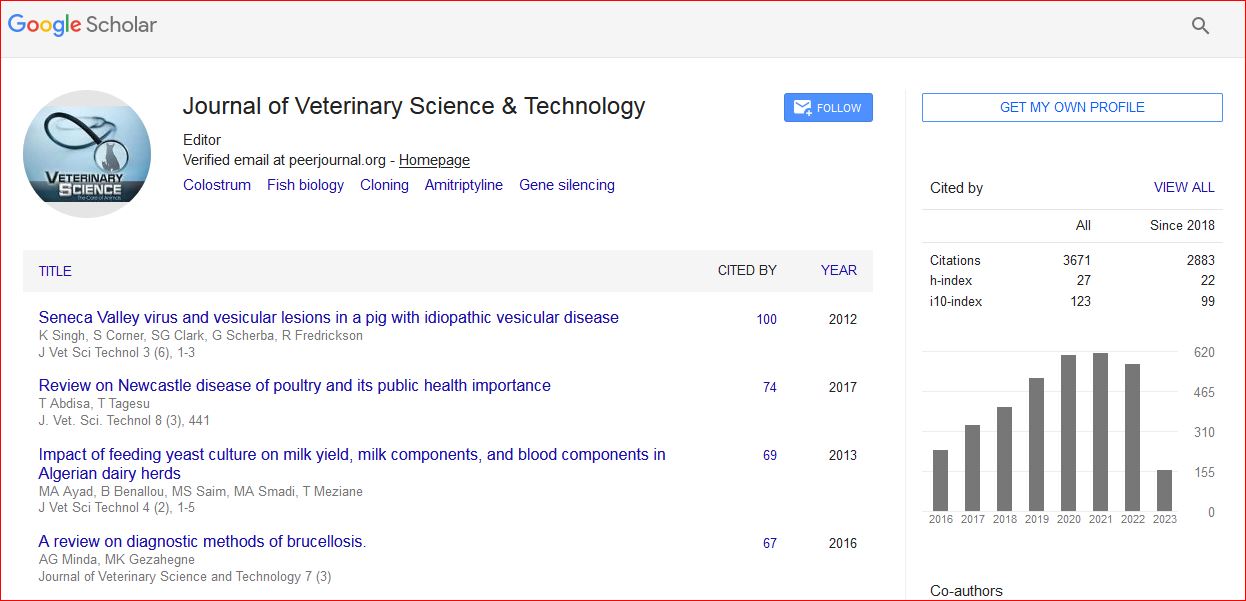
Veterinary Science & Technology received 4472 citations as per Google Scholar report