Perspective - (2025) Volume 11, Issue 2
Received: 01-Apr-2025, Manuscript No. JOV-26-186411;
Editor assigned: 03-Apr-2025, Pre QC No. p-186411;
Reviewed: 17-Apr-2025, QC No. Q-186411;
Revised: 22-Apr-2025, Manuscript No. R-186411;
Published:
29-Apr-2025
, DOI: 10.37421/2471-9544.2025.11.298
Citation: Schneider, Tobias. ”Vascular Silence: Morphological Markers in Vasculitis.” J Vasc 11 (2025):298.
Copyright: © 2025 Schneider T. This is an open-access article distributed under the terms of the Creative Commons Attribution License, which permits unrestricted use, distribution and reproduction in any medium, provided the original author and source are credited.
The intricate landscape of autoimmune and inflammatory disorders is often characterized by subtle yet significant changes within the vascular system, a phenomenon aptly described as 'vascular silence' [1].
This research delves into these often-overlooked alterations, highlighting how cellular and structural modifications can precede or coincide with overt disease manifestations. Understanding these early indicators is paramount for timely diagnosis and intervention. The early stages of vasculitis present a complex interplay between immune cells and the vascular endothelium, with distinct morphological hallmarks [2].
Detailed histological analysis is crucial for deciphering the activation state of endothelial cells, the types of inflammatory infiltrates, and the structural integrity of the vascular network, all of which are vital for comprehending disease pathogenesis and developing novel therapeutic strategies. A comprehensive morphological characterization of vascular lesions across various systemic vasculitis forms reveals dynamic changes in vessel walls throughout disease progression [3].
From initial inflammation to potential fibrotic remodeling, a visual atlas of these transformations, correlating specific morphological features with clinical phenotypes and disease activity, is essential for accurate diagnosis and prognosis. At a more granular level, ultrastructural changes within the vessel wall, particularly concerning basement membrane components and extracellular matrix remodeling, play a critical role in vasculitis pathogenesis [4].
Advanced electron microscopy has illuminated subtle alterations in collagen deposition and laminin organization, contributing significantly to vascular dysfunction and fragility, thus offering a deeper understanding at the subcellular level. Furthermore, the morphological correlates of therapeutic response in vasculitis offer valuable insights into patient management [5].
By examining serial biopsies, researchers can identify specific histological features that predict treatment efficacy and the likelihood of relapse. This understanding is crucial for guiding clinical decision-making and personalizing patient care. The specific architecture of immune cells within vasculitic lesions provides critical clues about the driving forces behind vascular damage [6].
Detailed immunohistochemical analysis mapping the spatial distribution and activation status of immune cell subsets, such as neutrophils and T cells, within inflamed vessel walls illuminates the intricate cellular mechanisms underlying the inflammatory cascade. A comparative morphological analysis across different vascular bedsâ??small, medium, and large vesselsâ??reveals distinct patterns of inflammation and damage characteristic of specific vasculitic syndromes [7].
This differentiation contributes to a more refined classification and a deeper understanding of the disease's heterogeneity, emphasizing the impact of vessel size on pathology. In the realm of microvascular changes, vasculitis significantly impacts tissue perfusion and oxygenation [8].
Morphological alterations in capillaries and arterioles, including increased permeability and thrombus formation, are directly linked to end-organ damage, underscoring the critical role of microvascular integrity in the overall disease pathology. The evolution of diagnostic tools has introduced advanced imaging techniques for the morphological assessment of vasculitis in vivo [9].
Modalities like high-resolution MRI and PET/CT complement traditional histological findings, offering a non-invasive window into vascular inflammation and remodeling, thereby transforming the diagnostic landscape. Finally, the role of the complement system in mediating vascular damage in ANCA-associated vasculitis is illuminated through detailed morphological analysis [10].
Identifying complement deposition patterns within vessel walls links specific pathway activation to observed inflammatory and destructive processes, paving the way for targeted therapies.
The field of rheumatology and immunology has seen significant advancements in understanding the intricate vascular changes associated with autoimmune and inflammatory disorders. A key area of focus is the concept of 'vascular silence,' referring to the subtle yet critical cellular and structural alterations within blood vessels that can precede or accompany overt disease [1].
These early morphological changes are instrumental in the pathogenesis of conditions like vasculitis and are increasingly recognized as vital diagnostic markers and potential therapeutic targets. Investigating the early stages of vasculitis reveals a complex interplay between immune cells and the vascular endothelium. Morphological hallmarks such as endothelial cell activation and perivascular inflammatory infiltrates are central to understanding disease initiation and progression [2].
The structural integrity of the vascular network is compromised, necessitating detailed histological analysis to unravel these pathogenic mechanisms and identify avenues for novel therapeutic interventions. Systemic vasculitis encompasses a spectrum of diseases, each with unique morphological characteristics of vascular lesions. Studies have provided a detailed characterization of these lesions, highlighting the dynamic changes in vessel walls from initial inflammation to fibrotic remodeling [3].
This visual atlas, correlating specific morphological features with clinical phenotypes and disease activity, is indispensable for accurate diagnosis and prognosis in diverse patient populations. Delving into the subcellular level, research has elucidated the role of the vascular basement membrane and extracellular matrix in vasculitis. Ultrastructural alterations in components like collagen and laminin contribute significantly to vascular dysfunction and fragility [4].
Advanced imaging techniques are crucial for visualizing these subtle changes, offering a deeper understanding of the pathobiology at a fundamental level. The ability to predict treatment response and relapse in vasculitis is significantly enhanced by understanding morphological changes. Serial biopsies have identified specific histological features that serve as reliable predictors of therapeutic efficacy [5].
This morphological insight is crucial for tailoring treatment strategies and personalizing patient management, leading to improved outcomes. The cellular environment within vasculitic lesions is a critical determinant of vascular damage. Detailed immunohistochemical analysis has mapped the spatial distribution and activation status of key immune cell subsets, such as neutrophils and T cells, within inflamed vessel walls [6].
This detailed understanding of immune cell architecture illuminates the specific cellular mechanisms driving the inflammatory cascade. Vasculitis syndromes can affect vessels of varying sizes, leading to distinct pathological patterns. Comparative morphological analyses have identified vascular bed-specific features that are characteristic of different vasculitic conditions [7].
This differentiation aids in refining classification systems and enhances the understanding of disease heterogeneity, recognizing that vessel size influences the nature of the inflammatory response. The impact of vasculitis on microvascular function is profound, affecting tissue perfusion and oxygenation. Morphological abnormalities in capillaries and arterioles, including increased permeability and thrombus formation, are directly linked to end-organ damage [8].
The integrity of the microvasculature is therefore a critical factor in disease pathology and its clinical manifestations. Advancements in medical imaging have revolutionized the morphological assessment of vasculitis in vivo. High-resolution MRI and PET/CT offer non-invasive methods to visualize vascular inflammation and remodeling, complementing traditional histological findings [9].
This evolution in diagnostic modalities provides a more comprehensive and dynamic understanding of the disease. Specific molecular pathways, such as the complement system, play a significant role in mediating vascular damage. Morphological evidence of complement activation within vessel walls in ANCA-associated vasculitis has been observed, linking specific complement pathway activation to inflammatory processes [10].
This provides a basis for developing targeted therapies aimed at inhibiting these damaging pathways.
This body of research focuses on the morphological changes within blood vessels in the context of autoimmune and inflammatory disorders, particularly vasculitis. The studies highlight the concept of 'vascular silence,' where subtle cellular and structural alterations often precede or accompany overt disease. Key areas explored include endothelial cell activation, perivascular immune cell infiltration, basement membrane modifications, and extracellular matrix remodeling. The research emphasizes the diagnostic and therapeutic significance of these morphological features, from early disease identification to predicting treatment response and understanding disease heterogeneity across different vascular beds. Advanced imaging techniques and cellular mechanisms are also investigated, providing a comprehensive view of vasculitis pathogenesis and management.
None
None
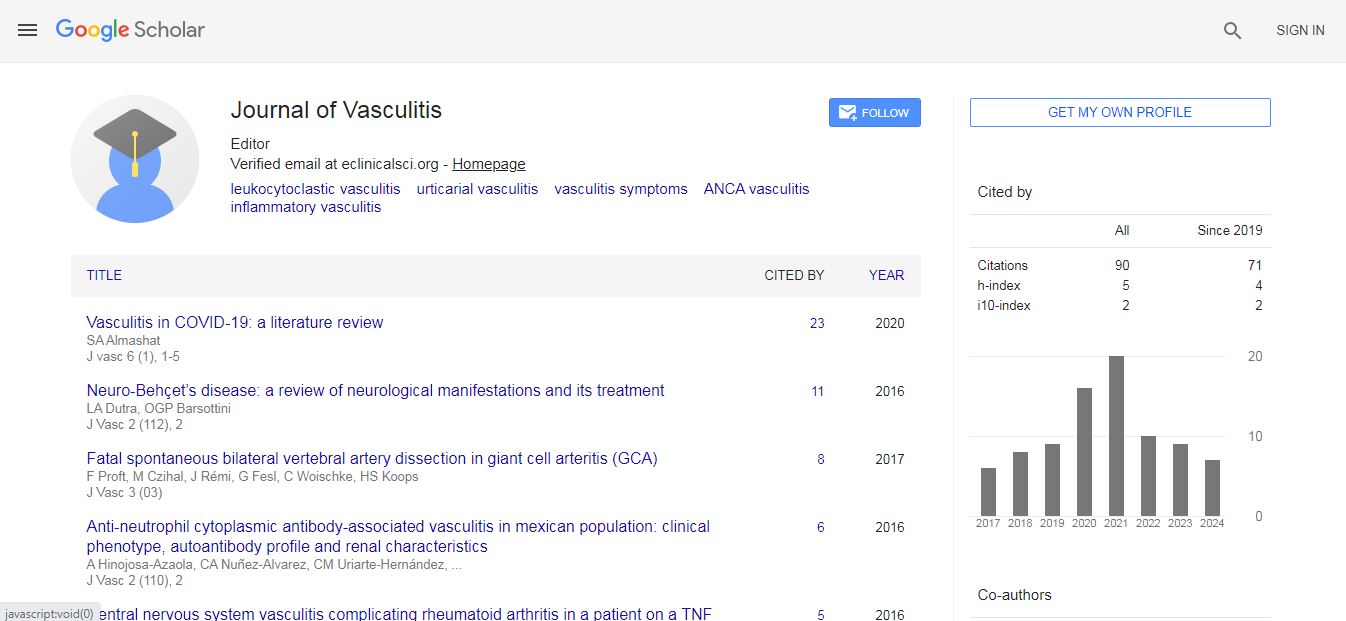
Journal of Vasculitis received 83 citations as per Google Scholar report