Opinion - (2025) Volume 16, Issue 6
Received: 01-Nov-2025, Manuscript No. jch-26-178800;
Editor assigned: 03-Nov-2025, Pre QC No. P-178800;
Reviewed: 17-Nov-2025, QC No. Q-178800;
Revised: 22-Nov-2025, Manuscript No. R-178800;
Published:
29-Nov-2025
, DOI: 10.37421/2157-7099.2025.16.827
Citation: Larsen, Henrik. ”Urine Cytology: Enhancing Urinary Tract Lesion Diagnosis.” J Cytol Histol 16 (2025):827.
Copyright: © 2025 Larsen H. This is an open-access article distributed under the terms of the Creative Commons Attribution License, which permits unrestricted use, distribution and reproduction in any medium, provided the original author and source are credited.
Cytological diagnosis of urinary tract lesions stands as a cornerstone in the early identification and effective management of urological conditions. This discipline has seen substantial advancements, particularly in enhancing the accuracy of detecting malignancy and pre-malignant states through refined sample preparation, sophisticated staining techniques, and the judicious application of ancillary testing. The characterization of cellular morphology, the analysis of nuclear features, and the recognition of architectural patterns within exfoliated urothelial cells and other urinary elements are paramount to achieving diagnostic precision. Furthermore, the integration of immunocytochemistry and molecular markers has significantly bolstered the diagnostic capabilities, especially in distinguishing benign cellular changes from malignant or reactive processes within the urinary tract [1].
Liquid-based cytology (LBC) has emerged as a valuable technique for processing urinary tract specimens, offering distinct advantages over conventional smear methods. LBC is recognized for its ability to improve cell preservation and minimize obscuring factors such as blood and debris, which collectively contribute to a higher diagnostic yield. The standardization of LBC techniques is crucial for its widespread adoption and effectiveness in the detection of urothelial carcinoma, encompassing both high-grade and low-grade lesions, as well as non-neoplastic conditions that may present in urine [2].
The diagnostic utility of urine cytology in identifying upper tract urothelial carcinoma (UTUC) is an area of active investigation. While its sensitivity for UTUC may be lower compared to bladder cancer, urine cytology remains an indispensable tool, especially when employed in conjunction with advanced imaging modalities. This approach allows for a more comprehensive assessment, and the examination of specific cytomorphological features associated with UTUC is critical, alongside strategies aimed at improving its detection rates through the thoughtful use of ancillary tests [3].
The choice of staining techniques significantly impacts the diagnostic accuracy in urinary cytology. Both Papanicolaou (PAP) stain and Diff-Quik stain have demonstrated efficacy in evaluating urothelial lesions. PAP stain is particularly advantageous for discerning subtle atypia due to its superior nuclear detail, whereas Diff-Quik offers the benefit of rapid preliminary assessment. The implementation of standardized protocols for both staining methods is essential to ensure the reliability and reproducibility of diagnoses derived from urine samples [4].
Immunocytochemistry (ICC) represents a significant technological leap forward in the field of urinary cytology, offering enhanced discriminatory power. The application of ICC markers, including cytokeratins (CKs), p16, and Ki-67, is instrumental in differentiating urothelial carcinoma from reactive atypia and other potentially confusing lesions. By improving both the sensitivity and specificity of diagnoses, ICC proves particularly valuable in managing challenging or equivocal cases encountered in routine cytological practice [5].
Beyond urothelial malignancies, urine cytology also plays a role in the diagnosis of non-urothelial neoplasms that can involve the urinary tract. This includes the evaluation of metastatic carcinomas, lymphomas, and other rare tumor types that may be shed into urine samples. The accurate identification of these lesions relies on recognizing distinct patterns and specific cellular features that can help differentiate them from primary urothelial malignancies, underscoring the broad applicability of urinary cytology [6].
Ancillary molecular testing is increasingly being integrated into the diagnostic workflow of urine cytology, further refining its accuracy and utility. The application of molecular biomarkers holds promise for the sensitive detection and precise classification of urothelial carcinoma, facilitating improved risk stratification and enabling more personalized treatment decisions. This evolving landscape of molecular pathology is continuously reshaping urologic diagnostics [7].
Cytological pitfalls in the interpretation of urothelial lesions, particularly in distinguishing benign inflammatory and reactive changes from high-grade urothelial carcinoma, present a significant diagnostic challenge. Key cytomorphological features, such as nuclear enlargement, hyperchromasia, and irregular chromatin patterns, can mimic malignant features, necessitating careful evaluation and awareness of potential diagnostic pitfalls. A thorough understanding of these mimics is crucial for accurate diagnosis [8].
In the context of bladder cancer management, urine cytology is a valuable tool for surveillance and the detection of recurrence following treatment. Its effectiveness in monitoring patients, identifying residual disease, and detecting new primary tumors underscores its importance in the post-treatment follow-up of patients with bladder cancer. This consistent monitoring aids in timely intervention and improved patient outcomes [9].
The interpretation of borderline cases and atypical urothelial cells of undetermined significance (AUS) in urine cytology presents diagnostic challenges. Guidance on standardized interpretation and the effective integration of ancillary tests are essential for resolving diagnostic ambiguity and ensuring that patient management strategies are appropriately informed. This pragmatic approach optimizes the clinical utility of urine cytology in complex scenarios [10].
The effectiveness of urine cytology in the diagnosis of upper tract urothelial carcinoma (UTUC) is a subject of considerable interest. Although generally less sensitive than for bladder cancer, urine cytology remains a valuable diagnostic modality, particularly when utilized alongside advanced imaging techniques. This article delves into the specific cytomorphological characteristics indicative of UTUC and explores strategies designed to enhance its detection, emphasizing the judicious use of ancillary diagnostic tests [3].
A comparative analysis of Papanicolaou (PAP) stain and Diff-Quik stain in urinary cytology highlights their respective strengths. Both stains are effective in the evaluation of urothelial lesions. PAP stain excels in providing detailed nuclear morphology crucial for identifying subtle atypia, while Diff-Quik offers the advantage of rapid preliminary assessment. The research underscores the critical importance of adhering to standardized protocols for both staining methods to ensure the reliability and consistency of diagnostic findings in urinary cytology [4].
Immunocytochemistry (ICC) represents a significant advancement in enhancing the diagnostic capabilities of urinary cytology. This paper reviews the utility of various ICC markers, such as cytokeratins (CKs), p16, and Ki-67, in the critical task of distinguishing urothelial carcinoma from reactive atypia and other problematic lesions. ICC plays a vital role in augmenting diagnostic sensitivity and specificity, proving especially beneficial in managing complex and ambiguous cases [5].
In addition to urothelial neoplasms, urine cytology is also employed in the diagnosis of non-urothelial malignancies within the urinary tract. This includes the cytological evaluation of metastatic carcinomas, lymphomas, and other rare tumor types that can involve the urinary system and be detected in urine samples. The accurate interpretation relies on recognizing characteristic patterns and specific cellular features that differentiate these entities from urothelial malignancies [6].
The integration of ancillary molecular testing is increasingly recognized as a powerful tool for enhancing the diagnostic accuracy of urine cytology. This approach encompasses the utilization of specific biomarkers for the detection and classification of urothelial carcinoma, which subsequently aids in more precise risk stratification and informs treatment decisions. The ongoing evolution of molecular pathology is continuously reshaping the landscape of urologic diagnostics [7].
Distinguishing inflammatory and reactive urothelial lesions from high-grade urothelial carcinoma is a critical challenge in cytological interpretation. This review outlines the key cytomorphological features that can mimic malignancy, such as nuclear enlargement, hyperchromasia, and irregular chromatin, and discusses common diagnostic pitfalls encountered in these cases. Awareness of these mimics is essential for accurate diagnosis [8].
Urine cytology plays a significant role in the surveillance of patients diagnosed with bladder cancer, particularly in the detection of recurrence. This paper assesses the effectiveness of urine cytology in monitoring patients after treatment, identifying residual disease, and detecting the development of new primary tumors, highlighting its value in long-term patient management [9].
The interpretation of borderline cases and atypical urothelial cells of undetermined significance (AUS) in urine cytology presents unique diagnostic challenges. This article offers practical guidance on interpretation and emphasizes the effective use of ancillary tests to resolve diagnostic ambiguity, thereby ensuring appropriate patient management and treatment strategies [10].
Urine cytology is a crucial diagnostic tool for identifying urinary tract lesions, with advancements in preparation, staining, and ancillary tests enhancing accuracy. Liquid-based cytology (LBC) improves cell preservation and diagnostic yield. While less sensitive for upper tract urothelial carcinoma (UTUC), urine cytology remains valuable alongside imaging. Both Papanicolaou (PAP) and Diff-Quik stains are effective, with PAP offering better nuclear detail. Immunocytochemistry (ICC) aids in distinguishing urothelial carcinoma from reactive changes. Urine cytology also helps diagnose non-urothelial neoplasms and is vital for bladder cancer surveillance. Interpreting atypical cells requires careful consideration and ancillary tests to avoid diagnostic pitfalls.
None
None
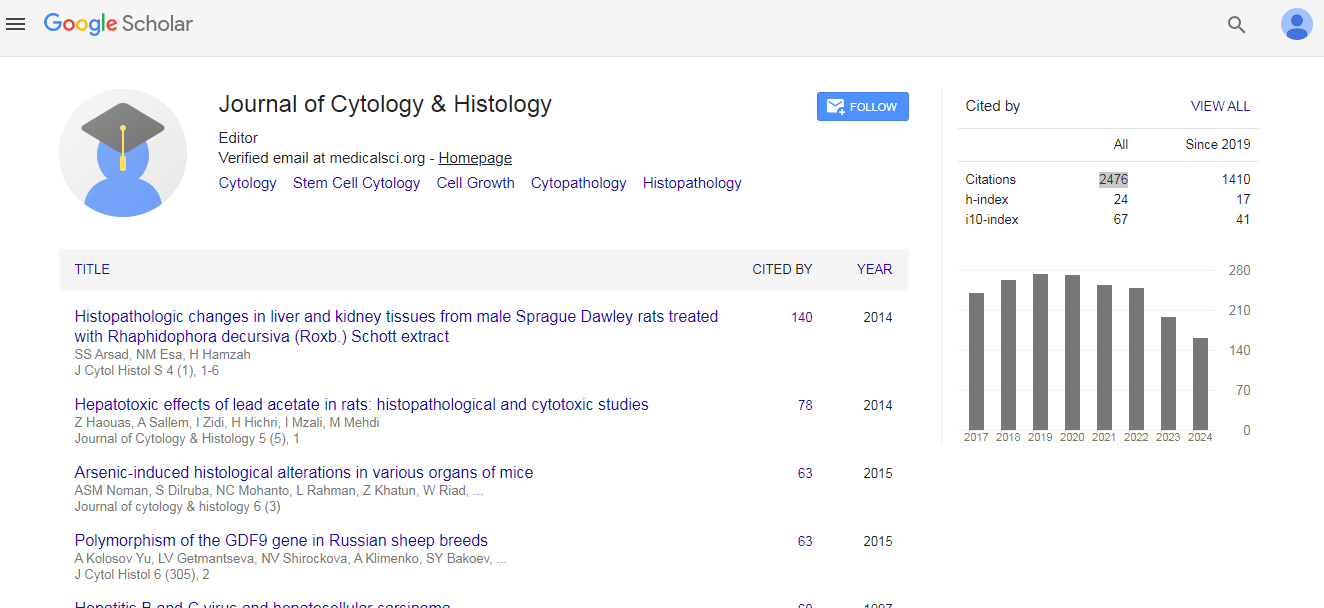
Journal of Cytology & Histology received 2476 citations as per Google Scholar report