Brief Report - (2025) Volume 17, Issue 3
Received: 01-May-2025, Manuscript No. jcst-25-172451;
Editor assigned: 05-May-2025, Pre QC No. P-172451;
Reviewed: 19-May-2025, QC No. Q-172451;
Revised: 22-May-2025, Manuscript No. R-172451;
Published:
29-May-2025
, DOI: 10.37421/1948-5956.2025.17.702
Citation: Carter, Emily. ”Tumor Microenvironment: Key Players
and Targets.” J Cancer Sci Ther 17 (2025):702.
Copyright: © 2025 Carter E. This is an open-access article distributed under the terms of the Creative Commons Attribution License, which permits unrestricted use, distribution
and reproduction in any medium, provided the original author and source are credited.
Myeloid cells in the tumor microenvironment (TME) are significant players, influencing tumor progression and therapeutic resistance. Understanding their diverse roles - from promoting angiogenesis and immunosuppression to sometimes exerting anti-tumor effects - is crucial. Effective strategies for cancer treatment increasingly involve targeting these cells to reprogram the TME, making it more hospitable for immune attack and improving patient outcomes, especially when combined with existing immunotherapies[1].
Exosomes, tiny vesicles secreted by cells, are key communicators within the tumor microenvironment. They carry a cargo of proteins, lipids, and nucleic acids, impacting everything from tumor growth and metastasis to angiogenesis and immune evasion. What this really means is that exosomes offer exciting potential as diagnostic biomarkers and as novel targets for therapeutic interventions, possibly delivering anti-cancer agents or modulating immune responses[2].
Cancer-associated fibroblasts (CAFs) are central to the tumor microenvironment, profoundly influencing cancer cell proliferation, invasion, and drug resistance. These cells remodel the extracellular matrix, secrete growth factors, and suppress anti-tumor immunity. Targeting CAFs directly, or disrupting their pro-tumorigenic functions, represents a promising strategy to dismantle the tumor's supportive stroma and enhance the efficacy of conventional and immunotherapeutic approaches[3].
The metabolic landscape within the tumor microenvironment is often drastically altered, with cancer cells and stromal cells engaging in complex metabolic crosstalk. This metabolic reprogramming fuels tumor growth, contributes to drug resistance, and creates an immunosuppressive environment. Understanding these unique metabolic pathways opens doors for therapies that target specific enzymes or nutrient dependencies, effectively starving cancer cells or restoring immune function[4].
Macrophages are highly versatile immune cells that infiltrate tumors and often become 'tumor-associated macrophages' (TAMs), adopting pro-tumorigenic functions. They promote tumor growth, angiogenesis, and metastasis, while suppressing anti-tumor immunity. Strategies to target TAMs, either by depleting them, blocking their recruitment, or reprogramming them to an anti-tumor phenotype, are emerging as powerful ways to enhance the effectiveness of current cancer immunotherapies[5].
Endothelial cells, which line blood vessels, are crucial components of the tumor microenvironment, forming the abnormal and leaky vasculature that supports tumor growth. They contribute to nutrient supply, waste removal, and metastasis. Here's the thing: targeting these endothelial cells to normalize tumor blood vessels or inhibit their formation can starve the tumor, reduce metastasis, and improve the delivery and efficacy of anti-cancer drugs and immune cells[6].
A key challenge in cancer treatment is the presence of immunosuppressive cells within the tumor microenvironment, which actively dampen anti-tumor immune responses. Cells like regulatory T cells (Tregs), myeloid-derived suppressor cells (MDSCs), and certain macrophages create a shield around the tumor, protecting it from immune attack. Understanding these cellular mechanisms is vital for developing therapies that can dismantle this immune suppression and unleash the full potential of immunotherapy[7].
Extracellular vesicles (EVs), including exosomes and microvesicles, serve as crucial mediators of intercellular communication within the tumor microenvironment. They shuttle various molecular cargo between cells, influencing tumor progression, immune escape, and metastasis. What this means is that EVs are not just waste products; they are potent drivers of tumor development and resistance, representing both diagnostic biomarkers and promising targets for innovative therapeutic strategies[8].
Fibroblasts are integral components of the tumor microenvironment, profoundly influencing cancer progression and therapeutic responses. These cells, often reprogrammed into cancer-associated fibroblasts (CAFs), orchestrate extracellular matrix remodeling, secrete growth factors, and suppress anti-tumor immunity. Targeting the specific pathways that activate and sustain CAFs or modulating their functions offers a multifaceted approach to disrupt the tumor's supportive niche and enhance the efficacy of cancer treatments[9].
The gut microbiota exerts a surprisingly profound influence on the tumor microenvironment, not just in gastrointestinal cancers but systemically. The composition and metabolic activities of gut microbes can modulate local and systemic immune responses, affect cancer therapy efficacy, and even contribute to tumorigenesis. Here's the thing: understanding this complex interplay is opening new avenues for cancer treatment, potentially through fecal microbiota transplantation or targeted dietary interventions to improve immunotherapy outcomes[10].
The tumor microenvironment (TME) is a complex and dynamic ecosystem, profoundly influencing cancer progression and therapeutic resistance. Myeloid cells in the TME are significant players, influencing tumor progression and therapeutic resistance. Understanding their diverse roles - from promoting angiogenesis and immunosuppression to sometimes exerting anti-tumor effects - is crucial. Effective strategies for cancer treatment increasingly involve targeting these cells to reprogram the TME, making it more hospitable for immune attack and improving patient outcomes, especially when combined with existing immunotherapies [1].
Exosomes, tiny vesicles secreted by cells, are key communicators within the TME. They carry a cargo of proteins, lipids, and nucleic acids, impacting everything from tumor growth and metastasis to angiogenesis and immune evasion. What this really means is that exosomes offer exciting potential as diagnostic biomarkers and as novel targets for therapeutic interventions, possibly delivering anti-cancer agents or modulating immune responses [2]. Extracellular vesicles (EVs), including exosomes and microvesicles, serve as crucial mediators of intercellular communication within the TME. They shuttle various molecular cargo between cells, influencing tumor progression, immune escape, and metastasis. What this means is that EVs are not just waste products; they are potent drivers of tumor development and resistance, representing both diagnostic biomarkers and promising targets for innovative therapeutic strategies [8].
Fibroblasts are integral components of the TME, profoundly influencing cancer progression and therapeutic responses. These cells, often reprogrammed into Cancer-Associated Fibroblasts (CAFs), orchestrate extracellular matrix remodeling, secrete growth factors, and suppress anti-tumor immunity [9]. CAFs are central to the TME, influencing cancer cell proliferation, invasion, and drug resistance. Targeting CAFs directly, or disrupting their pro-tumorigenic functions, represents a promising strategy to dismantle the tumor's supportive stroma and enhance the efficacy of conventional and immunotherapeutic approaches [3]. Targeting the specific pathways that activate and sustain CAFs or modulating their functions offers a multifaceted approach to disrupt the tumor's supportive niche and enhance the efficacy of cancer treatments [9].
A key challenge in cancer treatment is the presence of immunosuppressive cells within the TME, which actively dampen anti-tumor immune responses. Cells like regulatory T cells (Tregs), Myeloid-Derived Suppressor Cells (MDSCs), and certain macrophages create a shield around the tumor, protecting it from immune attack. Understanding these cellular mechanisms is vital for developing therapies that can dismantle this immune suppression and unleash the full potential of immunotherapy [7]. Macrophages are highly versatile immune cells that infiltrate tumors and often become 'tumor-associated macrophages' (TAMs), adopting pro-tumorigenic functions. They promote tumor growth, angiogenesis, and metastasis, while suppressing anti-tumor immunity. Strategies to target TAMs, either by depleting them, blocking their recruitment, or reprogramming them to an anti-tumor phenotype, are emerging as powerful ways to enhance the effectiveness of current cancer immunotherapies [5]. Endothelial cells, which line blood vessels, are crucial components of the TME, forming the abnormal and leaky vasculature that supports tumor growth. They contribute to nutrient supply, waste removal, and metastasis. Here's the thing: targeting these endothelial cells to normalize tumor blood vessels or inhibit their formation can starve the tumor, reduce metastasis, and improve the delivery and efficacy of anti-cancer drugs and immune cells [6].
The metabolic landscape within the TME is often drastically altered, with cancer cells and stromal cells engaging in complex metabolic crosstalk. This metabolic reprogramming fuels tumor growth, contributes to drug resistance, and creates an immunosuppressive environment. Understanding these unique metabolic pathways opens doors for therapies that target specific enzymes or nutrient dependencies, effectively starving cancer cells or restoring immune function [4]. The gut microbiota exerts a surprisingly profound influence on the TME, not just in gastrointestinal cancers but systemically. The composition and metabolic activities of gut microbes can modulate local and systemic immune responses, affect cancer therapy efficacy, and even contribute to tumorigenesis. Here's the thing: understanding this complex interplay is opening new avenues for cancer treatment, potentially through fecal microbiota transplantation or targeted dietary interventions to improve immunotherapy outcomes [10].
The tumor microenvironment (TME) is a complex ecosystem, critical for understanding cancer progression and therapy. Myeloid cells are significant players, influencing tumor development, angiogenesis, and immunosuppression [1]. Exosomes serve as vital communicators, impacting tumor growth, metastasis, and immune evasion, holding promise as diagnostic biomarkers and therapeutic targets [2]. Cancer-associated fibroblasts (CAFs) are central to the TME, remodeling the extracellular matrix and suppressing anti-tumor immunity; targeting them can disrupt the tumor's supportive stroma and boost treatment efficacy [3, 9]. Metabolic reprogramming within the TME fuels tumor growth and resistance. Understanding these unique metabolic pathways opens doors for therapies that starve cancer cells or restore immune function [4]. Macrophages, often becoming 'tumor-associated macrophages' (TAMs), promote tumor growth and metastasis while suppressing anti-tumor immunity. Strategies to target TAMs enhance cancer immunotherapies [5]. Endothelial cells form the abnormal vasculature that supports tumor growth. Targeting these cells can starve tumors, reduce metastasis, and improve drug delivery [6]. Immunosuppressive cells like regulatory T cells (Tregs) and Myeloid-Derived Suppressor Cells (MDSCs) actively dampen anti-tumor immune responses, presenting a major challenge. Dismantling this immune suppression is vital for unleashing immunotherapy's potential [7]. Extracellular Vesicles (EVs), including exosomes, mediate intercellular communication, influencing tumor progression and immune escape, and represent diagnostic biomarkers and therapeutic targets [2, 8]. The gut microbiota profoundly influences the TME, modulating immune responses and affecting therapy efficacy. Understanding this interplay is opening new avenues for cancer treatment, potentially through fecal microbiota transplantation or targeted dietary interventions [10].
Indexed at, Google Scholar, Crossref
Indexed at, Google Scholar, Crossref
Indexed at, Google Scholar, Crossref
Indexed at, Google Scholar, Crossref
Indexed at, Google Scholar, Crossref
Indexed at, Google Scholar, Crossref
Indexed at, Google Scholar, Crossref
Indexed at, Google Scholar, Crossref
Indexed at, Google Scholar, Crossref
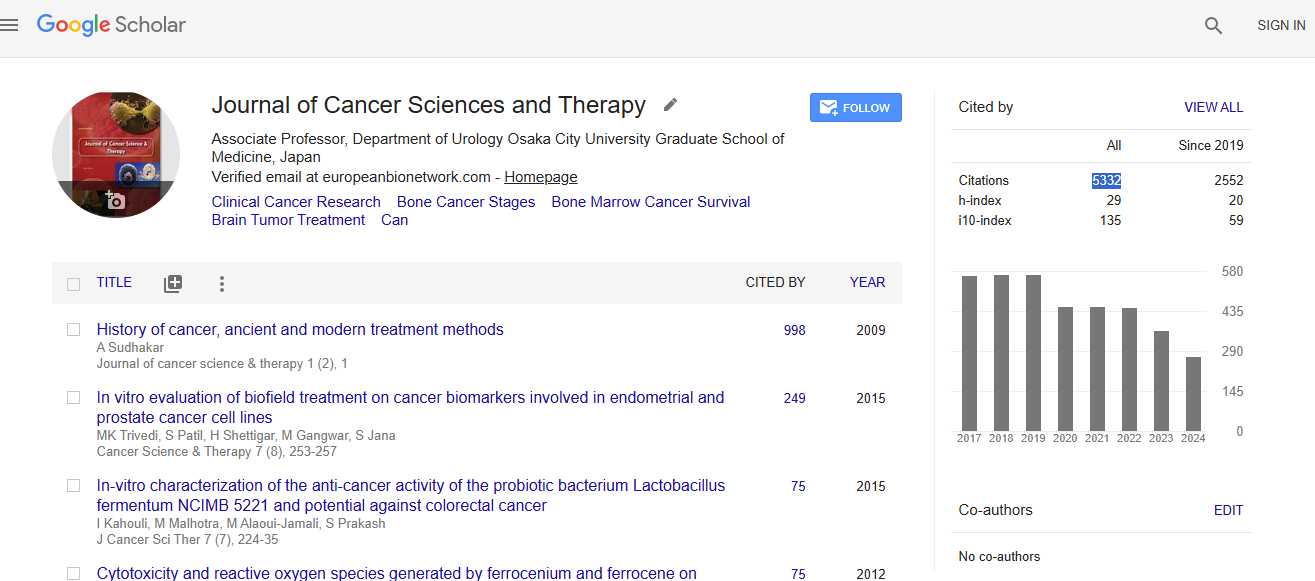
Cancer Science & Therapy received 5332 citations as per Google Scholar report