Opinion - (2025) Volume 15, Issue 5
Received: 02-Oct-2025, Manuscript No. jbbs-25-174254;
Editor assigned: 06-Oct-2025, Pre QC No. P-174254;
Reviewed: 20-Oct-2025, QC No. Q-174254;
Revised: 23-Oct-2025, Manuscript No. R-174254;
Published:
30-Oct-2025
, DOI: 10.37421/2155-9538.2025.15.499
Citation: Miller, Jason. ”Transforming Prosthetics: The Future of Bionic Integration.” J Bioengineer & Biomedical Sci 15 (2025):499.
Copyright: © 2025 Miller J. This is an open-access article distributed under the terms of the Creative Commons Attribution License, which permits unrestricted use, distribution and reproduction in any medium, provided the original author and source are credited.
The field of prosthetics and orthotics is witnessing a transformative era, marked by significant advancements aimed at enhancing the quality of life and functional independence for individuals with limb loss or mobility impairments. Recent research highlights several key areas of innovation, pushing the boundaries of what these devices can achieve. This article explores the evolving landscape of osseointegrated prostheses for amputations, detailing the surgical techniques and clinical outcomes observed in patients. These direct bone-anchored prosthetics offer significant advantages over traditional socket systems, leading to better mobility and quality of life for users. The review highlights the importance of precise surgical placement and postoperative rehabilitation in achieving successful integration and long-term function [1].
This piece delves into neural interfaces, explaining how they enable more intuitive control over advanced prosthetics. By directly connecting with the nervous system, these interfaces are moving us closer to prosthetics that feel like a natural extension of the body, offering a range of possibilities for complex movements and sensory feedback. The authors discuss both current capabilities and future directions for this exciting field [2].
Bionic limbs are transforming what's possible for individuals with limb loss. This article provides an overview of the current state of bionic prosthetics, highlighting advancements in control systems, sensory feedback, and material science. We are moving beyond simple cosmetic or functional devices towards limbs that restore a much higher degree of motor control and tactile sensation, greatly improving user independence and experience [3].
This article reviews the impact of 3D printing in the world of prosthetics and orthotics. This technology enables highly customized, cost-effective, and rapidly produced devices. This flexibility means prosthetics can be perfectly tailored to individual patient anatomy, significantly enhancing comfort, fit, and overall functional outcomes. It also opens doors for new complex designs not feasible with traditional manufacturing [4].
Regenerative medicine plays a vital role in improving prosthetic integration. This paper highlights how techniques like tissue engineering and biomaterial advancements are being used to create better interfaces between the body and implants. We are looking at fostering biological integration and reducing rejection, potentially leading to prosthetics that heal into place and function more like natural limbs, with less discomfort and fewer complications [5].
This systematic review looks at sensory feedback in upper limb prostheses. Adding the ability for users to feel sensations through their prosthesis dramatically improves user experience and functional performance. It makes the device feel more connected to the body, aids in object manipulation, and significantly reduces the cognitive load required to operate the prosthetic limb [6].
This article focuses on the long-term success rates of dental implants. The review consolidates evidence, showing dental implants are a highly reliable and durable solution for tooth replacement, with impressive longevity when properly maintained. This highlights their effectiveness not just for aesthetics but for restoring chewing function and maintaining oral health over many years [7].
This review explores how Artificial Intelligence is being applied in prosthetics and orthotics. AI algorithms can dramatically improve the functionality of these devices, from optimizing fit and design to enabling more adaptive and intuitive control. Devices can learn user patterns, predict movements, and respond in real-time, making them more natural and efficient for daily activities [8].
This article discusses the emerging field of hybrid bionic systems, which combine prosthetics with exoskeletons to boost mobility. Individuals with severe mobility impairments can benefit from devices that not only replace lost limb function but also augment remaining capabilities, offering unprecedented levels of support, strength, and endurance for complex tasks and ambulation [9].
Finally, recent advancements in biomaterials specifically for orthopedic implants are crucial. The crucial insight here is the development of materials that offer better biocompatibility, mechanical properties, and even bioactive capabilities that promote tissue regeneration. This means less inflammation, stronger integration with surrounding bone, and a greater potential for long-term implant success, minimizing revision surgeries [10].
The modern landscape of prosthetics and orthotics is characterized by a dynamic integration of advanced technologies and biological understanding, aiming to significantly improve the lives of individuals requiring artificial limbs or support devices. A major stride has been made with osseointegrated prostheses, which are direct bone-anchored systems for amputations. These offer substantial benefits over conventional socket prosthetics, enhancing user mobility and overall quality of life. Achieving successful, long-term function with these devices hinges on precise surgical techniques and comprehensive postoperative rehabilitation [1]. This development underscores a move towards more stable and naturally integrated prosthetic solutions.
Parallel advancements in control systems and sensory feedback are revolutionizing how users interact with their prostheses. Neural interfaces, for instance, facilitate more intuitive control by directly connecting with the nervous system, bringing us closer to prosthetics that feel like genuine extensions of the body. These interfaces open up a spectrum of possibilities for complex movements and invaluable sensory feedback, with ongoing discussions about their current capabilities and future potential [2]. Bionic limbs, building on these principles, are fundamentally transforming what individuals with limb loss can achieve. Through innovations in control systems, sensory feedback mechanisms, and material science, these bionic devices now offer a much higher degree of motor control and tactile sensation. This translates into greatly improved independence and a richer user experience, moving beyond mere functionality towards true embodiment [3]. Furthermore, the addition of sensory feedback in upper limb prostheses dramatically boosts functional performance and user satisfaction. Enabling users to â??feelâ? through their prosthesis fosters a stronger connection to the device, aids in precise object manipulation, and notably lessens the cognitive effort required for operation [6].
Manufacturing techniques and material science are also playing a pivotal role. The advent of 3D printing in prosthetics and orthotics has been a game-changer, allowing for the rapid production of highly customized and cost-effective devices. This flexibility ensures prosthetics can be perfectly molded to an individualâ??s unique anatomy, leading to superior comfort, fit, and functional outcomes. It also unlocks the potential for intricate designs that were previously impossible with traditional manufacturing methods [4]. Complementing this, regenerative medicine is crucial for enhancing prosthetic integration by focusing on creating better interfaces between the body and implants. Techniques such as tissue engineering and advancements in biomaterials aim to foster biological integration, minimize rejection, and ultimately lead to prosthetics that can heal into place and function more like natural limbs, reducing discomfort and complications [5]. Expanding on this, recent progress in biomaterials for orthopedic implants highlights the development of materials with superior biocompatibility, enhanced mechanical properties, and even bioactive capabilities that actively promote tissue regeneration. This means less inflammation, stronger integration with surrounding bone, and a greater likelihood of long-term implant success, thereby reducing the need for revision surgeries [10].
Looking ahead, advanced technological integrations are pushing the frontiers of prosthetic utility. Artificial Intelligence (AI) algorithms are being increasingly applied in prosthetics and orthotics to optimize device design, fit, and control. AI-driven systems can learn user patterns, predict movements, and respond in real-time, making prosthetics more natural, adaptive, and efficient for daily activities [8]. An exciting development is the emergence of hybrid bionic systems, which combine prosthetics with exoskeletons. These systems are designed to augment mobility for individuals with severe impairments, not only replacing lost limb function but also enhancing remaining capabilities. This offers unprecedented levels of support, strength, and endurance for complex tasks and ambulation, promising a new era of assistive technology [9]. The broader success of implantable devices, such as the impressive long-term outcomes observed with dental implants, further validates the continuous efforts in materials and integration strategies across implant fields. Dental implants consistently demonstrate reliability and durability for tooth replacement, restoring chewing function and maintaining oral health over many years [7]. These collective advancements highlight a future where prosthetics are not just replacements, but integrated, intelligent extensions of the human body.
The landscape of prosthetics is undergoing a remarkable transformation, driven by innovations across several domains. Direct bone-anchored osseointegrated prostheses are emerging as a superior alternative to traditional socket systems, providing better mobility and quality of life through precise surgical placement and rehabilitation. Neural interfaces are another critical advancement, enabling intuitive control over sophisticated prosthetics by directly connecting with the nervous system. This technology moves us closer to devices that feel like natural body extensions, supporting complex movements and sensory feedback. Bionic limbs are fundamentally reshaping possibilities for individuals with limb loss. Advancements in control systems, sensory feedback, and material science mean these prosthetics offer a much higher degree of motor control and tactile sensation, boosting user independence. The role of 3D printing is significant, allowing for the creation of highly customized, cost-effective, and rapidly produced devices, which ensures prosthetics can be perfectly tailored to individual anatomy, improving comfort, fit, and functional outcomes. Regenerative medicine approaches, including tissue engineering and biomaterials, are crucial for enhancing prosthetic integration. The aim is to foster biological integration, reduce rejection, and allow prosthetics to function more like natural limbs, minimizing discomfort and complications. Sensory feedback in upper limb prostheses drastically improves user experience and functional performance. Artificial Intelligence (AI) is optimizing prosthetics from design to adaptive control. AI algorithms learn user patterns, predict movements, and respond in real-time, making devices more natural and efficient. Hybrid bionic systems, combining prosthetics with exoskeletons, further augment mobility for severe impairments, offering unprecedented support and endurance. Finally, advances in biomaterials for orthopedic implants, alongside the proven long-term success of general implants like dental implants, underscore the broader commitment to durable and integrated prosthetic solutions.
None
None
1. Lenneke H, Guido CBdR, Mark RK. "Osseointegrated Prostheses for Amputation: Review of the Surgical Techniques and Clinical Outcomes".Ann Surg 278 (2023):e936-e945.
Indexed at, Google Scholar, Crossref
2. Max O, Christian P, Thomas S. "Neural interfaces for advanced prosthetic control: Current status and future directions".J Neuroengineering Rehabil 20 (2023):70.
Indexed at, Google Scholar, Crossref
3. Dario F, Oskar CA, Levi H. "Bionic limbs: The state of the art in prosthetics and future perspectives".J Neuroengineering Rehabil 18 (2021):119.
Indexed at, Google Scholar, Crossref
4. Haiyan C, Haibo Z, Xiumei L. "3D Printing in Prosthetics and Orthotics: A Review of Current Applications and Future Opportunities".J Mech Behav Biomed Mater 127 (2022):105086.
Indexed at, Google Scholar, Crossref
5. Xiaoxu Z, Yali W, Jun L. "Regenerative Medicine Approaches to Improve Prosthetic Integration and Function".Adv Healthc Mater 12 (2023):e2202688.
Indexed at, Google Scholar, Crossref
6. Sarah ME, Jorge MZ, Salvatore D. "Sensory feedback in upper limb prostheses: A systematic review".J Rehabil Res Dev 57 (2020):1-14.
Indexed at, Google Scholar, Crossref
7. Ammar AH, Ali A, Mustafa A. "Long-Term Outcomes of Dental Implants: A Systematic Review".J Oral Implantol 47 (2021):306-319.
Indexed at, Google Scholar, Crossref
8. Linda R, Marco B, Lorenzo F. "Artificial intelligence in prosthetics and orthotics: A systematic review".J Neuroengineering Rehabil 19 (2022):28.
Indexed at, Google Scholar, Crossref
9. Yen-Tung L, Jongbae P, Dongyoon K. "Hybrid Bionic Systems: Combining Prosthetics and Exoskeletons for Enhanced Mobility".Front Neurorobot 17 (2023):1210433.
Indexed at, Google Scholar, Crossref
10. Rachana M, Neeraj K, Sanat NS. "Recent advances in biomaterials for orthopaedic implants: A review".Mater Sci Eng C Mater Biol Appl 120 (2021):111677.
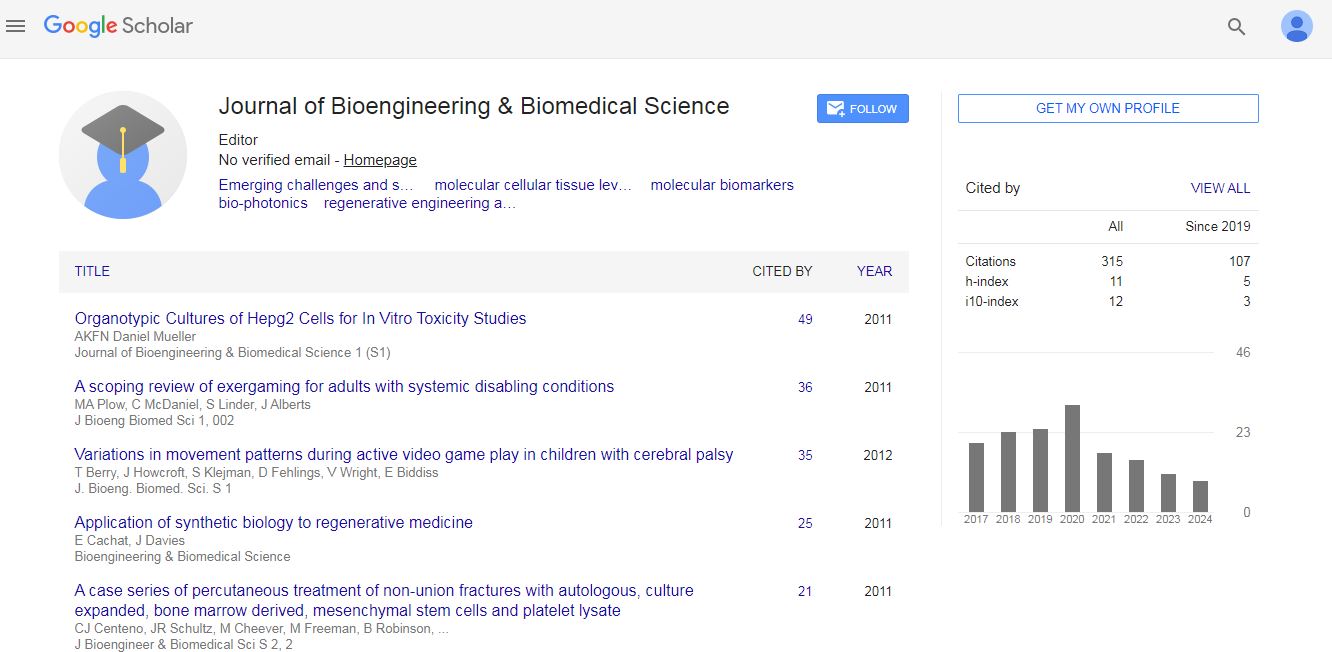
Journal of Bioengineering & Biomedical Science received 307 citations as per Google Scholar report