Opinion - (2025) Volume 12, Issue 4
Received: 01-Aug-2025, Manuscript No. jreac-26-185847;
Editor assigned: 04-Aug-2025, Pre QC No. P-185847;
Reviewed: 18-Aug-2025, QC No. Q-185847;
Revised: 22-Aug-2025, Manuscript No. R-185847;
Published:
29-Aug-2025
, DOI: 10.37421/2380-2391.2025.12.439
Citation: Haddad, Layla. ”Trace Environmental Analysis: Robust Limits and Uncertainty.” J Environ Anal Chem 12 (2025):439.
Copyright: © 2025 Haddad L. This is an open-access article distributed under the terms of the Creative Commons Attribution License, which permits unrestricted use, distribution and reproduction in any medium, provided the original author and source are credited.
The quantification of emerging contaminants in complex environmental matrices, such as wastewater, presents unique analytical challenges. Matrix effects can significantly influence analytical signals, complicating the accurate determination of LODs and the reliable estimation of uncertainty. Addressing these effects through strategic mitigation approaches is essential for ensuring the accuracy of analytical results and supporting robust public health risk assessments. The intricate nature of these samples necessitates a thorough understanding of potential interferences and their impact on analytical performance [3].
Chemometric and multivariate calibration techniques offer sophisticated tools for enhancing the accuracy of trace analyte determination and reducing uncertainty in environmental samples. These advanced statistical methodologies are particularly valuable for setting appropriate detection limits and developing more meaningful uncertainty budgets, especially in scenarios involving the simultaneous assessment of multiple pollutants. Their application allows for a more nuanced understanding of complex analytical data and improved confidence in the reported results [4].
The concept of expanded uncertainty is fundamental to the reporting and interpretation of analytical results in environmental chemistry. A clear understanding of how to calculate and express expanded uncertainty is vital for comparing measured values against regulatory limits and for making sound decisions concerning environmental management. The paper emphasizes that a comprehensive appreciation of all sources of variation that affect detection limits is a prerequisite for accurate uncertainty reporting [5].
Moving beyond simply detecting analytes, establishing reliable quantification limits (LOQs) is crucial, particularly for legally defensible environmental data. The determination of LOQs, alongside LODs, requires rigorous validation studies to minimize uncertainty in trace analysis. These validation processes provide essential insights into method performance and are critical for ensuring the reliability of quantitative measurements in environmental monitoring [6].
Calibration strategies significantly influence the accuracy of low-level measurements and the subsequent estimation of uncertainty in environmental analysis. Exploring various calibration models, including linear and non-linear approaches, and employing techniques like weighted regression and the use of certified reference materials, can substantially improve the reliability of LODs and the overall analytical performance. The choice of calibration method directly impacts the confidence one can place in the analytical results [7].
Determining detection limits and estimating uncertainty for specific classes of compounds, such as volatile organic compounds (VOCs) in air samples, present specialized challenges. The influence of sampling techniques, sample storage conditions, and the intricacies of analytical instrumentation can all affect the final reported values and their associated uncertainties. This highlights the need for tailored approaches and a deep understanding of the factors unique to VOC analysis in environmental matrices [8].
Quality control (QC) samples, including blanks, spiked samples, and certified reference materials, play an indispensable role in establishing robust detection limits and accurately assessing analytical uncertainty. A well-defined framework for integrating QC data into the overall uncertainty budget enhances the credibility and reliability of trace environmental analysis, ensuring that results are both accurate and defensible [9].
Advanced statistical methods like Monte Carlo simulations offer a powerful and practical approach for estimating the uncertainty in trace environmental measurements. This technique excels at propagating uncertainties from diverse sources, yielding a more comprehensive and realistic assessment of the overall measurement uncertainty. Such robust uncertainty estimations are fundamental for establishing reliable detection limits and instilling confidence in analytical data [10].
The critical aspects of establishing and validating detection limits (LODs) and estimating measurement uncertainty in trace environmental analysis are thoroughly examined, emphasizing their profound importance for the reliable interpretation of analytical data. The review highlights common pitfalls associated with traditional LOD calculation methods and advocates for the adoption of modern statistical approaches to achieve more robust uncertainty assessments. Such rigorous assessment is indispensable for regulatory compliance and effective risk evaluation within environmental monitoring programs, ensuring that decisions are based on sound scientific evidence [1].
Practical considerations for achieving ultra-low detection limits in environmental analysis, particularly for challenging analytes like persistent organic pollutants, are explored through the lens of instrumental methods. The paper elucidates how critical steps such as method optimization, meticulous sample preparation techniques, and precise instrument calibration directly influence the achievable LODs. Furthermore, it details the subsequent impact on the uncertainty of reported concentrations, underscoring the imperative need for the development and adherence to standardized analytical protocols to ensure comparability and reliability of results across different laboratories and studies [2].
This study specifically investigates the inherent uncertainty associated with the quantification of emerging contaminants within complex environmental matrices, such as wastewater samples. It thoroughly delineates the challenges posed by matrix effects, which can significantly alter analytical signals and compromise accuracy. The research proposes and discusses effective strategies for mitigating these matrix effects, aiming to ensure precise LOD determination and dependable uncertainty estimations. These efforts are crucial for the accurate assessment of public health risks associated with environmental contamination [3].
The application of chemometrics and advanced multivariate calibration techniques is explored as a means to significantly enhance the accuracy of trace analyte determination and effectively reduce measurement uncertainty in environmental samples. The utility of these sophisticated statistical tools is critically examined in the context of setting appropriate detection limits and providing more meaningful and comprehensive uncertainty budgets. This is particularly relevant for scenarios involving the complex assessment of multi-component pollution, where interferences and synergistic effects can complicate analysis [4].
This review places a strong emphasis on the concept of expanded uncertainty and its proper reporting within the field of environmental analytical chemistry. It provides a detailed exposition of the methods required for both the calculation and the clear expression of expanded uncertainty. The paper stresses that this metric is vital for enabling meaningful comparisons of analytical results with established regulatory limits and for facilitating informed decision-making processes related to environmental management strategies. A deep understanding of all sources of variation affecting detection limits is highlighted as a fundamental requirement [5].
The article addresses the practical complexities and outlines best practices for determining the limit of quantification (LOQ) in conjunction with the detection limit, with a particular focus on ensuring the legal defensibility of environmental data. It emphasizes the critical role of well-designed validation studies in establishing reliable LOQs and systematically minimizing uncertainty in trace analysis. The work offers valuable insights and practical guidance on robust method validation protocols essential for regulatory compliance and accurate reporting [6].
An evaluation of the impact that different calibration strategies have on the accuracy of low-level measurements and the subsequent estimation of uncertainty in environmental analysis is presented. The paper delves into various calibration models, including linear and non-linear approaches, and discusses the merits of techniques such as weighted regression. It also examines the use of certified reference materials as a means to enhance the reliability of detection limits and the overall analytical performance, providing a comparative analysis of different calibration methodologies [7].
This article addresses the specific and often significant challenges encountered when determining detection limits and estimating uncertainty for volatile organic compounds (VOCs) within air samples collected for environmental monitoring. It meticulously discusses the profound influence that various factors, including different sampling techniques, sample storage durations, and the specific characteristics of analytical instrumentation, can exert on the final reported values and their associated uncertainties. This underscores the necessity for specialized analytical approaches tailored to the unique properties of VOCs [8].
The crucial role of quality control (QC) samples, encompassing a range of essential types such as blanks, spiked samples, and certified reference materials, is thoroughly explored. These QC measures are fundamental for establishing robust and defensible detection limits and for accurately assessing overall analytical uncertainty. The paper proposes a clear framework for the systematic integration of QC data into the comprehensive uncertainty budget, thereby significantly enhancing the credibility and reliability of trace environmental analysis performed across the discipline [9].
The application of Monte Carlo simulations for the estimation of uncertainty in trace environmental measurements is examined. This powerful statistical approach is presented as a practical tool for effectively propagating uncertainties originating from multiple diverse sources. By doing so, it facilitates a more comprehensive and realistic assessment of the overall measurement uncertainty, providing a robust foundation for the establishment of reliable detection limits and instilling greater confidence in the analytical data generated [10].
This collection of research addresses the critical importance of accurately determining detection limits (LODs) and estimating measurement uncertainty in trace environmental analysis. It highlights the limitations of traditional methods and promotes modern statistical approaches for more robust assessments, essential for regulatory compliance and risk evaluation. The studies cover instrumental method optimization, addressing matrix effects in complex samples, and the application of chemometrics. They also detail the reporting of expanded uncertainty, the establishment of quantification limits, the impact of calibration strategies, and specific challenges in analyzing volatile organic compounds. The role of quality control samples and advanced techniques like Monte Carlo simulations are emphasized for enhancing data reliability and ensuring defensible environmental measurements.
None
None
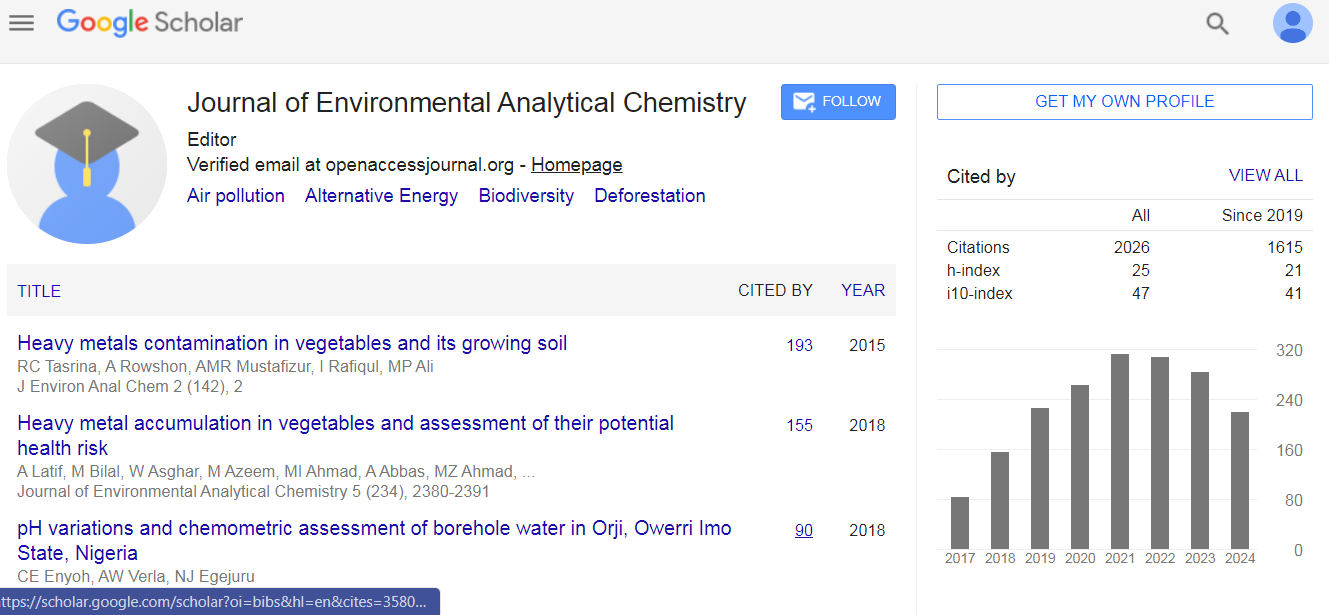
Journal of Environmental Analytical Chemistry received 1781 citations as per Google Scholar report