Perspective - (2025) Volume 11, Issue 2
Received: 02-May-2025, Manuscript No. jotr-25-175576;
Editor assigned: 05-May-2025, Pre QC No. P-175576;
Reviewed: 19-May-2025, QC No. Q-175576;
Revised: 23-May-2025, Manuscript No. R-175576;
Published:
30-May-2025
, DOI: 10.37421/2476-2261. 2025.11.306
Citation: Mbali, Sarah. ”TME: Overcoming Resistance, Improving Cancer Treatment.” J Oncol Transl Res 11 (2025):306.
Copyright: © 2025 Mbali S. This is an open-access article distributed under the terms of the Creative Commons Attribution License, which permits unrestricted use, distribution and reproduction in any medium, provided the original author and source are credited.
This article delves into the complex role of the tumor microenvironment (TME) in pancreatic cancer, highlighting how its unique immunosuppressive nature limits the efficacy of current immunotherapies. It discusses various cellular and molecular components within the TME, such as cancer-associated fibroblasts and myeloid-derived suppressor cells, and proposes novel strategies to remodel this environment to enhance therapeutic responses[1].
This paper investigates the intricate interplay between colorectal cancer cells and their surrounding microenvironment, emphasizing its pivotal role in tumor progression and therapeutic resistance. It outlines current strategies and future prospects for targeting various components of the tumor microenvironment, including immune cells and stromal cells, to develop more effective treatments for colorectal cancer[2].
The article comprehensively reviews the multifaceted nature of the tumor microenvironment (TME) in glioblastoma, a highly aggressive brain cancer. It discusses how the TME contributes to its resistance to conventional therapies, and explores novel therapeutic strategies aimed at modulating key TME components, such as immune cells and angiogenesis, to improve patient outcomes[3].
This paper highlights the critical role of the tumor microenvironment in dictating the success or failure of immunotherapy in pancreatic cancer. It details the various immunosuppressive elements within the TME, such as dense stroma and suppressive immune cells, and discusses emerging strategies to overcome these barriers, paving the way for more effective immunotherapeutic approaches[4].
This review summarizes the latest progress in therapeutic strategies that target components of the tumor microenvironment to combat cancer. It covers a broad spectrum of targets, including stromal cells, immune cells, and signaling pathways, and highlights how understanding these interactions can lead to the development of innovative and more effective anti-cancer treatments[5].
This article focuses on strategies for remodeling the tumor microenvironment to improve the efficacy of cancer therapies. It discusses various approaches, including immunotherapy and targeted therapies, that aim to convert the immunosuppressive TME into an immune-supportive one, thereby enhancing anti-tumor responses and overcoming drug resistance[6].
The authors examine the critical components of the tumor microenvironment (TME) in prostate cancer and their contributions to tumor progression, metastasis, and resistance to therapy. The paper explores various therapeutic strategies that specifically target TME elements, such as immune cells and growth factors, aiming to improve treatment outcomes for prostate cancer patients[7].
This paper explores the crucial role of the tumor microenvironment (TME) in the pathogenesis and progression of hepatocellular carcinoma (HCC). It discusses the key cellular and non-cellular components of the HCC TME and proposes that targeting these elements offers a promising avenue for developing novel molecular therapies to overcome therapeutic resistance and improve patient survival[8].
This review focuses on the strategies for precisely targeting the tumor microenvironment to enhance the efficacy of immunotherapy. It discusses various cellular and molecular targets within the TME that contribute to immune suppression and resistance, highlighting how tailored interventions can overcome these barriers and improve patient responses to immune checkpoint blockade and other immunotherapies[9].
This article comprehensively reviews how the tumor microenvironment (TME) acts as a significant contributor to drug resistance in various cancers. It elucidates the diverse mechanisms by which TME components, including stromal cells, extracellular matrix, and signaling molecules, protect cancer cells from therapeutic agents, offering insights into potential strategies to overcome this formidable challenge[10].
The tumor microenvironment (TME) represents a pivotal battleground in the fight against cancer, profoundly influencing disease progression, metastasis, and, critically, the efficacy of therapeutic interventions. Across a spectrum of malignancies, including pancreatic cancer, colorectal cancer, glioblastoma, prostate cancer, and hepatocellular carcinoma, the TME's complex nature dictates clinical outcomes. In pancreatic cancer, its notably immunosuppressive characteristics significantly impede the effectiveness of current immunotherapies [1]. This intricate interplay is not unique, as the TME also plays a central role in tumor progression and the development of therapeutic resistance in colorectal cancer [2]. Similarly, for highly aggressive brain cancers like glioblastoma, the TME is a known contributor to resistance against conventional treatments, posing a substantial challenge for patient care [3].
Detailed investigations into the TME reveal a diverse ecosystem of cellular and molecular components that collectively promote tumor growth and confer protection upon cancer cells. Key elements identified include cancer-associated fibroblasts and myeloid-derived suppressor cells, which are particularly active in the pancreatic cancer TME [1]. This hostile environment, characterized by dense stroma and suppressive immune cells, is a primary factor dictating the success or failure of immunotherapy in pancreatic cancer [4]. Furthermore, a comprehensive review underscores that the TME, through its stromal cells, extracellular matrix, and various signaling molecules, acts as a significant contributor to widespread drug resistance across numerous cancer types [10].
The profound challenges posed by the TME necessitate innovative therapeutic strategies. A primary focus involves directly targeting specific TME components to disrupt their pro-tumor functions. For colorectal cancer, current strategies and future prospects emphasize targeting immune cells and stromal cells to develop more effective treatments [2]. In glioblastoma, research explores novel therapeutic strategies aimed at modulating key TME elements like immune cells and angiogenesis to improve patient outcomes [3]. Similarly, studies on prostate cancer pinpoint critical TME components, such as immune cells and growth factors, as promising targets to enhance treatment efficacy for patients [7].
Beyond merely targeting existing components, another powerful therapeutic approach centers on remodeling the tumor microenvironment. This involves various strategies, including immunotherapy and targeted therapies, designed to fundamentally alter the TME from an immunosuppressive state to one that is immune-supportive [6]. Such remodeling efforts are crucial for enhancing anti-tumor responses and overcoming drug resistance, thereby improving the overall effectiveness of treatments. Specifically, precision immunotherapy focuses on accurately targeting cellular and molecular elements within the TME that contribute to immune suppression and resistance, aiming to overcome these barriers and bolster patient responses to immune checkpoint blockade and other forms of immunotherapy [9].
Recent advancements summarize the significant progress in therapeutic strategies that specifically target components of the tumor microenvironment to combat cancer [5]. These strategies cover a broad spectrum, from stromal cells and immune cells to complex signaling pathways, emphasizing that a deep understanding of these intricate interactions is paramount for developing innovative and more effective anti-cancer treatments. The exploration of the TME's role in hepatocellular carcinoma (HCC) highlights that targeting its key cellular and non-cellular components offers a promising avenue for novel molecular therapies, vital for overcoming therapeutic resistance and improving patient survival [8]. The concerted efforts to manipulate and understand the TME signify a promising frontier in cancer research, holding the potential to revolutionize how we approach and treat this complex disease, leading to more potent and lasting benefits for patients.
The tumor microenvironment (TME) plays a critical, multifaceted role in various cancers, including pancreatic cancer, colorectal cancer, glioblastoma, prostate cancer, and hepatocellular carcinoma. It significantly influences tumor progression, metastasis, and, critically, resistance to conventional and emerging therapies like immunotherapy. The TME is a complex ecosystem composed of various cellular and molecular components such as cancer-associated fibroblasts, myeloid-derived suppressor cells, immune cells, stromal cells, extracellular matrix, and signaling molecules. Research consistently highlights the TME's immunosuppressive nature, especially in aggressive cancers like pancreatic cancer, which severely limits the effectiveness of immunotherapeutic approaches. This is due to elements like dense stroma and suppressive immune cells. The collective body of work emphasizes that understanding and modulating these intricate interactions within the TME is essential for developing more effective anti-cancer treatments. Numerous strategies are being explored to target and remodel the TME. These approaches aim to convert an immunosuppressive environment into an immune-supportive one, thereby enhancing anti-tumor responses, overcoming drug resistance, and improving patient outcomes. This includes precision immunotherapy, targeting specific TME elements such as immune cells, angiogenesis, and growth factors, as well as broader strategies to disrupt the TME's protective mechanisms. The overarching goal across these studies is to overcome therapeutic resistance and improve patient survival by strategically intervening in the TME. Efforts are focused on developing innovative and tailored interventions that consider the unique characteristics of the TME in different cancer types to pave the way for more potent and durable therapeutic responses.
None
None
Chunlei M, Jian W, Jiajing W. "Immunotherapy in pancreatic cancer: targeting the tumor microenvironment.".Signal Transduct Target Ther 8 (2023):236.
Indexed at, Google Scholar, Crossref
Xing F, Yong D, Xu W. "Targeting the tumor microenvironment in colorectal cancer: a new therapeutic approach.".Mol Cancer 22 (2023):147.
Indexed at, Google Scholar, Crossref
Nayoung K, Jing H, Peichen Y. "Targeting the Tumor Microenvironment in Glioblastoma.".Front Oncol 12 (2022):914040.
Indexed at, Google Scholar, Crossref
Vivek S, Neha S, Aditya G. "Tumor Microenvironment: A Key Player in Pancreatic Cancer Immunotherapy.".Cells 11 (2022):3452.
Indexed at, Google Scholar, Crossref
Wei Z, Xiaolu L, Yang M. "Recent advances in targeting the tumor microenvironment for cancer therapy.".Chin J Cancer Res 34 (2022):588-601.
Indexed at, Google Scholar, Crossref
Fan W, Huizhi Y, Haoran W. "Tumor Microenvironment Remodeling in Cancer Therapy.".Curr Gene Ther 21 (2021):457-466.
Indexed at, Google Scholar, Crossref
Jordy G, Gloria F, Raffaella D. "Targeting the tumor microenvironment in prostate cancer.".Int J Mol Sci 22 (2021):11466.
Indexed at, Google Scholar, Crossref
Jian C, Fang L, Jing S. "Tumor microenvironment in hepatocellular carcinoma: a promising target for molecular therapy.".Signal Transduct Target Ther 5 (2020):299.
Indexed at, Google Scholar, Crossref
Wei T, Jian C, Keqing D. "Targeting the tumor microenvironment for precision immunotherapy.".Signal Transduct Target Ther 5 (2020):260.
Indexed at, Google Scholar, Crossref
Cong Z, Weiqi Z, Hanqing N. "The tumor microenvironment contributes to drug resistance in cancer.".Pharmacol Ther 224 (2021):107830.
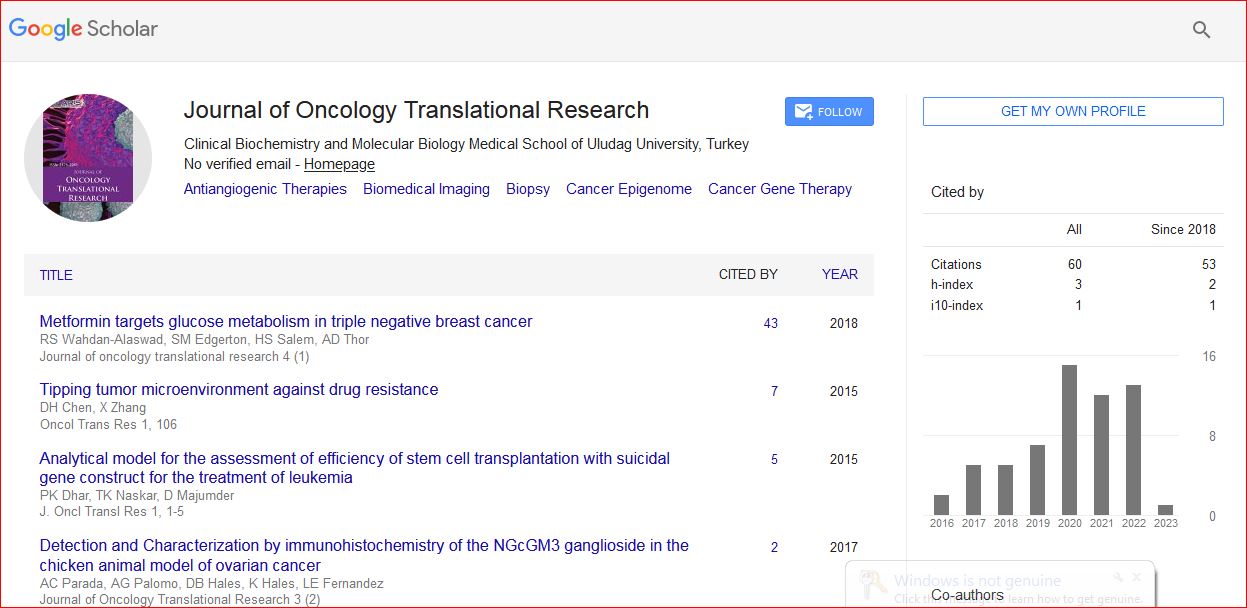
Journal of Oncology Translational Research received 93 citations as per Google Scholar report