Short Communication - (2025) Volume 16, Issue 2
Received: 03-Mar-2025, Manuscript No. jch-26-178752;
Editor assigned: 05-Mar-2025, Pre QC No. P-178752;
Reviewed: 19-Mar-2025, QC No. Q-178752;
Revised: 24-Mar-2025, Manuscript No. R-178752;
Published:
31-Mar-2025
, DOI: 10.37421/2157-7099.2025.16.790
Citation: Xiu, Chen. ”Tissue Fixation: Boosting Diagnostic Accuracy.” J Cytol Histol 16 (2025):790.
Copyright: © 2025 Xiu C. This is an open-access article distributed under the terms of the Creative Commons Attribution License, which permits unrestricted use, distribution and reproduction in any medium, provided the original author and source are credited.
Recent advancements in tissue fixation and processing are significantly improving diagnostic accuracy in both cytology and histology. Innovations in chemical fixatives, including improved formaldehyde-based solutions and novel cross-linking agents, are enhancing cellular morphology and antigen preservation, leading to more precise diagnoses. Automated tissue processing systems are also playing a crucial role by reducing processing time and variability, which in turn leads to more consistent and reliable results for pathologists. Emerging techniques, such as microwave-assisted fixation and processing, alongside rapid staining methods, are particularly beneficial for urgent cases, enabling faster turnaround times without compromising diagnostic quality. Furthermore, the integration of digital imaging and advanced staining techniques is further refining the analytical capabilities of histological examination, paving the way for more comprehensive insights [1].
Optimizing tissue fixation is fundamentally crucial for preserving the integrity of cellular structures and biomolecules, which directly impacts the effectiveness of immunohistochemistry and molecular pathology. New fixative formulations are continuously being developed to minimize antigen masking and degradation, thereby improving the sensitivity and specificity of diagnostic assays employed in laboratories worldwide. Automated tissue processors, offering precise control over vital steps like dehydration, clearing, and infiltration, are increasingly becoming standard in many modern laboratories. These sophisticated systems ensure a high degree of reproducibility and significantly reduce the hands-on time required for sample preparation, allowing skilled histotechnologists to dedicate their attention to more complex tasks. The ongoing quest for faster and more effective fixation methods is primarily driven by the critical need for rapid diagnosis in time-sensitive clinical settings [2].
The development of novel fixatives is actively aimed at overcoming the inherent limitations of traditional formalin, particularly concerning antigenicity and the preservation of nucleic acids, which are vital for molecular studies. Techniques such as modified zinc fixation and various alcohol-based fixatives are showing considerable promise in improving the quality of biomolecular targets within tissue samples. Automation in tissue processing continues its rapid advancement, with integrated systems now capable of handling multiple steps from initial fixation through to the final embedding process. This not only increases overall efficiency but also profoundly standardizes the entire process, thereby reducing inter-laboratory and intra-laboratory variability, which is crucial for consistent diagnostic outcomes. The impact of these refinements on downstream analyses, including advanced molecular diagnostics, represents a key area of ongoing research and development [3].
Rapid tissue processing techniques are of paramount importance for urgent surgical pathology, especially for intraoperative consultations where timely results are critical for patient management. Microwave-assisted fixation and processing, in particular, offer significant time savings by dramatically accelerating chemical reactions and improving the penetration of reagents into the tissue. When properly optimized, these methods can yield high-quality histological slides that exhibit well-preserved morphology, crucial for accurate diagnosis. The primary challenge in this area lies in effectively balancing the need for speed with the imperative of maintaining diagnostic accuracy and minimizing potential artifacts that could arise from rapid processing. Continued research focused on optimizing microwave parameters and fixative compositions is therefore crucial for their widespread adoption and reliable application in clinical practice. This area of investigation is absolutely vital for improving patient management in scenarios where time is a critical factor [4].
The preservation of RNA and DNA integrity during tissue processing is absolutely paramount for the success of molecular diagnostics, a rapidly expanding field in modern medicine. Traditional formalin fixation, while effective for morphology, can unfortunately lead to significant nucleic acid degradation, thereby negatively impacting the reliability and interpretability of downstream analyses. Newer fixation methods, such as the use of RNA-later and various combinations of alcohols and cross-linkers, are actively being investigated and refined to improve both RNA and DNA yields from tissue samples. Furthermore, automated embedding machines and microtomes are also subjects of continuous improvement, with a strong focus on enhancing precision and ensuring user safety during operation. These incremental yet significant advancements in the pre-analytical phase contribute to a more streamlined and inherently more reliable workflow, from the initial biopsy acquisition to the final diagnostic report [5].
Standardization of tissue fixation and processing protocols is a critical requirement for ensuring inter-laboratory consistency and maintaining high standards of quality assurance in histopathology. Concerted efforts are currently underway to develop and rigorously validate new protocols that are not only robust and reproducible but also adaptable to a wide range of tissue types and diverse diagnostic needs. Automated systems are playing a pivotal role in achieving this essential standardization by effectively minimizing human error and ensuring consistent processing parameters across different batches and laboratories. The use of decalcification agents, which often represent a significant bottleneck in the processing of bone tissue, is also an active area of research, with a focus on developing faster and less destructive agents that preserve tissue integrity [6].
The advent of novel fixatives, such as zinc formalin, has provided a valuable alternative to traditional formaldehyde fixation, offering notable advantages in terms of improved antigen and nucleic acid preservation. These alternative fixatives can significantly enhance the quality of staining for immunohistochemistry, leading to clearer and more reliable results, and also improve the yield of high-quality RNA essential for comprehensive molecular analysis. Automated tissue processors, with their precise control over reagent delivery and processing times, make a substantial contribution to the reproducibility of these advanced fixation techniques. The seamless integration of these automated technologies with novel fixation methods streamlines the overall workflow and demonstrably improves diagnostic efficiency in pathology laboratories [7].
Advances in tissue processing extend beyond mere speed and automation; they also encompass significant improvements in embedding media and sectioning techniques, which are fundamental steps in preparing tissue for microscopic examination. The development of specialized embedding resins is crucial for enhancing the cutting properties of challenging tissues and for improving the quality of ultrathin sections required for electron microscopy. Sophisticated microtomes equipped with advanced features further contribute to the precision and accuracy of tissue sectioning. These incremental yet impactful improvements in the pre-analytical phase of tissue preparation have a cascading positive effect on the overall accuracy and reliability of both cytological and histological diagnoses, ultimately benefiting patient care [8].
The integration of artificial intelligence (AI) and machine learning (ML) with digital pathology workflows is fundamentally transforming the landscape of tissue analysis. While these advanced computational technologies are not directly fixation or processing techniques themselves, they rely heavily on the availability of high-quality, consistently prepared histological slides to function effectively. Advances in fixation and processing are therefore essential as they ensure that the morphological and molecular information captured within these slides is optimal for AI algorithms, leading to more accurate and efficient diagnostic interpretations. This crucial synergy between meticulous pre-analytical preparation and sophisticated computational analysis represents a defining hallmark of modern pathology practice [9].
Quality control (QC) in tissue fixation and processing is not a static endpoint but rather an ongoing, dynamic process that requires continuous attention and refinement. Implementing rigorous quality assurance (QA) measures, including regular proficiency testing and the adherence to standardized operating procedures, is absolutely vital for ensuring the consistent reliability and accuracy of diagnostic results derived from tissue samples. Innovations in automation and the development of novel fixatives are making significant contributions to improved quality control by effectively reducing inherent variability associated with manual processes. The continuous evaluation and refinement of these critical techniques are therefore essential for maintaining the highest possible standards in the fields of cytopathology and histology [10].
Recent scientific endeavors have concentrated on enhancing tissue fixation and processing techniques to elevate diagnostic precision in cytology and histology. Innovations in chemical fixatives, such as refined formaldehyde solutions and novel cross-linking agents, demonstrably improve cellular morphology and antigen preservation, crucial for accurate interpretation. Automated tissue processing systems are pivotal in reducing processing times and minimizing variability, thereby yielding more consistent and dependable results. Emerging methodologies, including microwave-assisted fixation and rapid staining, are particularly advantageous for urgent diagnostic scenarios, expediting turnaround times without compromising diagnostic quality. The incorporation of digital imaging alongside advanced staining techniques further refines the analytical capabilities of histological examination, enriching diagnostic insights [1].
Optimizing tissue fixation is fundamentally critical for maintaining the structural integrity of cells and preserving biomolecules, which directly influences the outcomes of immunohistochemistry and molecular pathology. Novel fixative formulations are being engineered to mitigate antigen masking and degradation, thereby boosting the sensitivity and specificity of diagnostic assays. Automated tissue processors, which offer meticulous control over dehydration, clearing, and infiltration, are becoming indispensable in many laboratories. These automated systems guarantee reproducibility and decrease the manual labor involved in sample preparation, allowing histotechnologists to focus on more demanding analytical tasks. The persistent drive for accelerated and more efficacious fixation methods is largely propelled by the clinical imperative for rapid diagnostic capabilities [2].
The development of innovative fixatives aims to address the limitations inherent in traditional formalin, especially concerning antigenicity and the preservation of nucleic acids. Techniques like modified zinc fixation and alcohol-based fixatives are demonstrating significant potential in enhancing the quality of biomolecular targets. Automation in tissue processing continues to evolve, featuring integrated systems capable of managing multiple stages from fixation to embedding. This not only boosts operational efficiency but also standardizes the procedure, reducing variations within and between laboratories. The downstream effects of these improvements on analyses, including molecular diagnostics, constitute a vital domain of current research [3].
Rapid tissue processing techniques are indispensable for critical applications such as urgent surgical pathology and intraoperative consultations. Microwave-assisted fixation and processing offer substantial time efficiencies by accelerating chemical reactions and tissue reagent penetration. These methods, when precisely optimized, can produce high-quality histological slides with well-preserved morphology. The key challenge involves balancing speed with diagnostic accuracy and minimizing potential artifacts. Ongoing research to refine microwave parameters and fixative compositions is vital for broader clinical adoption, offering significant benefits in time-sensitive patient care scenarios [4].
Preserving the integrity of RNA and DNA during tissue processing is of utmost importance for molecular diagnostics. Conventional formalin fixation can compromise nucleic acid quality, impacting subsequent analyses. Emerging fixation methods, including RNA-later and various alcohol and cross-linker combinations, are under active investigation to enhance RNA and DNA yields. Concurrently, automated embedding machines and microtomes are undergoing continuous refinement to improve precision and user safety. These advancements collectively contribute to a more efficient and reliable workflow, spanning from biopsy to definitive diagnosis [5].
Standardization of tissue fixation and processing protocols is essential for ensuring consistency across laboratories and for robust quality assurance. Significant efforts are directed towards creating and validating new protocols that are reliable, reproducible, and adaptable to diverse tissue types and diagnostic requirements. Automated systems are instrumental in achieving this standardization by minimizing human error and ensuring uniform processing parameters. The application of decalcification agents, often a procedural bottleneck for bone tissues, is also a focus of research aiming for faster and less tissue-damaging alternatives [6].
The introduction of novel fixatives, such as zinc formalin, presents a viable alternative to conventional formaldehyde, offering enhanced preservation of both antigens and nucleic acids. These fixatives can improve the quality of immunohistochemical staining and increase the yield of high-quality RNA for molecular analyses. Automated tissue processors, with their capacity for precise control over reagent delivery and processing durations, enhance the reproducibility of these advanced fixation methods. The synergistic integration of these technologies streamlines laboratory workflows and boosts diagnostic efficiency [7].
Progress in tissue processing encompasses not only speed and automation but also enhancements in embedding media and sectioning techniques. The development of specialized embedding resins can improve the cutting characteristics of difficult tissues and yield higher quality ultrathin sections for electron microscopy. Advanced microtomes with sophisticated features contribute to greater precision in tissue sectioning. These cumulative improvements in the pre-analytical phase positively influence the overall accuracy and reliability of cytological and histological diagnoses [8].
The integration of artificial intelligence and machine learning within digital pathology workflows is fundamentally revolutionizing tissue analysis. Although not direct fixation or processing techniques, these technologies necessitate high-quality, consistently prepared histological slides. Advances in fixation and processing ensure that morphological and molecular information captured in slides is optimized for AI algorithms, leading to more accurate and efficient diagnostic interpretations. This synergistic relationship between pre-analytical preparation and computational analysis is a defining characteristic of contemporary pathology [9].
Quality control in tissue fixation and processing is an essential, continuous undertaking. Implementing stringent quality assurance measures, including proficiency testing and standardized operating procedures, is crucial for guaranteeing the dependability of diagnostic outcomes. Innovations in automation and the development of new fixatives contribute to improved quality control by reducing inherent variability. Ongoing evaluation and refinement of these techniques are indispensable for upholding high standards in cytopathology and histology [10].
Recent advancements in tissue fixation and processing are significantly enhancing diagnostic accuracy in cytology and histology. Innovations include improved chemical fixatives, automated processing systems, and rapid techniques like microwave-assisted fixation. These developments lead to better cellular morphology and antigen preservation, reduced processing time, and more consistent results. Novel fixatives are addressing limitations of traditional formalin, improving biomolecule preservation for molecular diagnostics. Automation plays a key role in standardization and efficiency. Rapid processing is vital for urgent cases, while advancements in embedding and sectioning improve sample quality. The integration with digital pathology and AI highlights the importance of high-quality tissue preparation. Continuous quality control and assurance are essential to maintain high standards in the field.
None
None
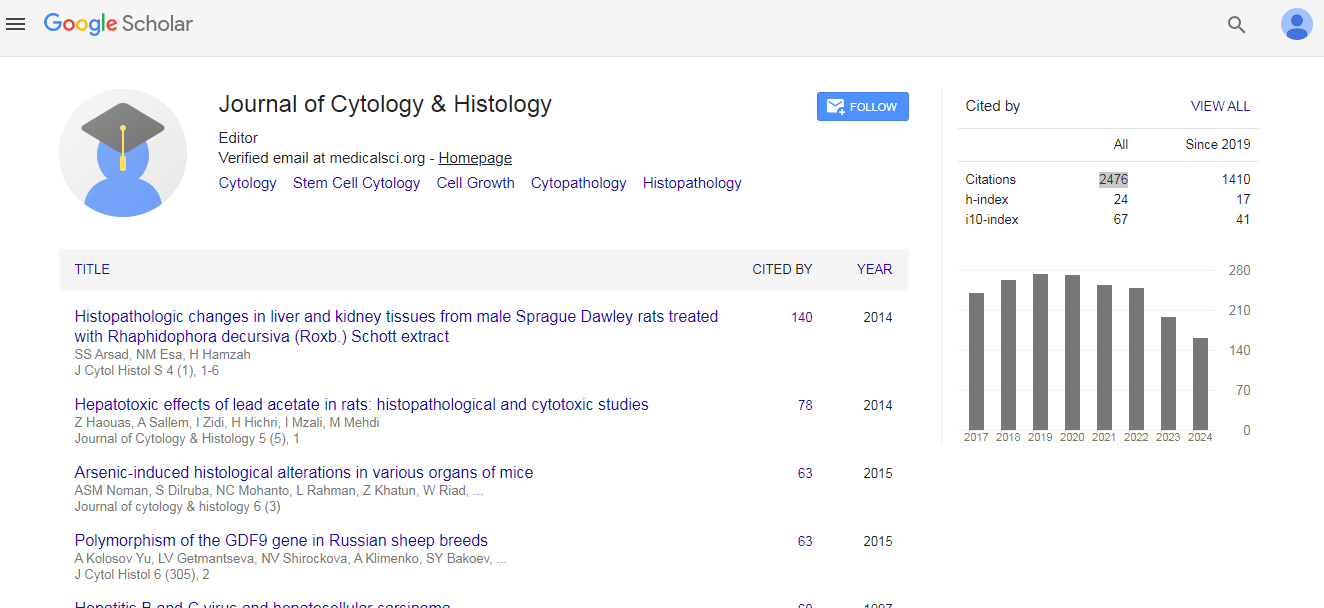
Journal of Cytology & Histology received 2476 citations as per Google Scholar report