Commentary - (2025) Volume 11, Issue 5
Received: 02-Sep-2025, Manuscript No. ohcr-25-174310;
Editor assigned: 04-Sep-2025, Pre QC No. P-174310;
Reviewed: 18-Sep-2025, QC No. Q-174310;
Revised: 23-Sep-2025, Manuscript No. R-174310;
Published:
30-Sep-2025
, DOI: 10.37421/2471-8726.2025.11.210
Citation: Voronina, Elena. ”Third Molar Management: Challenges, Risks and Care.” Oral Health Case Rep 11 (2025):210.
Copyright: © 2025 Voronina E. This is an open-access article distributed under the terms of the Creative Commons Attribution License, which permits unrestricted use, distribution and reproduction in any medium, provided the original author and source are credited.
The management of third molars, commonly known as wisdom teeth, is a cornerstone of oral and maxillofacial surgery, encompassing a wide array of clinical considerations and challenges. These procedures, while often routine, are not immune to broader global health events. For instance, the COVID-19 pandemic severely disrupted third molar surgery, resulting in a noticeable decrease in procedures and a re-evaluation of surgical priorities across most departments [1].
This shift meant a greater focus on emergency cases and the management of severe infections, with elective wisdom tooth extractions frequently postponed. Such an experience highlights the profound impact global health crises can have on even well-established dental care and surgical practices. Beyond pandemic-related disruptions, the very nature of third molar extractions carries inherent risks that demand meticulous attention. Nerve injuries, particularly following lower third molar extractions, are a recognized albeit relatively rare complication [2].
Insights into the incidence of such injuries underscore the critical need for careful preoperative assessment. This is especially true when considering the close proximity of the wisdom tooth to vital structures like the inferior alveolar nerve. Acknowledging these potential risks is fundamental for effective patient counseling and robust surgical planning. Furthermore, a persistent point of discussion in the field revolves around the decision to remove asymptomatic impacted mandibular third molars [3].
A comprehensive review of the arguments surrounding this practice considers various factors. These include the potential for future pathologies such as cysts, tumors, or caries, as well as the risk of periodontal complications affecting adjacent teeth, alongside the general risks associated with the surgical procedure itself. The prevailing consensus emphasizes the importance of individualized patient assessment, moving away from a blanket prophylactic extraction strategy. Once a decision for extraction is made, patient comfort, particularly pain management after wisdom tooth surgery, becomes critical [4].
A systematic review and network meta-analysis has evaluated the effectiveness of diverse oral analgesics, providing evidence-based recommendations. These guidelines assist clinicians in selecting the most appropriate medications to minimize postoperative discomfort. Moreover, understanding the prevalence and key risk factors associated with impacted third molars is crucial for predicting potential complications and guiding preventative strategies [5].
Studies, like those from specific populations, identify particular demographic and anatomical factors that increase the likelihood of wisdom tooth impaction. Such insights are invaluable for early detection and for informing orthodontic treatment planning. When addressing impacted molars, accurate diagnostic tools are indispensable. Cone-Beam Computed Tomography (CBCT) plays a pivotal role in assessing the intricate relationship between impacted mandibular third molars and the inferior alveolar nerve [6].
This advanced imaging technique improves diagnostic accuracy significantly, facilitating better surgical planning and ultimately reducing the risk of nerve damage compared to traditional 2D radiography. The goal here is to minimize risks through the application of advanced imaging. Another crucial aspect of surgical planning is predicting the difficulty of third molar extraction [7].
A prospective study identified several key factors that clinicians can use to gauge surgical complexity. These include impaction depth, angulation, and root morphology. Understanding these predictors allows surgeons to prepare more effectively for the procedure and to manage patient expectations realistically. Alongside postoperative pain management, effective pain control during the actual surgery is also a priority [8].
A systematic review and network meta-analysis evaluated various anesthetic techniques, pinpointing approaches that provide superior pain relief. These findings offer valuable guidance for practitioners in selecting optimal local anesthesia methods to ensure patient comfort throughout the procedure and to mitigate both intraoperative and postoperative discomfort. Despite careful planning and execution, postoperative complications are an inherent risk with any surgical procedure, including mandibular third molar extractions [9].
A retrospective study examining a large number of cases identified common complications such as swelling, pain, infection, and paresthesia. This data is vital for clinicians to better inform patients about potential outcomes and to develop proactive strategies for mitigating these risks. Finally, the presence of impacted mandibular third molars can significantly affect the periodontal health of adjacent second molars [10].
A systematic review and meta-analysis confirmed that impacted wisdom teeth often lead to increased probing depths, attachment loss, and bone resorption around the second molar. This compelling evidence supports considering extraction in specific cases for its preventative periodontal benefits. Collectively, these studies paint a comprehensive picture of the challenges and best practices in the realm of third molar management.
Third molar surgery is a common procedure within oral and maxillofacial practices, yet it is subject to a variety of influences and complexities, as evidenced by recent research. One significant factor highlighted is the impact of global events, such as the COVID-19 pandemic, which caused a substantial reduction in third molar surgical procedures and necessitated a shift in clinical priorities towards urgent cases [C001]. This period underscored the fragility of routine dental care in the face of widespread health crises.
Beyond external influences, the surgical procedure itself carries specific risks that require careful consideration. Nerve injuries, while relatively rare, represent a real concern following lower third molar extractions. Studies provide insights into the incidence of such injuries, emphasizing the absolute necessity for meticulous preoperative assessment, especially given the close proximity of wisdom teeth to critical structures like the inferior alveolar nerve [C002]. Recognizing these potential risks is crucial for comprehensive patient counseling and the development of a robust surgical plan. This proactive approach helps to manage expectations and ensure patient safety.
The decision-making process for extracting asymptomatic impacted mandibular third molars remains a subject of ongoing discussion among clinicians. Current reviews delve into the various arguments, taking into account potential future pathologies such as cysts, tumors, or caries, as well as the risk of periodontal complications, and weighing these against the inherent risks of the surgical intervention [C003]. The consensus leans towards individualized assessment rather than a blanket approach to prophylactic extraction, advocating for a patient-centric decision based on specific clinical indicators.
Effective pain management is another paramount aspect of third molar surgery, both during and after the procedure. Research has extensively evaluated the efficacy of different oral analgesics for postoperative pain, providing evidence-based recommendations that guide clinicians in selecting the most appropriate medications to optimize patient comfort and minimize discomfort [C004]. Similarly, the choice of anesthetic techniques during surgery has been rigorously assessed to identify approaches that offer superior pain control, thereby ensuring a more comfortable experience for the patient intraoperatively and postoperatively [C008].
Understanding the underlying factors contributing to impaction is also crucial. Studies have investigated the prevalence and specific risk factors for impacted third molars, identifying demographic and anatomical elements that increase the likelihood of impaction in various populations [C005]. These findings are invaluable for early detection and intervention, informing both orthodontic treatment planning and preventative strategies.
Advanced diagnostic imaging plays a critical role in pre-surgical planning. Cone-Beam Computed Tomography (CBCT), for example, is instrumental in accurately assessing the intricate relationship between impacted mandibular third molars and the inferior alveolar nerve [C006]. This technology significantly enhances diagnostic accuracy, allowing for more precise surgical planning and a notable reduction in the risk of nerve damage compared to traditional 2D radiography. This focus on advanced imaging is central to minimizing surgical risks.
Predicting the difficulty of a third molar extraction is another key element for successful surgical outcomes and patient communication. Prospective studies identify several crucial factors, including impaction depth, angulation, and root morphology, which clinicians can utilize to gauge surgical complexity [C007]. Such predictive insights enable surgeons to prepare more effectively and manage patient expectations regarding the procedure's duration and potential challenges.
Despite thorough planning, postoperative complications are an expected part of any surgical procedure, including mandibular third molar extractions. Retrospective analyses of large case series highlight the incidence and types of commonly encountered complications, such as swelling, pain, infection, and paresthesia [C009]. This data is essential for clinicians to provide comprehensive patient education and to develop robust strategies aimed at mitigating these risks and improving recovery outcomes.
Finally, the long-term impact of impacted mandibular third molars on the periodontal health of adjacent second molars is a significant clinical consideration. Systematic reviews and meta-analyses confirm that impacted wisdom teeth can lead to increased probing depths, attachment loss, and bone resorption around the neighboring second molar [C010]. This evidence often supports the extraction of impacted molars not just for immediate relief, but also for preventative periodontal benefits, safeguarding the health of adjacent dentition. These diverse research areas collectively form the bedrock of contemporary third molar management.
Third molar surgery presents a multifaceted challenge in oral and maxillofacial practices. The COVID-19 pandemic significantly disrupted routine procedures, shifting focus to emergency cases and highlighting how global health crises can impact dental care. Beyond systemic disruptions, specific surgical risks like nerve injuries, though rare, necessitate meticulous preoperative assessment. The debate surrounding the prophylactic removal of asymptomatic impacted wisdom teeth continues, with emphasis on individualized patient evaluation rather than universal extraction, considering potential future pathologies against immediate surgical risks. Patient comfort is a high priority, driving research into effective pain management strategies and optimal anesthetic techniques for both intraoperative and postoperative care. Identifying prevalence and risk factors for impacted molars, including demographic and anatomical indicators, aids in early detection and treatment planning. Advanced imaging technologies like Cone-Beam Computed Tomography are critical for precise diagnostic accuracy, especially in assessing the intricate relationship between impacted teeth and adjacent nerves, thus mitigating surgical complications. Understanding predictors of surgical difficulty, such as impaction depth and root morphology, also enhances preparedness. Postoperative complications like swelling, pain, infection, and paresthesia are recognized risks requiring proactive management. Importantly, the influence of impacted wisdom teeth on the periodontal health of adjacent second molars often provides a clear indication for extraction, supporting preventative periodontal benefits. This body of research collectively informs comprehensive and patient-centric approaches to third molar management.
None
None
1. Carmine D, Roberta B, Antonio C. "Impact of COVID-19 Pandemic on Third Molar Surgery in Oral and Maxillofacial Surgery Departments".J Clin Med 11 (2022):4791.
Indexed at, Google Scholar, Crossref
2. Tatsuya K, Masako T, Hisanori K. "Incidence of nerve injury following lower third molar extraction: A retrospective study of 2,122 cases".J Oral Maxillofac Surg Med Pathol 35 (2023):260-264.
Indexed at, Google Scholar, Crossref
3. Nitesh K, Vivek P, Richa S. "Prophylactic Removal of Asymptomatic Impacted Mandibular Third Molars: A Narrative Review".J Maxillofac Oral Surg 22 (2023):3-9.
Indexed at, Google Scholar, Crossref
4. Xiaojing L, Xuebing W, Yanchao Y. "Efficacy of Different Oral Analgesics for Postoperative Pain Management after Mandibular Third Molar Surgery: A Systematic Review and Network Meta-Analysis".J Oral Maxillofac Surg 82 (2024):110-120.
Indexed at, Google Scholar, Crossref
5. Karine CLP, Gyselle MS, Danielle JSL. "Prevalence and Risk Factors of Impacted Third Molars in a Brazilian Population: A Retrospective Study".J Maxillofac Oral Surg 22 (2023):479-485.
Indexed at, Google Scholar, Crossref
6. Fatimah HSA, Abdullah AMA, Abdullah SA. "Application of Cone-Beam Computed Tomography in Assessing the Relationship between Impacted Mandibular Third Molars and Inferior Alveolar Nerve: A Systematic Review".J Clin Imaging Sci 13 (2023):32.
Indexed at, Google Scholar, Crossref
7. Shweta S, Pankaj S, Shikha V. "Predictors for Difficulty of Third Molar Extraction: A Prospective Study".J Maxillofac Oral Surg 19 (2020):54-58.
Indexed at, Google Scholar, Crossref
8. Chun L, Jiaqi H, Xiaolin S. "The Efficacy of Different Anesthetic Techniques in Pain Control during and after Mandibular Third Molar Surgery: A Systematic Review and Network Meta-analysis".J Oral Maxillofac Surg 81 (2023):1229-1240.
Indexed at, Google Scholar, Crossref
9. Fahad AA, Shaad MA, Mohammad AA. "Postoperative Complications After Mandibular Third Molar Extractions: A Retrospective Study of 1,200 Cases".J Oral Maxillofac Surg 80 (2022):1152-1159.
Indexed at, Google Scholar, Crossref
10. Rawa A, Halah A, Yasmin A. "Impact of Impacted Mandibular Third Molars on Periodontal Health of Adjacent Second Molars: A Systematic Review and Meta-Analysis".J Contemp Dent Pract 25 (2024):181-190.
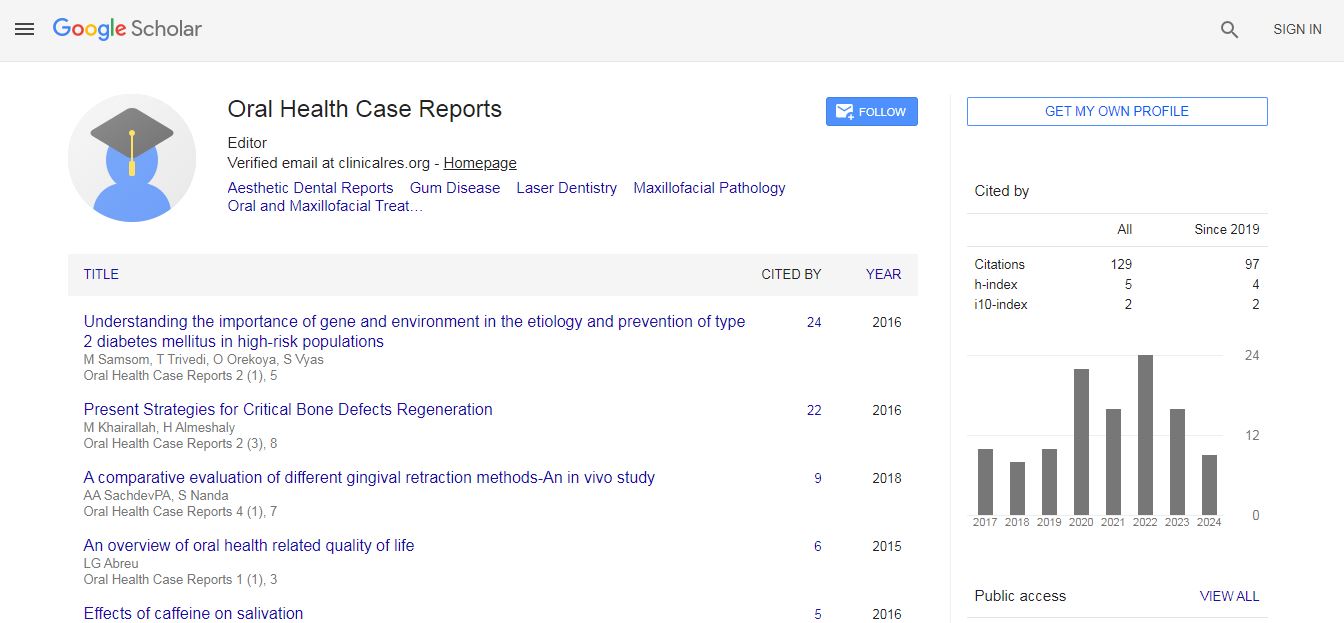
Oral Health Case Reports received 120 citations as per Google Scholar report