Brief Report - (2025) Volume 14, Issue 3
Received: 02-Jun-2025, Manuscript No. jnc-25-171665;
Editor assigned: 06-Feb-2025, Pre QC No. P-171665;
Reviewed: 16-Jun-2025, QC No. Q-171665;
Revised: 23-Jun-2025, Manuscript No. R-171665;
Published:
30-Jun-2025
, DOI: 10.37421/2167-1168.2025.14.715
Citation: Zhu, Jiechun. “The Role of Psychiatric Nurses in Managing Medication Adherence Among Patients with Schizophrenia: Challenges and Strategies.” J Nurs Care 14 (2025): 715.
Copyright: © 2025 Zhu J. This is an open-access article distributed under the terms of the Creative Commons Attribution License, which permits unrestricted use, distribution and reproduction in any medium, provided the original author and source are credited.
Family involvement is another area where psychiatric nurses exert a profound influence. Families play a vital role in supporting medication adherence, especially in outpatient or community-based settings. Nurses often serve as liaisons, educating families about the nature of schizophrenia, the importance of medication adherence and strategies for supporting their loved ones. They also provide guidance on recognizing signs of relapse or non-compliance and how to respond appropriately. By involving families in the care process, nurses help build a supportive network around the patient, which can significantly enhance adherence and overall outcomes. Community psychiatric nursing, including home visits and outpatient follow-up, is an increasingly important aspect of long-term schizophrenia management. Psychiatric nurses working in community settings must often operate independently, conducting assessments, administering medications and providing psychoeducation outside the structured environment of a hospital. In these contexts, the nurse's ability to establish rapport, adapt to diverse cultural and social contexts and tailor interventions to each patient's unique circumstances becomes even more critical. They may also collaborate with social workers, case managers and primary care providers to address broader determinants of health that affect medication adherence, such as housing instability, substance abuse, or lack of transportation [2].
Technology has also become an important tool in supporting medication adherence and psychiatric nurses are at the forefront of integrating these tools into patient care. Mobile apps, automated reminders, electronic pill dispensers and telehealth consultations are increasingly used to assist patients in managing their medications. Nurses play a vital role in educating patients on how to use these technologies, troubleshooting issues and evaluating their effectiveness. Especially in younger populations who may be more tech-savvy but also more prone to skipping medications, such strategies can significantly enhance engagement and consistency. Cultural competence is another essential aspect of psychiatric nursing that directly impacts medication adherence. Cultural beliefs about mental illness, medication and healthcare providers can deeply influence how patients perceive and accept treatment. Nurses who take the time to understand a patientâ??s cultural background and beliefs can better address resistance rooted in cultural or religious values. For example, some patients may believe that mental illness is a spiritual issue and prefer traditional or alternative remedies over pharmacological treatment. In such cases, psychiatric nurses can engage in culturally sensitive discussions, possibly integrating certain traditional practices alongside medical treatment when safe and appropriate, thus creating a more acceptable and adherent treatment plan [3].
Motivational Interviewing (MI) is one evidence-based technique that many psychiatric nurses employ to enhance medication adherence. This patient-centered counseling style involves exploring and resolving ambivalence, helping patients articulate their own motivations for change. MI has been shown to improve adherence in patients with schizophrenia by fostering intrinsic motivation and empowering them to make informed decisions about their treatment. Trained psychiatric nurses can use MI techniques during routine interactions, gradually shifting the patientâ??s perspective from resistance to collaboration. It is also important to highlight the emotional and psychological toll that schizophrenia and its treatment can take on patients. Living with a chronic mental illness can lead to feelings of hopelessness, isolation and low self-worth. Psychiatric nurses are uniquely positioned to address these emotional needs through consistent therapeutic presence, validation and encouragement. By helping patients set achievable goals, celebrate small victories and maintain a sense of purpose, nurses can indirectly improve medication adherence by reinforcing the value of staying well and functioning independently [4].
Despite the critical role psychiatric nurses play, systemic challenges remain. Understaffing, high patient-to-nurse ratios and limited time for individual interactions can hinder the ability of nurses to provide the depth of support needed for effective adherence interventions. Additionally, a lack of continuing education and training in advanced communication techniques or psychopharmacology may limit nursesâ?? confidence in addressing complex medication-related issues. Healthcare systems must recognize the invaluable role of psychiatric nurses and invest in training, staffing and support systems that enable them to function at the highest level of their scope. Furthermore, integrating psychiatric nursing practice with multidisciplinary team approaches enhances the effectiveness of medication adherence strategies. Collaboration with psychiatrists, psychologists, pharmacists and social workers allows for comprehensive care planning that addresses all aspects of a patientâ??s life. Nurses often act as coordinators in these teams, ensuring continuity of care, tracking treatment progress and facilitating communication among providers. This holistic approach not only supports adherence but also improves the overall quality of life for individuals living with schizophrenia [5].
Google Scholar Cross Ref Indexed at
Google Scholar Cross Ref Indexed at
Google Scholar Cross Ref Indexed at
Google Scholar Cross Ref Indexed at
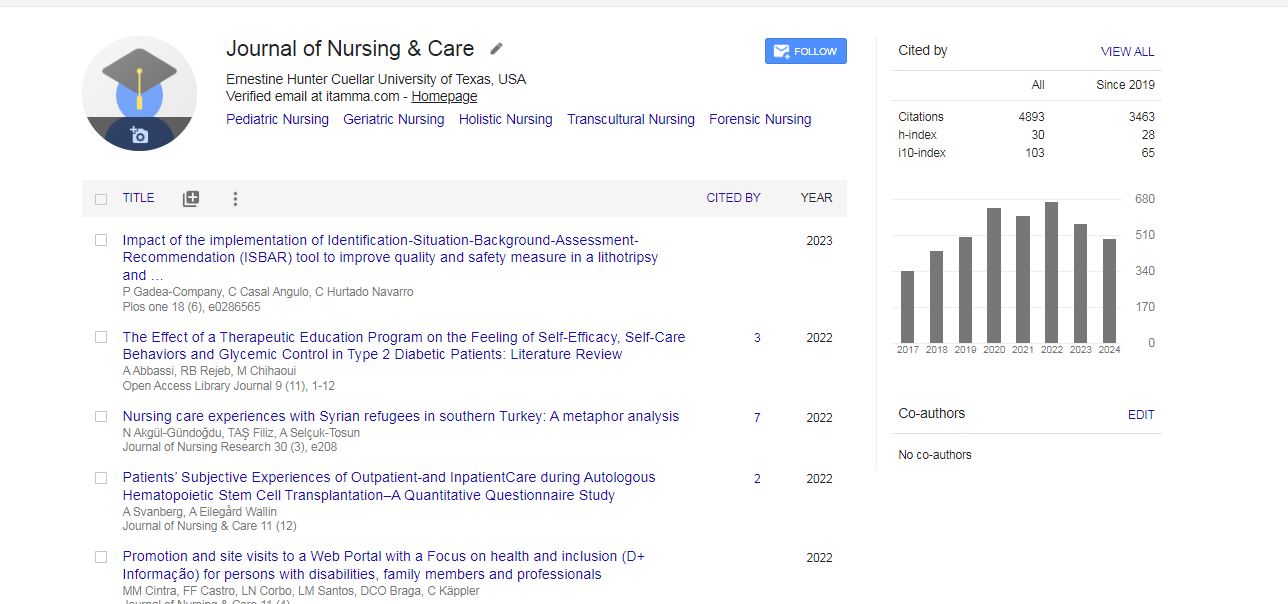
Journal of Nursing & Care received 4230 citations as per Google Scholar report