Short Communication - (2025) Volume 11, Issue 3
Received: 01-Aug-2025, Manuscript No. jmt-25-175195;
Editor assigned: 04-Aug-2025, Pre QC No. P-175195;
Reviewed: 18-Aug-2025, QC No. Q-175195;
Revised: 22-Aug-2025, Manuscript No. R-175195;
Published:
29-Aug-2025
, DOI: 10.37421/2471-271X.2025.11.355
Citation: Park, Jae-Hyun. ”TF-CBT: Effective, Accessible Youth Trauma Therapy.” J Ment Disord Treat 11 (2025):355.
Copyright: © 2025 Park J. This is an open-access article distributed under the terms of the Creative Commons Attribution License, which permits unrestricted use, distribution and reproduction in any medium, provided the original author and source are credited.
Trauma-Focused Cognitive Behavioral Therapy (TF-CBT) shows significant promise for youth experiencing complex trauma, offering a clear path towards healing. This approach is structured to address the multifaceted challenges young individuals face, moving beyond symptom reduction to promote holistic recovery and resilience. TF-CBT provides a comprehensive framework, empowering clinicians to navigate the intricate layers of trauma and its impact on development [1].
The sustained effectiveness of TF-CBT in community settings has been consistently demonstrated over a decade of research. What this really means is that this therapy is not merely effective in controlled trials, but it robustly holds up in real-world environments, making a tangible difference for many people. This success underscores the therapy's practical utility and broad applicability outside of academic research settings [2].
A systematic review of psychological therapies for preventing and treating Post-Traumatic Stress Disorder (PTSD) in children and young people highlights a strong evidence base for trauma-focused interventions. Research confirms that therapies designed to directly address traumatic experiences are critical for helping younger populations recover and mitigate long-term impacts of trauma. It is about finding what truly works for young minds [3].
Ensuring young people in need receive TF-CBT is a major goal, and research points to key strategies for implementation. This involves understanding and overcoming barriers in community mental health settings, making sure that evidence-based practices reach the individuals who can benefit most. It is about bridging the gap between research and real-world application [4].
An integrated TF-CBT for traumatized refugee youth shows remarkable effectiveness, according to a randomized controlled trial. This work is critical because it highlights how specific, adapted therapeutic approaches can address the complex trauma experienced by refugee populations, providing much-needed support for healing and integration. It acknowledges the unique vulnerabilities and resilience of these young people [5].
Culturally adapted trauma-focused cognitive behavioral therapy has a growing body of evidence supporting its efficacy. The research suggests that tailoring therapy to specific cultural contexts is not just a good idea, it is often essential for effective treatment. This ensures that interventions resonate with clients' experiences and beliefs, making them more accessible and impactful. It is about respecting and integrating cultural nuances into healing [6].
Understanding the neural mechanisms of trauma-focused psychotherapy for PTSD gives deeper insights into how these interventions actually change the brain. This research explores the biological underpinnings of recovery, showing that therapy is not just about talk; it is about reshaping neural pathways. Knowing this helps refine treatments and build more targeted, effective interventions for PTSD. It is truly fascinating to see the brain's capacity for healing [7].
The shift towards telehealth delivery for trauma-focused cognitive behavioral therapy is proving to be a valuable adaptation, especially given recent global changes. This narrative review explores how virtual platforms can effectively deliver these critical services, increasing accessibility for many who might otherwise face barriers to in-person care. It really expands the reach of much-needed therapeutic support [8].
Adapting trauma-focused cognitive behavioral therapy for adolescents who also have co-occurring substance use issues is a crucial area of focus. This work demonstrates how modifications can be made to effectively address both trauma and substance use within community mental health settings, providing integrated care that acknowledges the complex interplay between these challenges. It is about meeting young people where they are with comprehensive support [9].
The role of parental engagement in Trauma-Focused Cognitive Behavioral Therapy (TF-CBT) for children and adolescents is really important. Research consistently shows that when parents or caregivers are actively involved, therapy outcomes for young people improve significantly. Their involvement provides a supportive environment and helps reinforce therapeutic strategies outside of sessions. It is a powerful partnership in the healing process [10].
Trauma-Focused Cognitive Behavioral Therapy (TF-CBT) stands out as a highly effective intervention for youth grappling with complex trauma, offering a structured approach that moves beyond mere symptom reduction to foster holistic recovery and resilience [1]. Its efficacy extends beyond controlled environments, consistently demonstrating sustained positive outcomes within real-world community settings over more than a decade of research [2]. This robust evidence base is further strengthened by systematic reviews that highlight the critical role of trauma-focused interventions in preventing and treating Post-Traumatic Stress Disorder (PTSD) in children and adolescents, emphasizing the importance of directly addressing traumatic experiences for lasting recovery and mitigating long-term impacts [3].
A major goal in mental healthcare is ensuring that young people who need TF-CBT actually receive it. Research has identified key strategies for successful implementation, focusing on understanding and overcoming barriers prevalent in community mental health settings. This effort is crucial for bridging the gap between research-proven practices and their real-world application, ensuring that effective therapies reach those who can benefit most. This involves dedicated efforts to disseminate knowledge and build capacity within existing mental health infrastructures [4]. Such efforts contribute significantly to improving access and equity in care, particularly for vulnerable populations, showcasing the practical utility and broad societal benefit of TF-CBT in diverse contexts.
TF-CBT has proven highly adaptable to specific populations and their unique challenges. For instance, an integrated TF-CBT model has shown remarkable effectiveness in randomized controlled trials for traumatized refugee youth, specifically designed to address their complex trauma and support their healing and integration into new communities. This work thoughtfully acknowledges the unique vulnerabilities and the inherent resilience present within refugee populations [5]. Beyond specific demographics, the importance of cultural sensitivity in therapeutic practice is increasingly recognized, with a growing body of evidence supporting culturally adapted TF-CBT. Tailoring therapy to specific cultural contexts is often essential for truly effective treatment, as it ensures interventions deeply resonate with clients' experiences and beliefs, thereby making them significantly more accessible and impactful [6]. This adaptation is not a mere modification but a fundamental integration of cultural nuances into the healing process.
Further adaptations extend to complex co-occurring conditions that young people often face. For adolescents grappling with both trauma and co-occurring substance use issues, specific modifications to TF-CBT have demonstrated effectiveness within community mental health settings, providing integrated care that comprehensively addresses the complex interplay between these often-related challenges [9]. The modality of delivery has also seen significant innovation; telehealth delivery of TF-CBT has emerged as a valuable and timely adaptation, especially in response to recent global changes and technological advancements. This virtual approach significantly increases accessibility for many individuals who might otherwise face substantial logistical or geographical barriers to in-person care, effectively expanding the reach of much-needed therapeutic support [8]. Moreover, the involvement of parents or primary caregivers is consistently highlighted as profoundly important; research consistently shows that active and meaningful parental engagement significantly improves therapy outcomes for children and adolescents, providing a consistent, supportive home environment and reinforcing therapeutic strategies learned during sessions [10]. This active partnership is a powerful catalyst in the healing process.
Beyond its widespread clinical application, a deeper understanding of TF-CBT involves exploring its neural mechanisms. Research delving into the biological underpinnings of trauma-focused psychotherapy for PTSD offers fascinating insights into precisely how these interventions actually instigate changes within the brain itself, effectively reshaping neural pathways. This neurobiological perspective helps refine treatments, leading to more targeted and effective interventions by clearly demonstrating the brain's inherent capacity for profound healing and adaptive change [7]. The cumulative evidence from these diverse studies points to TF-CBT as a flexible, empirically supported, and increasingly accessible therapeutic approach, continually being refined and adapted to meet the diverse and complex needs of young people experiencing trauma across various contexts.
Trauma-Focused Cognitive Behavioral Therapy (TF-CBT) is a highly promising and effective intervention for youth experiencing complex trauma and Post-Traumatic Stress Disorder (PTSD). It offers a structured framework that not only reduces symptoms but actively promotes holistic recovery and resilience in young individuals. The therapy's sustained effectiveness has been rigorously demonstrated in diverse community settings over more than a decade, proving its utility beyond controlled academic trials. This robust evidence base supports its widespread application and highlights its capacity to make a tangible difference in real-world environments. TF-CBT shows remarkable adaptability, with successful implementations for specific vulnerable populations such as traumatized refugee youth through integrated models. Furthermore, culturally adapted approaches enhance its efficacy by ensuring interventions resonate with clients' unique experiences and beliefs, making therapy more accessible and impactful. The therapy has also been effectively modified for adolescents grappling with co-occurring substance use issues, providing comprehensive, integrated care. Ensuring broad access to TF-CBT is a significant focus, with research identifying key strategies to overcome implementation barriers in community mental health settings. Recent advancements in telehealth delivery have further expanded its reach, offering valuable remote support and increasing accessibility for many who face traditional obstacles to in-person care. Additionally, the crucial role of parental engagement in TF-CBT for children and adolescents is well-documented, as active caregiver involvement consistently leads to improved therapy outcomes and reinforces therapeutic strategies outside of sessions. Beyond its clinical applications, studies are also shedding light on the neural mechanisms of trauma-focused psychotherapy, revealing how these interventions reshape brain pathways and contribute to recovery. This comprehensive body of work underscores TF-CBT's versatility, efficacy, and critical role in supporting the healing and resilience of young people facing trauma.
None
None
Sahil C, Judith AC, Shefali S. "Trauma-Focused Cognitive Behavioral Therapy for Youth with Complex Trauma".Child Adolesc Psychiatr Clin N Am 30 (2021):747â??760.
Indexed at, Google Scholar, Crossref
Shannon D, Shannon WS, Catherine M. "Sustained effectiveness of trauma-focused cognitive behavioral therapy in community settings: A decade of research".Depress Anxiety 37 (2020):415â??424.
Indexed at, Google Scholar, Crossref
Christopher L, Anna CO, Jonathan IB. "A systematic review of evidence for psychological therapies in preventing and treating PTSD in children and young people".Eur J Psychotraumatol 11 (2020):1785590.
Indexed at, Google Scholar, Crossref
Rinad SB, Shannon D, Sokhom P. "Getting trauma-focused cognitive behavioral therapy to young people who need it".J Am Acad Child Adolesc Psychiatry 61 (2022):209â??212.
Indexed at, Google Scholar, Crossref
Angela N, Belinda L, Ivan P. "The Effectiveness of an Integrated Trauma-Focused Cognitive Behavioral Therapy (TF-CBT) for Traumatized Refugee Youth: A Randomized Controlled Trial".J Am Acad Child Adolesc Psychiatry 60 (2021):1239â??1249.
Indexed at, Google Scholar, Crossref
Kyle CJ, Emily CH, Silvia S. "Culturally adapted trauma-focused cognitive behavioral therapy: a systematic review of the evidence".J Child Fam Stud 32 (2023):1148â??1166.
Indexed at, Google Scholar, Crossref
Negar F, Youngsun K, Zhaoxian L. "Neural Mechanisms of Trauma-Focused Psychotherapy for PTSD".Biol Psychiatry 90 (2021):727â??737.
Indexed at, Google Scholar, Crossref
David T, Joanna R, Ashley S. "Telehealth delivery of trauma-focused cognitive behavioral therapy: A narrative review".J Technol Hum Serv 40 (2022):173â??193.
Indexed at, Google Scholar, Crossref
Emily MB, Dillon LS, Sokhom P. "Trauma-focused cognitive behavioral therapy for adolescents with co-occurring substance use: An adaptation for community mental health".J Subst Abuse Treat 118 (2020):108078.
Indexed at, Google Scholar, Crossref
Jennifer W, Kirby D, Carla B. "The Role of Parental Engagement in Trauma-Focused Cognitive Behavioral Therapy for Children and Adolescents: A Systematic Review".Clin Child Fam Psychol Rev 22 (2019):481â??497.
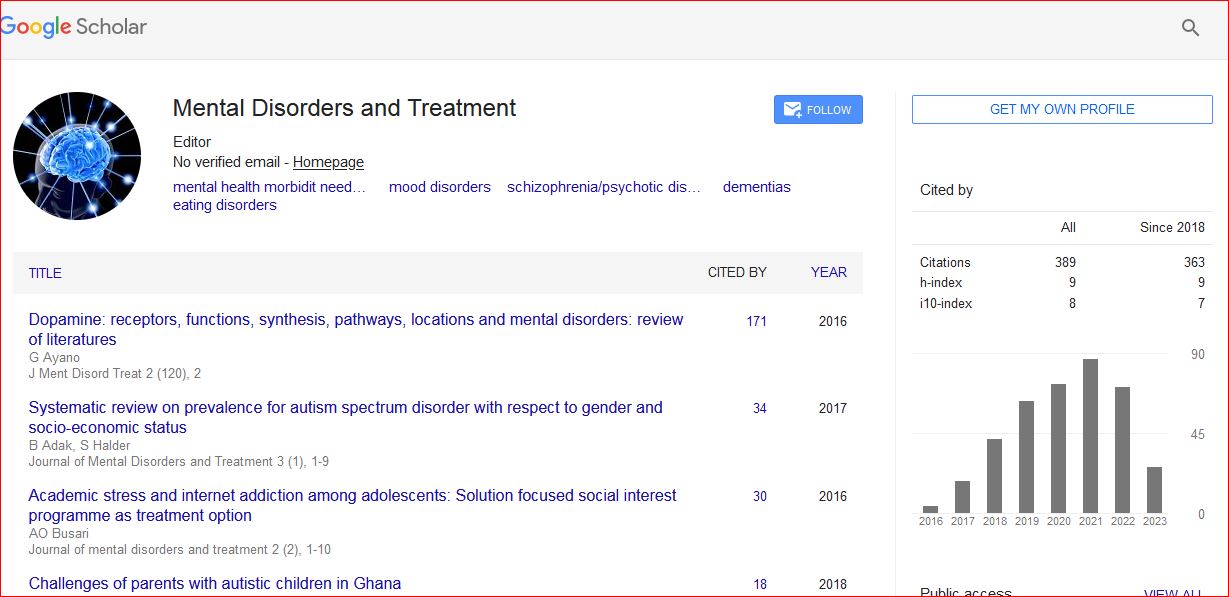
Mental Disorders and Treatment received 556 citations as per Google Scholar report