Commentary - (2025) Volume 15, Issue 5
Received: 01-Sep-2025, Manuscript No. jtese-26-184250;
Editor assigned: 03-Sep-2025, Pre QC No. P-184250;
Reviewed: 17-Sep-2025, QC No. Q-184250;
Revised: 22-Sep-2025, Manuscript No. R-184250;
Published:
29-Sep-2025
, DOI: 10.37421/2165-8064.2025.15.673
Citation: Ferreira, Lucas. ”Textile Waste Recycling: Advancements Toward Circularity.” J Textile Sci Eng 15 (2025):673.
Copyright: © 2025 Ferreira L. This is an open-access article distributed under the terms of the Creative Commons Attribution License, which permits unrestricted use, distribution and reproduction in any medium, provided the original author and source are credited.
The textile industry, a cornerstone of the global economy, is facing an unprecedented challenge with the escalating volume of textile waste. This pervasive issue necessitates innovative and sustainable solutions to mitigate its environmental impact and foster a circular economy within the sector. Significant advancements in textile waste recycling technologies are emerging, encompassing mechanical, chemical, and biological approaches, each offering unique pathways to resource recovery and waste reduction [1].
Mechanical recycling, a traditional method, is being revolutionized by novel techniques aimed at enhancing the quality of recycled fibers. These include advanced fibrillation and fiber modification processes that overcome the limitations of conventional recycling, producing higher-value materials suitable for diverse applications [4].
Chemical recycling, particularly solvent-based and depolymerization methods, holds immense promise for processing mixed textile waste. These techniques focus on efficiently recovering high-purity monomers and polymers from complex blends, thereby enabling truly circular textile production and minimizing reliance on virgin resources [2].
Emerging research is also exploring the use of green solvents, such as ionic liquids and deep eutectic solvents, for the chemical recycling of polyester textiles. These innovative solvents facilitate the dissolution of PET and the recovery of valuable components like terephthalic acid and ethylene glycol, significantly reducing the environmental footprint of polyester recycling [8].
Biological recycling methods, including enzymatic hydrolysis and microbial processes, offer a more sustainable and environmentally friendly alternative for breaking down textile waste. Enzymatic hydrolysis, for instance, efficiently converts cellulosic waste into valuable sugars, paving the way for bio-based material production and sustainable resource utilization [3].
The potential of bio-recycling technologies is vast, with ongoing research focusing on enhancing microbial efficiency and scaling up enzymatic processes for industrial application, offering a sustainable route for textile waste valorization [9].
The integration of advanced sorting technologies, particularly artificial intelligence (AI) and machine learning (ML), is proving crucial for tackling the complexities of textile waste streams. AI-powered optical sorting systems can accurately differentiate fibers based on composition, color, and type, a critical step towards efficient and cost-effective recycling [5].
Addressing the specific challenge of recycling blended textile fibers, such as cotton-polyester blends, requires specialized separation techniques. Novel mechanical and chemical processes are being developed to efficiently deconstruct these blends into their constituent materials, enabling high-quality fiber-to-fiber recycling [10].
Beyond material recovery, the valorization of textile waste through processes like pyrolysis is gaining traction. Pyrolysis of textile waste can lead to the recovery of valuable chemical compounds and facilitate energy generation, providing a viable method for managing non-recyclable waste streams and recovering energy resources [6].
To guide the widespread adoption of these technologies, comprehensive life cycle assessments (LCAs) are essential. Comparative LCAs of various textile recycling technologies provide crucial data on environmental impacts, enabling informed decision-making and identifying the most sustainable recycling pathways for the industry [7].
The overarching goal is to establish a robust circular economy for textiles, where waste is minimized, and resources are continuously reused and recycled, transforming the industry into a more sustainable and environmentally responsible sector [1].
The landscape of textile waste management is being dramatically reshaped by a suite of innovative recycling technologies designed to address the growing environmental burden of discarded fabrics. These technologies span a spectrum from sophisticated mechanical interventions to advanced chemical processes and novel biological approaches, each contributing to a more sustainable textile ecosystem. Mechanical recycling is experiencing a renaissance through the development of advanced fibrillation methods and fiber modification processes. These techniques are instrumental in elevating the quality of recycled fibers, thereby overcoming the inherent limitations of traditional mechanical recycling and enabling the production of higher-value materials suitable for a broader array of applications [4].
Chemical recycling, particularly through solvent-based and depolymerization techniques, offers a powerful solution for mixed textile waste. Research in this domain focuses on the efficient recovery of high-purity monomers and polymers from complex fiber blends, such as cotton-polyester composites, which is a critical step towards achieving true circularity in textile production [2].
Further advancements in chemical recycling involve the exploration of green solvents, including ionic liquids and deep eutectic solvents. These innovative solvent systems are being developed to enhance the dissolution of materials like PET and facilitate the recovery of valuable chemical constituents such as terephthalic acid and ethylene glycol, thereby significantly reducing the environmental footprint associated with polyester recycling [8].
Biological recycling methods are emerging as a sustainable alternative, leveraging enzymatic hydrolysis and microbial action to break down textile waste. Enzymatic hydrolysis, for instance, efficiently converts cellulosic fibers into valuable sugars, opening avenues for the production of bio-based materials and fostering a more environmentally conscious approach to resource utilization [3].
The burgeoning field of bio-recycling also encompasses the development of microbial processes and the optimization of enzyme cocktails to enhance the efficiency of textile waste breakdown, with a focus on scaling these processes for industrial adoption and maximizing textile waste valorization [9].
A critical bottleneck in textile recycling is the accurate and efficient sorting of waste materials. The integration of artificial intelligence (AI) and machine learning (ML) is revolutionizing this aspect, with AI-powered optical sorting systems capable of precisely differentiating fibers based on their composition, color, and type, thereby streamlining the recycling process [5].
The intricate challenge of recycling blended textile fibers, such as common cotton-polyester mixtures, is being addressed through specialized separation technologies. These encompass both advanced mechanical separation methods and novel chemical processes engineered for the efficient deconstruction of blends into their constituent components, facilitating high-quality fiber-to-fiber recycling [10].
Beyond direct material recycling, the valorization of textile waste through thermal processes like pyrolysis is being investigated. Pyrolysis offers a means to recover valuable chemical compounds and generate energy from textile waste, presenting a viable strategy for managing non-recyclable textiles and extracting residual value [6].
To inform the strategic implementation of these diverse recycling technologies, comprehensive life cycle assessments (LCAs) are indispensable. Comparative LCAs rigorously evaluate the environmental impacts of mechanical, chemical, and energy recovery methods, providing crucial data that supports informed decision-making and identifies the most environmentally sound recycling pathways for the textile industry [7].
Ultimately, these collective advancements are geared towards fostering a circular economy for textiles, minimizing waste, and maximizing resource efficiency throughout the product lifecycle [1].
This collection of research explores advancements in textile waste recycling, covering mechanical, chemical, and biological methods. Innovations include enhanced mechanical recycling for higher quality fibers, solvent-based and depolymerization chemical recycling for mixed textiles, and enzymatic hydrolysis for cellulosic waste. The use of green solvents and AI-powered sorting systems are highlighted as crucial for efficiency and sustainability. Pyrolysis offers a route for energy recovery from non-recyclable waste. Life cycle assessments are used to compare the environmental impacts of different technologies. The overall aim is to promote a circular economy for textiles by enabling high-quality material recovery and minimizing waste.
None
None
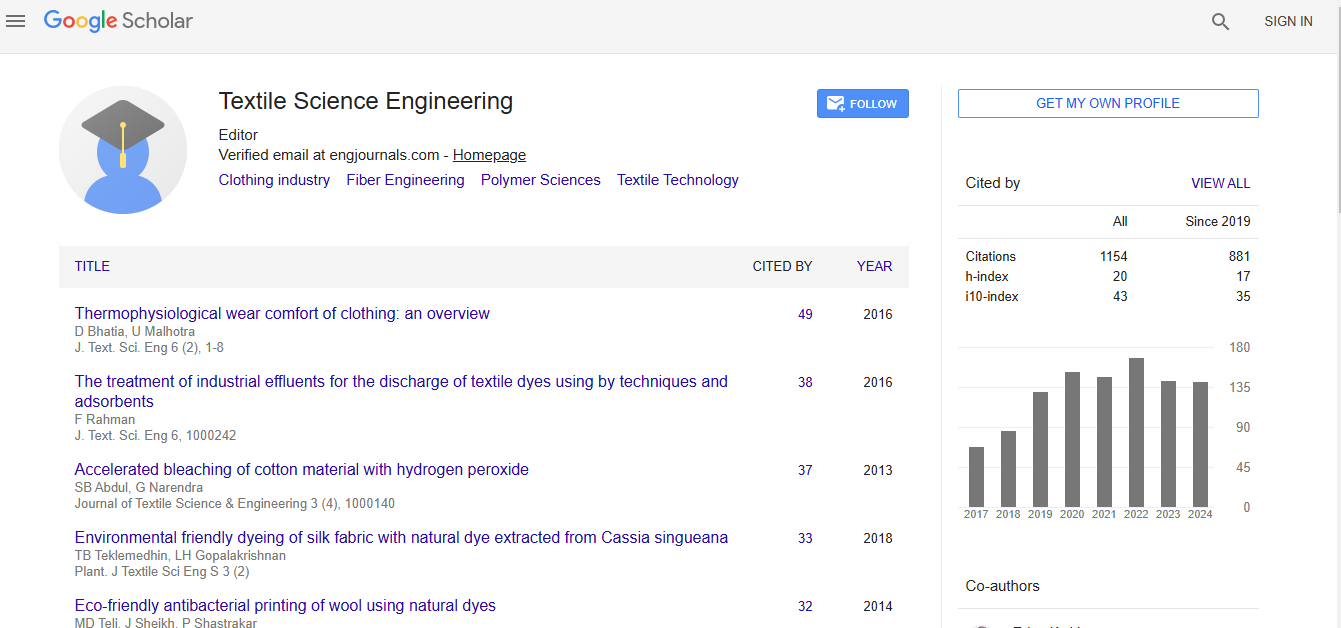
Journal of Textile Science & Engineering received 1008 citations as per Google Scholar report