Opinion - (2025) Volume 15, Issue 5
Received: 01-Sep-2025, Manuscript No. jtese-26-184247;
Editor assigned: 03-Sep-2025, Pre QC No. P-184247;
Reviewed: 17-Sep-2025, QC No. Q-184247;
Revised: 22-Sep-2025, Manuscript No. R-184247;
Published:
29-Sep-2025
, DOI: 10.37421/2165-8064.2025.15.671
Citation: Rahman, Khalid. ”Textile Industry’s Green Innovations: Conserving Water and Energy.” J Textile Sci Eng 15 (2025):671.
Copyright: © 2025 Rahman K. This is an open-access article distributed under the terms of the Creative Commons Attribution License, which permits unrestricted use, distribution and reproduction in any medium, provided the original author and source are credited.
The textile industry faces significant environmental challenges, particularly concerning water and energy consumption throughout its processing stages. Addressing these issues is paramount for achieving sustainability and reducing the ecological footprint of textile manufacturing. Innovative approaches are being developed to minimize resource utilization, from dyeing and finishing to wastewater treatment and recycling. One crucial area of focus is the optimization of wet processing techniques to reduce water and energy use. This involves adopting eco-friendly chemicals, investing in advanced machinery, and implementing efficient wastewater management systems. The potential for cost savings and environmental benefits through strategic implementation of these reduction strategies is substantial, as highlighted in comprehensive reviews of sustainable textile wet processing [1].
The efficacy of advanced oxidation processes (AOPs) in treating textile wastewater is another significant area of research. These processes are particularly effective in removing persistent organic pollutants, which are often challenging to eliminate through conventional methods. Integrating AOPs with biological treatment can create a synergistic approach, leading to enhanced effluent quality and a reduced overall water footprint for the industry [2].
Waterless dyeing technologies present a revolutionary shift towards sustainability. Supercritical carbon dioxide (scCO2) dyeing, for instance, offers a viable alternative to traditional water-intensive methods for dyeing polyester fabrics. This technique significantly reduces energy consumption and completely eliminates wastewater, while maintaining desirable dye uptake and fastness properties, marking it as a highly environmentally friendly solution [3].
The integration of cutting-edge technologies like the Internet of Things (IoT) and Artificial Intelligence (AI) is transforming energy management in textile dyeing. Real-time monitoring and precise control of process parameters enabled by IoT, coupled with AI's predictive capabilities, allow for significant energy savings and enhanced operational efficiency, paving the way for smarter and more sustainable textile manufacturing [4].
Novel enzymatic treatments are emerging as a key strategy for sustainable textile pre-treatment, specifically for desizing and scouring. These enzymatic processes offer a greener alternative to traditional chemical methods, leading to substantial reductions in water and chemical usage, as well as a decreased effluent load. This contributes to a significantly smaller environmental footprint during the initial stages of textile processing [5].
Membrane filtration technologies are proving to be highly effective for water recycling within textile dyeing operations. By evaluating different membrane types and configurations, researchers are identifying optimal systems for treating dye-contaminated wastewater, thereby enabling the reuse of water. This contributes to the development of a circular economy within the textile sector, offering both economic and environmental advantages [6].
The impact of low liquor ratio dyeing techniques on resource consumption is a critical area of study. Modern low liquor ratio methods offer substantial reductions in both water and energy usage compared to traditional high liquor ratio dyeing. Analysis confirms the feasibility and benefits of these techniques for sustainable textile production, without compromising dye yield or fabric quality [7].
Digital printing technologies are emerging as a sustainable alternative to conventional textile printing methods. They offer remarkable reductions in water consumption, chemical usage, and waste generation, while also improving design flexibility and efficiency. These advancements position digital printing as a pivotal technology for eco-friendly textile manufacturing [8].
The development and application of biodegradable and bio-based auxiliaries in textile finishing represent another significant step towards environmental responsibility. These sustainable alternatives offer comparable or superior performance to conventional chemicals, leading to considerable water and energy savings and reduced effluent pollution during finishing processes, further enhancing the sustainability of textile operations [9].
Life Cycle Assessment (LCA) provides a comprehensive framework for evaluating the environmental footprint of various textile dyeing methods. By quantifying the impacts of different processes, LCA studies enable a clear comparison of conventional, reactive, and eco-friendly dyeing options, thereby informing decision-making towards more resource-efficient manufacturing and a reduced overall impact on water and energy [10].
The textile industry's environmental impact, particularly its high water and energy consumption, necessitates innovative and sustainable processing solutions. This review highlights various strategies and technologies aimed at mitigating these challenges, encompassing advancements in dyeing, finishing, wastewater treatment, and material utilization. The overarching goal is to foster a more resource-efficient and environmentally responsible textile sector. Sustainable textile wet processing strategies are central to reducing resource intensity. Research into innovative dyeing and finishing techniques, coupled with the adoption of eco-friendly chemicals and advanced machinery, is key. Furthermore, the effective treatment and recycling of wastewater are crucial components for sustainable textile manufacturing, offering significant cost savings and environmental benefits through their strategic implementation [1].
Advanced Oxidation Processes (AOPs) are gaining prominence for their effectiveness in treating textile wastewater, particularly in removing recalcitrant organic pollutants. The synergistic combination of AOPs with biological treatment methods has proven to enhance effluent quality significantly, thereby contributing to a reduced water footprint for the industry and supporting its sustainability objectives [2].
A truly transformative approach in textile dyeing is the adoption of waterless technologies like supercritical carbon dioxide (scCO2) dyeing for polyester fabrics. This method drastically cuts down on energy use and completely eliminates the generation of wastewater, while still achieving satisfactory dye uptake and fastness, presenting a robust, environmentally benign alternative to conventional dyeing [3].
The integration of Internet of Things (IoT) and Artificial Intelligence (AI) is revolutionizing energy management in textile dyeing. By enabling real-time monitoring and precise control of critical process parameters, these technologies facilitate significant energy conservation. AI's predictive capabilities further optimize processes, leading to enhanced efficiency and a more sustainable manufacturing approach [4].
Enzymatic treatments are emerging as a greener solution for textile pre-treatment processes such as desizing and scouring. These methods offer a significant reduction in water and chemical consumption compared to traditional chemical approaches. The use of enzymes leads to a diminished effluent load, contributing to a more environmentally friendly textile production chain [5].
Membrane filtration technologies play a vital role in achieving water recycling goals within the textile dyeing industry. Different membrane types and configurations are being explored for their effectiveness in treating dye-laden wastewater, enabling water reuse and promoting a circular economy. This technological advancement offers both economic and ecological advantages [6].
Low liquor ratio dyeing represents a significant advancement in reducing resource consumption during the dyeing process. Compared to conventional high liquor ratio methods, these techniques demonstrate substantial savings in both water and energy. Studies confirm their feasibility, showing no adverse effects on dye yield or fabric quality, making them a sustainable choice [7].
Digital printing technologies are positioned as a highly sustainable alternative for textile printing. They inherently reduce water usage, chemical consumption, and waste generation. Moreover, digital printing enhances design flexibility and overall process efficiency, making it a key technology for achieving eco-friendly textile manufacturing [8].
The textile finishing sector is also embracing sustainability through the use of biodegradable and bio-based auxiliaries. Research indicates that these eco-friendly alternatives can achieve significant reductions in water and energy consumption, as well as minimize effluent pollution, offering a more sustainable pathway for finishing processes [9].
Life Cycle Assessment (LCA) provides a critical tool for evaluating the environmental impact of textile dyeing methods. By quantifying water and energy consumption across various dyeing processes, LCA helps in comparing conventional and sustainable alternatives, thereby guiding the industry towards more resource-efficient practices and a reduced environmental footprint [10].
The textile industry is actively pursuing strategies to reduce its substantial water and energy consumption. Innovations include eco-friendly dyeing and finishing techniques, advanced wastewater treatment, and waterless dyeing methods like supercritical CO2. The integration of IoT and AI is optimizing energy use, while enzymatic treatments and biodegradable auxiliaries minimize chemical and water footprints in pre-treatment and finishing. Membrane filtration supports water recycling, and low liquor ratio dyeing significantly cuts resource use. Digital printing offers a sustainable alternative to conventional printing. Life Cycle Assessments are used to evaluate and promote resource-efficient dyeing processes. These collective efforts aim to create a more sustainable and environmentally responsible textile manufacturing sector.
None
None
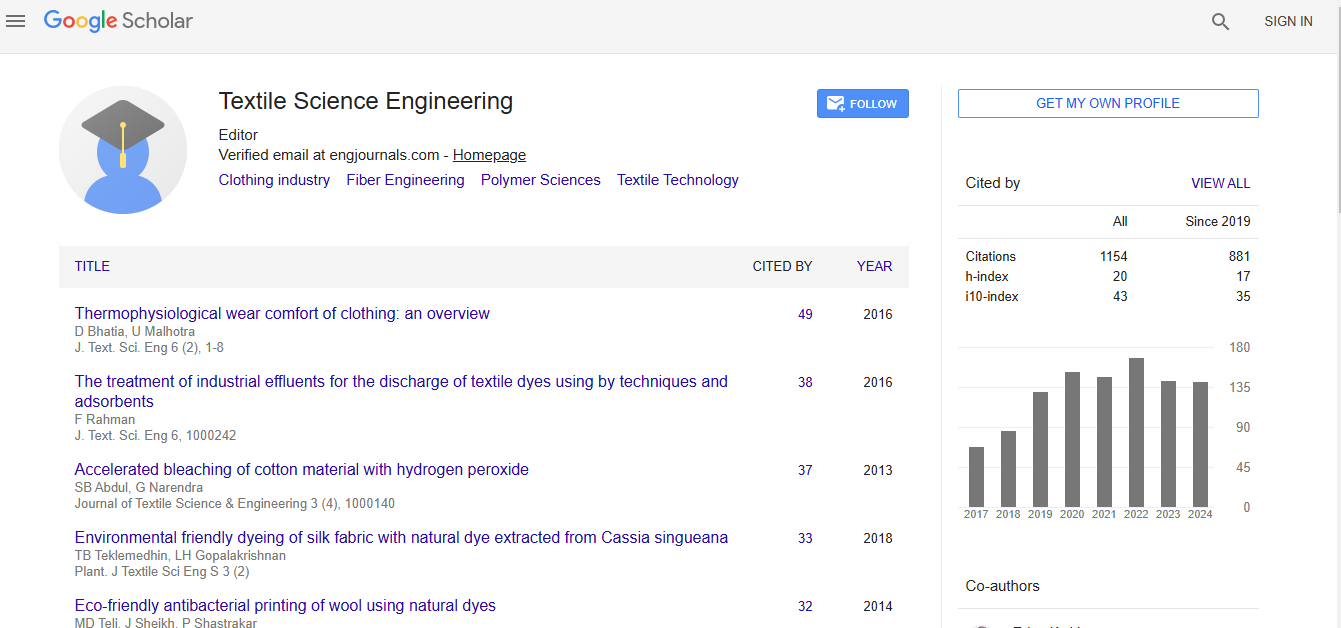
Journal of Textile Science & Engineering received 1008 citations as per Google Scholar report