Opinion - (2025) Volume 14, Issue 4
Received: 01-Dec-2025, Manuscript No. ara-25-175626;
Editor assigned: 03-Dec-2025, Pre QC No. P-175626;
Reviewed: 17-Dec-2025, QC No. Q-175626;
Revised: 22-Dec-2025, Manuscript No. R-175626;
Published:
29-Dec-2025
, DOI: 10.37421/2168-9695.2025.14.345
Citation: Kruger, Daniel. ”Telerobotics: Enhancing Human Capability Across Remote Domains.” Adv Robot Autom 14 (2025):345.
Copyright: © 2025 Kruger D. This is an open-access article distributed under the terms of the Creative Commons Attribution License, which permits unrestricted use, distribution and reproduction in any medium, provided the original author and source are credited.
Telerobotic systems are transforming various fields by extending human capabilities into remote or challenging environments. In surgical procedures, telerobotics with force feedback enhances surgeon perception and operational performance. Reviews detail experimental setups and clinical applications, highlighting the advantages and ongoing challenges of integrating haptic technology into surgical telerobotics [1].
The evolution of human-robot collaboration in telerobotics focuses on shared and supervisory control methods. This involves exploring how operators and autonomous systems effectively share control, discussing different architectural approaches and the complexities of achieving seamless collaboration during remote operations [2].
Telerobotics also extends to industrial applications, particularly remote manufacturing. This field addresses critical aspects like latency management, ensuring network reliability, designing intuitive human-machine interfaces, and establishing robust safety protocols necessary for widespread industrial adoption [3].
Specialized medical fields, such as neurosurgery, benefit significantly from telerobotic applications. These systems enhance precision and minimize invasiveness for intricate brain and spinal procedures. Reviews discuss existing systems, their benefits, and future research pathways to advance remote surgical capabilities [4].
Innovation in telerobotic system design aims for advanced remote presence and manipulation. New papers detail architectural designs, control algorithms, and experimental validation, showcasing potential for applications demanding high-fidelity remote interaction and precise handling [5].
Telerobotic systems are crucial in rehabilitation, offering remote therapy to improve patient access and ensure continuity of care. Research examines various robotic platforms, control strategies, and observed clinical outcomes in tele-rehabilitation settings [6].
The integration of haptic and visual feedback within virtual reality environments significantly enhances operator immersion and task performance in remote manipulation. Such systems provide a richer and more intuitive sensory experience, bridging the gap between operator and remote environment [7].
In surgical telerobotics, shared control strategies explore how intelligent automation supports surgeons. This aims to reduce cognitive load and improve precision, while ensuring the surgeon retains ultimate control over critical actions during complex procedures [8].
Mobile telerobotics is vital for remote inspection and maintenance across industries, especially in hazardous environments. Reviews highlight capabilities in sensor integration, navigation, and manipulation, addressing challenges of autonomy and mobility in remote settings [9].
Telerobotic platforms are also leveraged for remote education and training, particularly in hands-on fields like engineering and medicine. These systems enable students to interact with physical hardware from a distance, overcoming geographical barriers and enhancing learning outcomes [10].
Telerobotics stands as a foundational technology in modern automation, enabling human operators to perform tasks remotely across a spectrum of environments. From the highly precise demands of medical surgery to the challenging conditions of industrial settings, these systems expand the operational reach and safety of human endeavors. A key area of innovation lies in surgical telerobotics, where systems incorporating force feedback are proving invaluable. These advancements significantly improve surgeon perception and operational performance, allowing for more intuitive and precise control during complex procedures. Detailed experimental setups and their practical clinical applications underscore the ongoing integration of haptic technology to address both the advantages and the inherent challenges in this specialized field [1]. Furthermore, within surgical telerobotics, the strategic use of shared control strategies is vital. These methods investigate how intelligent automation can assist surgeons, effectively reducing their cognitive load and boosting precision, all while ensuring the surgeon maintains ultimate authority over critical surgical maneuvers [8].
The broader concept of human-robot collaboration is central to many telerobotic applications. This involves a careful balance of shared and supervisory control, where operators and autonomous systems work in concert. Research explores diverse architectural approaches and tackles the difficulties inherent in achieving truly seamless collaboration during remote operations [2]. This collaborative paradigm is particularly pertinent in industrial contexts, such as remote manufacturing. Here, teleoperating industrial robots faces distinct hurdles, including managing latency, ensuring unwavering network reliability, crafting intuitive human-machine interfaces, and implementing robust safety protocols. Overcoming these challenges is crucial for the widespread adoption of telerobotics in industrial sectors [3]. Extending this industrial utility, mobile telerobotics provides critical capabilities for remote inspection and maintenance across various industries. These mobile systems are especially adept in hazardous or inaccessible environments, demanding advanced sensor integration, navigation capabilities, and sophisticated manipulation systems [9].
Advancements in the design and control of telerobotic systems are continuously pushing the boundaries of what is possible. Novel systems are being engineered specifically to provide advanced remote presence and manipulation. The development process often involves meticulous attention to architectural design, sophisticated control algorithms, and rigorous experimental validation. These efforts demonstrate the immense potential of such systems for applications requiring high-fidelity remote interaction and precise handling [5]. A significant enhancement in operator experience comes from integrating haptic and visual feedback within immersive virtual reality environments. These systems are designed to provide a richer, more intuitive sensory experience, which in turn boosts operator immersion and greatly improves task performance during remote manipulation [7].
Beyond general surgery, telerobotics is carving out essential roles in other medical domains. In neurosurgery, telerobotic applications are reviewed for their current utility and future prospects, emphasizing their benefits in achieving higher precision and reducing invasiveness for delicate brain and spinal procedures [4]. Equally impactful is the application of telerobotics in rehabilitation, offering remote therapeutic systems that improve patient access and ensure continuity of care. Studies in this area scrutinize various robotic platforms, control strategies, and the resulting clinical outcomes in tele-rehabilitation settings [6]. Moreover, the reach of telerobotics extends into education and training. Telerobotic platforms are being leveraged for remote learning, particularly in hands-on fields like engineering and medicine. These systems allow students to engage with physical hardware from a distance, effectively bridging geographical barriers and significantly enhancing learning outcomes through practical, remote experience [10].
What these studies collectively reveal is a dynamic and expanding field where telerobotics is not just a tool but a transformative technology. The recurring themes across these diverse applications include the need for enhanced human-machine interfaces, reliable communication infrastructure, sophisticated feedback mechanisms, and intelligent automation. As research continues to address these intricate challenges, the capabilities of telerobotic systems are set to become even more pervasive and impactful, offering unprecedented control and access in an increasingly interconnected world.
Telerobotics represents a significant advancement, extending human capabilities into remote or hazardous environments. This field encompasses a wide array of applications, from enhancing precision in surgical procedures to enabling remote industrial operations and even facilitating education. Across these domains, researchers are consistently exploring ways to improve operator perception, control, and overall system performance. In medical contexts, telerobotics has found critical roles in surgical systems, where haptic feedback significantly enhances surgeon perception and operational performance, detailing experimental setups and clinical applications. Neurosurgery, in particular, benefits from telerobotics by achieving greater precision and minimizing invasiveness for intricate brain and spinal procedures. Beyond surgery, telerobotic systems are being developed for rehabilitation, aimed at improving patient access and ensuring continuity of care through remote therapeutic sessions. Shared control strategies are also key in surgical telerobotics, supporting surgeons by reducing cognitive load and improving precision while maintaining human oversight. Industrial applications of telerobotics focus on remote manufacturing, tackling challenges such as latency management, ensuring network reliability, human-machine interface design, and safety protocols for widespread adoption. Mobile telerobotics further extends this to remote inspection and maintenance in hazardous or inaccessible environments, addressing sensor integration, navigation, and manipulation challenges. Advancements in general telerobotic systems include novel designs for advanced remote presence and manipulation, featuring sophisticated architectural designs and control algorithms for high-fidelity interaction. Integrating haptic and visual feedback within virtual reality environments significantly enhances operator immersion and task performance in remote manipulation. Finally, telerobotic platforms are proving valuable for remote education and training, especially in hands-on fields like engineering and medicine, by allowing students to interact with physical hardware remotely, thereby overcoming geographical barriers and improving learning outcomes.
None
None
Yi L, Yang H, Jing W. "Robotic telesurgery with force feedback: A review on systems, experiments, and applications".Med Biol Eng Comput 61 (2023):2977â??2996.
Indexed at, Google Scholar, Crossref
Ashish KS, Shankar MK, Manu SK. "Human-Robot Collaboration in Telerobotics: A Review of Shared Control and Supervisory Control Approaches".IEEE Access 10 (2022):44299-44318.
Indexed at, Google Scholar, Crossref
J. MKKPS, M. SCSR, V. JR. "Towards Teleoperation of Industrial Robots for Remote Manufacturing: Challenges and Future Directions".IEEE Trans Ind Inform 17 (2021):7087-7098.
Indexed at, Google Scholar, Crossref
LuÃs GBAP, Pedro GBSF, Rodrigo GBGSL. "Telerobotics in Neurosurgery: A Review of Current Applications and Future Directions".World Neurosurg 143 (2020):367-374.
Indexed at, Google Scholar, Crossref
Wei Z, Xiaojie L, Yan W. "Design and Control of a Novel Telerobotic System for Remote Presence and Manipulation".IEEE/ASME Trans Mechatron 28 (2023):1774-1785.
Indexed at, Google Scholar, Crossref
Md. RNK, Sheikh SI, Md. GRSC. "Telerobotics in Rehabilitation: A Review of Remote Therapeutic Systems".Biomed Eng Online 21 (2022):22.
Indexed at, Google Scholar, Crossref
Hanyun W, Zheng R, Yifan L. "A Haptic and Visual Feedback System for Telerobotic Manipulation in Virtual Reality".Sensors 21 (2021):8208.
Indexed at, Google Scholar, Crossref
Yu L, Si W, Yang Z. "Shared Control Strategies for Telerobotic Surgical Systems: A Review".J Healthc Eng 2020 (2020):Article ID 6652873.
Indexed at, Google Scholar, Crossref
Devendra AS, Vinay KS, Ashish KG. "Mobile Telerobotics for Remote Inspection and Maintenance: A Review".Machines 11 (2023):386.
Indexed at, Google Scholar, Crossref
Ruijie C, Mengmeng L, Kai Z. "Telerobotic Platforms for Remote Education and Training: A Review".Educ Sci 12 (2022):88.
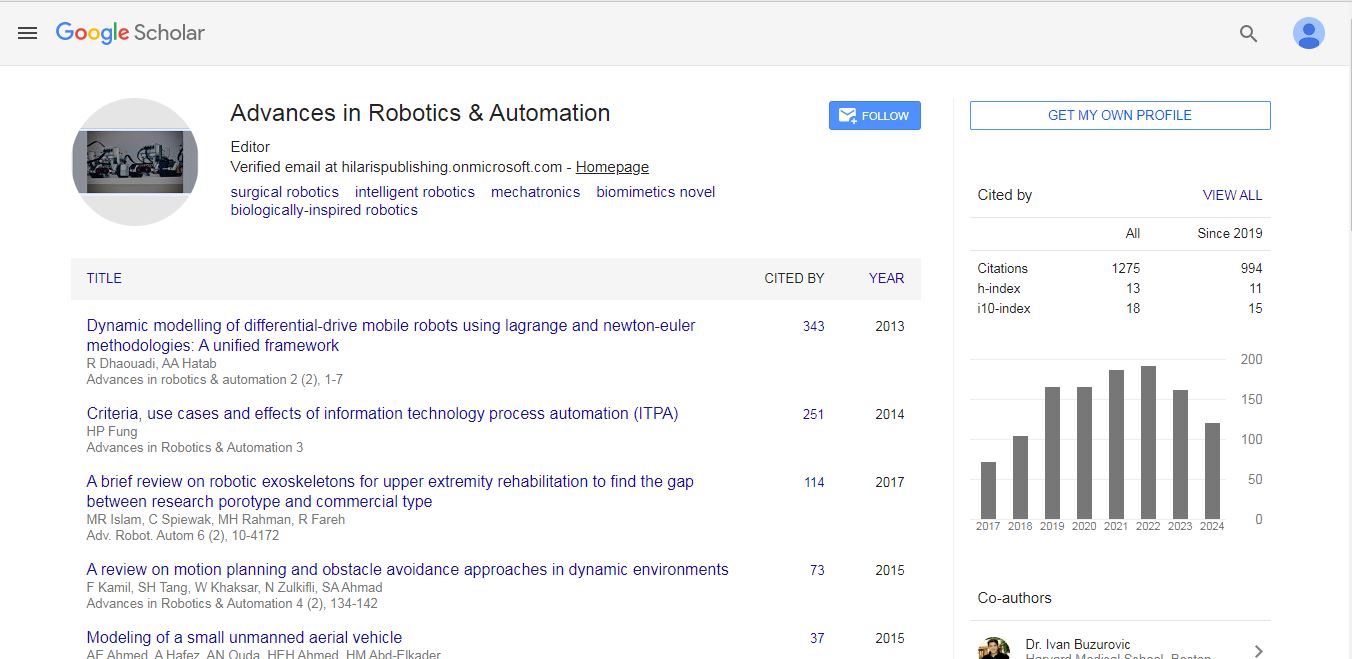
Advances in Robotics & Automation received 1275 citations as per Google Scholar report