Short Communication - (2025) Volume 14, Issue 6
Received: 01-Dec-2025, Manuscript No. jnc-25-178153;
Editor assigned: 03-Dec-2025, Pre QC No. P-178153;
Reviewed: 17-Dec-2025, QC No. Q-178153;
Revised: 22-Dec-2025, Manuscript No. R-178153;
Published:
29-Dec-2025
, DOI: DOI: 10.37421/2167-1168.2025.14.744
Citation: Hassan, Laila. ”Technology’s Transformative Role in Palliative Nursing.” J Nurs Care 14 (2025):744.
Copyright: © 2025 Hassan L. This is an open-access article distributed under the terms of the Creative Commons Attribution License, which permits unrestricted use, distribution and reproduction in any medium, provided the original author and source are credited.
The integration of technology into nursing care, particularly within palliative and end-of-life care, is rapidly transforming patient monitoring and care coordination. Telehealth applications, including remote consultation and patient monitoring, offer significant potential to enhance access to specialized nursing support, empowering both patients and their families with effective self-management tools. This technological advancement aims to optimize resource allocation, leading to a more responsive and patient-centered delivery of care. However, the successful integration of these technologies necessitates a thorough consideration of ethical implications, the digital literacy of users, and the equitable access for all patient populations [1].
Remote patient monitoring (RPM) has emerged as a critical tool in the management of chronic diseases, and its application extends to end-of-life care, demonstrating a positive impact on patient outcomes and a reduction in hospital readmissions. Technologies such as wearable sensors and home-based monitoring devices facilitate continuous data collection, enabling healthcare providers to intervene proactively. Despite these benefits, challenges such as data security, patient adherence to monitoring protocols, and the requirement for robust technical support remain significant considerations for widespread adoption [2].
Virtual nursing care represents a viable strategy for extending the reach of specialized nursing expertise, especially in geographically underserved regions. This innovative approach allows nurses to conduct comprehensive assessments, deliver essential patient education, and provide crucial emotional support remotely, thereby contributing to more holistic and effective care plans. Key to the successful implementation of virtual nursing care are strategies to address the digital divide and ensure that patients are comfortable and proficient with virtual interactions [3].
The burgeoning field of artificial intelligence (AI) in nursing care holds considerable promise for automating routine tasks, predicting patient deterioration with greater accuracy, and personalizing treatment strategies. AI-powered tools are capable of analyzing vast datasets to identify subtle patterns and provide actionable insights that significantly support clinical decision-making, thereby enhancing both the efficiency and accuracy of nursing interventions. Nevertheless, crucial ethical considerations surrounding data privacy and the potential for algorithmic bias demand careful and ongoing attention [4].
Mobile health (mHealth) applications are increasingly becoming integral to supporting patient self-management and enhancing communication channels between patients and their healthcare providers. For individuals managing chronic conditions or those receiving palliative care, mHealth applications can deliver timely health information, provide crucial medication reminders, and offer symptom tracking capabilities, fostering greater patient engagement in their own care journeys. Ensuring the usability and accessibility of these applications for diverse patient populations is paramount for their effectiveness [5].
The role of wearable technology in nursing care is expanding beyond basic activity tracking to encompass advanced physiological monitoring capabilities. These sophisticated devices can continuously capture vital signs, sleep patterns, and a variety of other health indicators, generating valuable data that supports proactive care planning and the early detection of potential adverse health events. A critical component of leveraging this technology effectively is ensuring that nurses receive adequate training to interpret the collected data and seamlessly integrate it into their clinical practice [6].
Tele-ICU (Intensive Care Unit) services have demonstrated a marked improvement in patient outcomes and a reduction in mortality rates within critical care settings, primarily through continuous remote monitoring and expert consultation. While these services are traditionally focused on acute care scenarios, the underlying principles of remote expert oversight can be effectively adapted to enhance specialized nursing care in other domains, including palliative care, by offering timely guidance and support to bedside nurses [7].
Digital therapeutics (DTx) are ushering in a new paradigm for delivering evidence-based interventions directly to patients through sophisticated software platforms. Within the context of palliative and end-of-life care, DTx can be instrumental in managing complex symptoms, providing essential psycho-social support, and delivering targeted educational content, thereby complementing traditional care modalities. Rigorous validation and regulatory oversight are critical prerequisites for the safe and effective implementation of these digital interventions [8].
The application of virtual reality (VR) in healthcare is steadily expanding, with promising potential across various domains including pain management, rehabilitation, and patient education. In the specialized context of palliative care, VR offers unique opportunities to provide immersive therapeutic experiences, serve as a distraction from discomfort, or facilitate reminiscence therapy, all aimed at enhancing a patient's quality of life and emotional well-being. Further dedicated research is essential to firmly establish its efficacy and define best practices for its utilization [9].
The successful development and implementation of technology-assisted nursing care mandates a profound emphasis on user-centered design principles and robust interprofessional collaboration. It is imperative that nurses, patients, and technology developers work in close concert to create solutions that are not only intuitive and effective but also precisely meet the specific needs of diverse patient populations. Comprehensive training programs and continuous support mechanisms are indispensable for ensuring successful adoption and sustained use of these technologies [10].
Technology-assisted nursing care, encompassing telehealth and remote monitoring, is significantly enhancing patient management, particularly in palliative and end-of-life settings. These advancements facilitate improved patient monitoring, remote consultations, and streamlined care coordination, thereby increasing access to specialized nursing support. Furthermore, they empower patients and their families with tools for self-management, leading to more responsive and patient-centric care delivery. However, the successful adoption of these innovations hinges on careful consideration of ethical dimensions, the digital literacy of users, and ensuring equitable access to these technologies for all individuals [1].
Remote patient monitoring (RPM) has proven effective in managing chronic diseases and has shown benefits in end-of-life care by improving patient outcomes and reducing hospital readmissions. Technologies like wearable sensors and home monitoring devices enable continuous data collection, allowing healthcare providers to intervene early. Key challenges that need addressing include ensuring data security, promoting patient adherence to monitoring protocols, and establishing the necessary robust technical support infrastructure [2].
Virtual nursing care offers a practical solution for extending the reach of specialized nursing expertise, particularly benefiting underserved areas. This modality allows nurses to remotely conduct patient assessments, deliver vital education, and provide emotional support, contributing to more comprehensive care plans. Critical to successful implementation are efforts to bridge the digital divide and ensure patient comfort and confidence with virtual communication methods [3].
The integration of artificial intelligence (AI) into nursing care promises to automate routine tasks, enhance the prediction of patient deterioration, and enable the personalization of treatment plans. AI tools can process large datasets to identify patterns and offer insights that aid clinical decision-making, boosting efficiency and accuracy. Nevertheless, it is imperative to carefully address ethical concerns related to data privacy and potential algorithmic bias [4].
Mobile health (mHealth) applications are increasingly utilized to support patient self-management and improve communication between patients and healthcare providers. For individuals with chronic conditions or those receiving palliative care, mHealth provides timely information, medication reminders, and symptom tracking, thereby promoting greater engagement in their own care. Ensuring that these applications are usable and accessible to diverse patient populations is crucial for their widespread effectiveness [5].
Wearable technology in nursing care is evolving beyond simple activity tracking to include advanced physiological monitoring. These devices continuously collect vital signs, sleep patterns, and other health indicators, providing valuable data for proactive care planning and the early detection of adverse events. Nurses require comprehensive training to effectively interpret this data and integrate it into their clinical practice for optimal patient benefit [6].
Tele-ICU (Intensive Care Unit) services have demonstrated improvements in patient outcomes and reductions in mortality within critical care settings through continuous remote monitoring and expert consultation. The core principles of remote expert oversight can be adapted to enhance specialized nursing care in other areas, including palliative care, by offering timely guidance and support to bedside nurses, thereby extending critical care expertise beyond the ICU walls [7].
Digital therapeutics (DTx) represent a novel approach to delivering evidence-based interventions directly to patients via software. In palliative and end-of-life care, DTx can play a significant role in managing symptoms, offering psycho-social support, and delivering educational content, thereby supplementing traditional care methods. The validation and regulatory approval of DTx are essential for their safe and effective implementation in clinical practice [8].
The application of virtual reality (VR) in healthcare is expanding, with potential uses in pain management, rehabilitation, and patient education. For patients in palliative care, VR can offer immersive therapeutic experiences, serve as a distraction from discomfort, or facilitate reminiscence therapy, all aimed at improving their quality of life and emotional well-being. Further research is necessary to confirm its efficacy and establish best practices for its integration into care pathways [9].
Developing and implementing technology-assisted nursing care requires a strong focus on user-centered design and interprofessional collaboration. Effective solutions are best achieved when nurses, patients, and technology developers work together to create tools that are intuitive, effective, and meet the specific needs of diverse patient groups. Adequate training and ongoing support are indispensable for successful adoption and sustained utilization of these technologies [10].
Technology is revolutionizing nursing care, especially in palliative and end-of-life settings. Telehealth, remote patient monitoring (RPM), and virtual nursing care enhance patient monitoring, consultation, and care coordination, improving access to specialized support and empowering patients. Mobile health (mHealth) applications facilitate self-management and communication, while wearable technology provides advanced physiological monitoring. Artificial intelligence (AI) offers potential for task automation and predictive analytics, and digital therapeutics (DTx) deliver interventions via software. Virtual reality (VR) shows promise for therapeutic experiences. Successful implementation across all these technologies hinges on user-centered design, interprofessional collaboration, addressing ethical concerns like data privacy and digital divide, and providing adequate training and support.
None
None
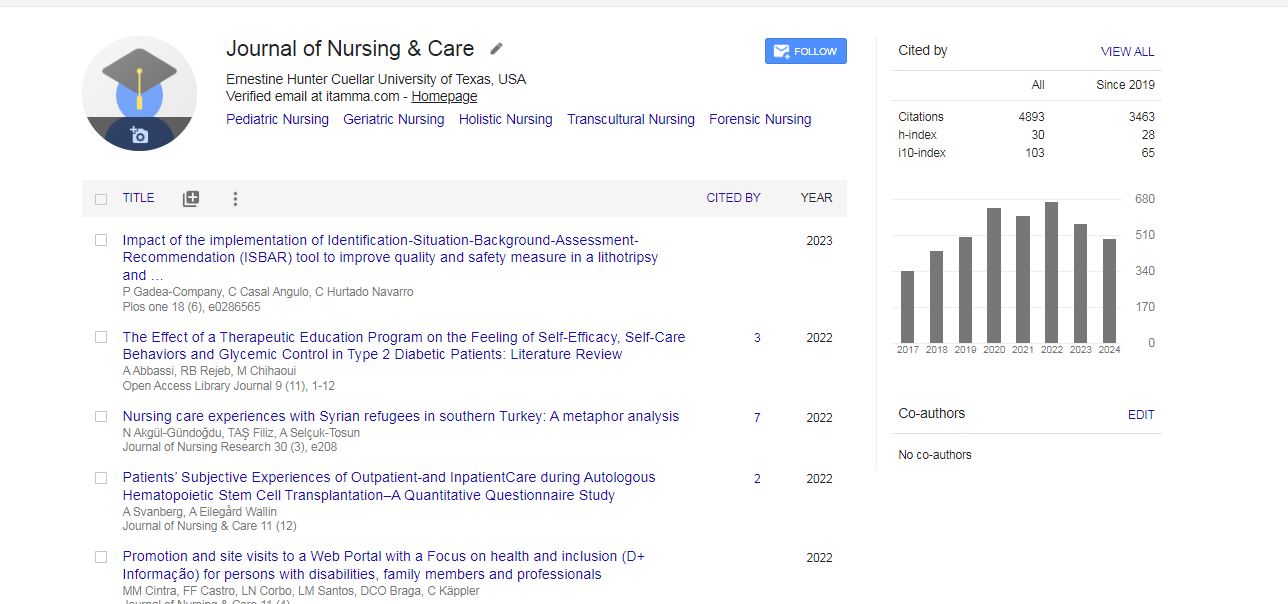
Journal of Nursing & Care received 4230 citations as per Google Scholar report