Commentary - (2025) Volume 10, Issue 5
Received: 01-Sep-2025, Manuscript No. apn-26-179338;
Editor assigned: 03-Sep-2025, Pre QC No. P-179338;
Reviewed: 14-Sep-2025, QC No. Q-179338;
Revised: 22-Sep-2025, Manuscript No. R-179338;
Published:
29-Sep-2025
, DOI: 10.37421/2573-0347.2025.10.455
Citation: Nguyen, Thomas. âTechnologyâs Transformative Role in Advanced Nursing Care.â J Adv Practice Nurs 10 (2025):455.
Copyright: © 2025 Nguyen T. This is an open-access article distributed under the terms of the Creative Commons Attribution License, which permits unrestricted use,
distribution and reproduction in any medium, provided the original author and source are credited.
The landscape of advanced nursing practice is undergoing a profound transformation driven by the seamless integration of emerging technologies. Telehealth and its associated digital tools are at the forefront of this evolution, significantly enhancing the delivery of sophisticated nursing care. These innovations enable healthcare providers to remotely monitor patients, conduct virtual consultations, and expand access to highly specialized medical services, particularly benefiting those in geographically isolated or underserved communities. This technological embrace empowers nurses to adopt a more personalized, efficient, and patient-centric approach to care. By leveraging sophisticated data analytics and robust digital platforms, nurses can proactively identify potential health issues and implement timely interventions, ultimately leading to improved patient outcomes. The integration of artificial intelligence (AI) and machine learning (ML) into advanced nursing workflows offers unprecedented predictive capabilities, allowing for early detection of patient deterioration and the development of highly individualized treatment strategies. Furthermore, AI and ML can automate many routine nursing tasks, freeing up valuable time for more complex patient interactions and critical thinking. This synergy between technology and nursing expertise supports data-driven decision-making, sharpens diagnostic accuracy, and optimizes the allocation of resources, especially when managing complex patient populations. Mobile health (mHealth) applications represent another critical component in the advancement of nursing care, playing a pivotal role in fostering patient engagement and facilitating the remote management of chronic conditions. These applications also serve as efficient channels for disseminating essential health information, empowering patients to take a more active role in their self-management and improving adherence to prescribed treatment regimens. mHealth tools extend the reach of nursing support beyond the confines of traditional clinical settings, providing continuous oversight and guidance. Wearable technology is revolutionizing patient monitoring by providing a constant stream of physiological data, which is instrumental in the early identification of subtle changes that may indicate patient decompensation. This real-time data stream facilitates proactive clinical interventions for a wide range of chronic diseases, including heart failure, diabetes, and respiratory conditions. The application of wearable technology can significantly reduce hospital readmissions and enhance the overall quality of life for patients managing long-term health challenges. The widespread adoption of electronic health records (EHRs) coupled with advanced nursing information systems is dramatically improving data accessibility and fostering better care coordination among healthcare teams. Interoperable EHR systems provide clinicians with comprehensive views of patient histories, thereby streamlining clinical workflows and minimizing the risk of medical errors through enhanced communication and seamless information exchange. Virtual reality (VR) and augmented reality (AR) are emerging as powerful tools capable of enhancing advanced nursing education and patient care through innovative methods. These immersive technologies are being employed in simulation-based training for nurses, offering realistic scenarios for skill acquisition and competency development. Additionally, VR and AR show promise in pain management and patient education, providing novel therapeutic interventions and improving the overall patient experience. Big data analytics is a cornerstone of modern advanced nursing practice, enabling the identification of critical health trends, the prediction of disease outbreaks, and the personalization of patient care pathways. By meticulously analyzing vast datasets, nurses can acquire profound insights into population health dynamics and the specific needs of individual patients. This deeper understanding facilitates the delivery of more effective, targeted, and proactive healthcare interventions, ultimately improving public health outcomes. The expanding role of telehealth in advanced nursing necessitates a careful consideration of the ethical implications, patient privacy concerns, and data security measures. Nurses must develop proficiency in navigating these complex issues to ensure the safe, secure, and effective deployment of technological solutions in healthcare. Maintaining patient trust and upholding professional standards are paramount in this evolving digital healthcare landscape.
Telehealth and technology integration are fundamentally reshaping advanced nursing care, providing unprecedented capabilities for patient monitoring and consultation. These advancements are particularly crucial in bridging the gap in healthcare access for individuals residing in remote or underserved regions, ensuring that specialized nursing services are available irrespective of geographical limitations. The adoption of these technologies empowers nurses to deliver care that is not only more personalized but also significantly more efficient, with a strong emphasis on patient-centeredness. By harnessing the power of data analytics and sophisticated digital platforms, nurses can identify at-risk patients and implement proactive interventions, thereby improving overall health outcomes and fostering preventative care strategies. Artificial intelligence (AI) and machine learning (ML) are increasingly being integrated into advanced nursing practice, offering powerful predictive analytics for identifying potential patient deterioration and enabling the creation of tailored treatment plans. The automation of routine administrative and clinical tasks through AI and ML frees up nurses to focus on higher-level cognitive functions, such as critical decision-making and complex patient management. This technological synergy enhances diagnostic accuracy and optimizes the utilization of healthcare resources, proving invaluable for managing diverse and complex patient populations. Mobile health (mHealth) applications have emerged as pivotal tools in the management of chronic diseases within advanced nursing care paradigms. These applications facilitate active patient engagement, enabling continuous remote monitoring of vital signs and adherence to treatment protocols. They also serve as effective conduits for disseminating crucial health education and information, empowering patients to better manage their conditions and promoting self-efficacy. The continuous support provided through mHealth extends nursing care beyond the confines of traditional healthcare settings, offering a sustained level of oversight and intervention. Wearable technology is fundamentally changing how patient health is monitored by providing a continuous stream of physiological data, which is critical for the early detection of subtle physiological changes that may signal impending patient decompensation. This real-time data allows for timely and proactive interventions, particularly for individuals managing chronic conditions such as heart failure, diabetes, and respiratory ailments, thereby contributing to a reduction in hospital readmissions and an overall improvement in patient quality of life. The integration of electronic health records (EHRs) with advanced nursing information systems significantly enhances the accessibility of critical patient data and fosters improved care coordination among multidisciplinary healthcare teams. Well-designed, interoperable EHR systems provide clinicians with a holistic view of patient health, streamlining clinical workflows and mitigating the risk of medical errors through enhanced communication and efficient information sharing. Virtual reality (VR) and augmented reality (AR) technologies are presenting novel opportunities within advanced nursing care, particularly in the domains of education and therapeutic intervention. These immersive technologies offer advanced simulation-based training for nurses, allowing for the development and refinement of clinical skills in a safe, controlled environment. Furthermore, VR and AR are being explored for their potential in pain management and patient education, offering innovative approaches to patient care and enhancing the overall healthcare experience. The application of big data analytics in advanced nursing practice is proving instrumental in identifying population health trends, predicting disease outbreaks, and personalizing patient care pathways. By processing and interpreting large volumes of health-related data, nurses can gain deeper insights into disease patterns and individual patient needs, leading to the development and implementation of more effective and evidence-based healthcare strategies. This analytical capability empowers nurses to move towards a more proactive and preventative model of healthcare delivery. The increasing reliance on telehealth within advanced nursing practice mandates a thorough examination of ethical considerations, including patient privacy and the security of sensitive health data. Nurses are tasked with developing a robust understanding of these technological challenges to ensure that telehealth services are delivered safely, securely, and effectively, thereby maintaining patient trust and upholding the highest professional standards in the rapidly evolving digital healthcare environment. Technology integration in advanced nursing care is also vital for overcoming geographical barriers and enhancing the overall accessibility of healthcare services. Innovations in communication platforms and remote diagnostic tools empower nurses to extend their reach and provide essential support to patients in remote or rural areas, significantly contributing to the advancement of health equity and ensuring that quality care is available to all.
Advanced nursing care is being transformed by technology, including telehealth, AI, mHealth, wearables, EHRs, VR/AR, and big data analytics. These innovations enable remote monitoring, personalized treatments, improved patient engagement, and early detection of health issues. Technology enhances data accessibility, care coordination, and efficiency, leading to better patient outcomes and reduced healthcare disparities. While offering significant benefits, the integration of these technologies also requires careful consideration of ethical implications, patient privacy, and data security.
None
None
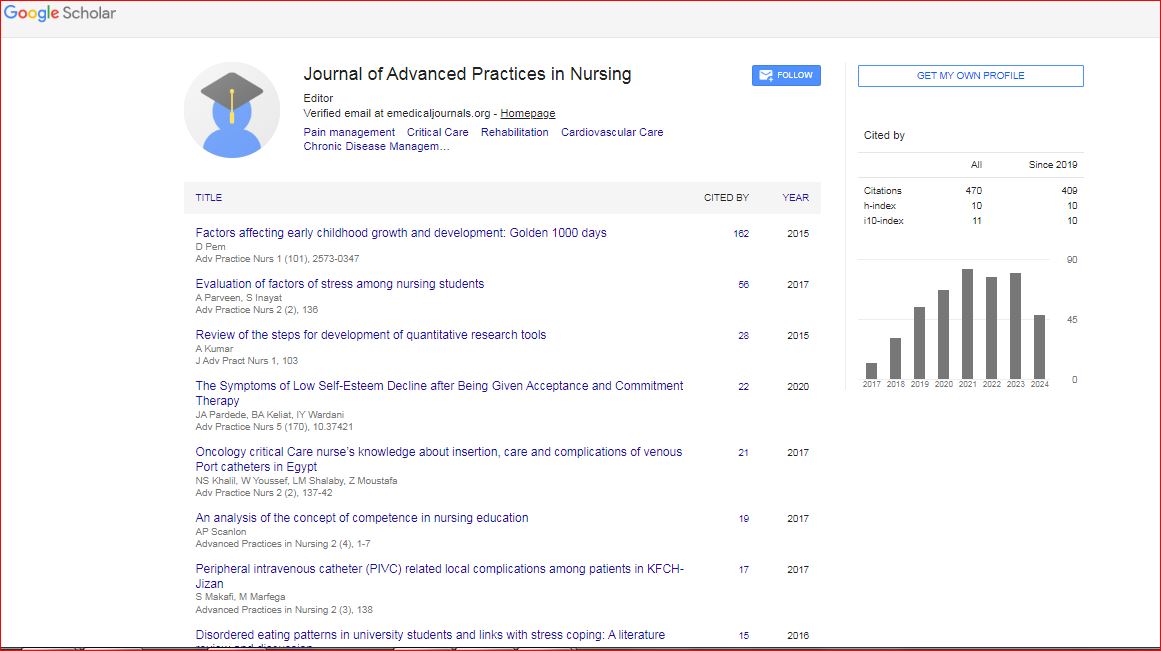
Journal of Advanced Practices in Nursing received 410 citations as per Google Scholar report