Short Communication - (2025) Volume 10, Issue 4
Received: 01-Jul-2025, Manuscript No. apn-26-179165;
Editor assigned: 03-Jul-2025, Pre QC No. P-179165;
Reviewed: 14-Jul-2025, QC No. Q-179165;
Revised: 22-Jul-2025, Manuscript No. R-179165;
Published:
29-Jul-2025
, DOI: 10.37421/2573-0347.2025.10.446
Citation: Moreau, Lucas. âTechnologyâs Impact: Advancing Health Assessment in Nursing.â J Adv Practice Nurs 10 (2025):446.
Copyright: © 2025 Moreau L. This is an open-access article distributed under the terms of the Creative Commons Attribution License, which permits unrestricted use,
distribution and reproduction in any medium, provided the original author and source are credited.
The field of nursing is undergoing a significant transformation, driven by technological advancements and evolving healthcare paradigms. Advanced health assessment techniques are at the forefront of this evolution, enabling nurses to provide more precise and personalized patient care. The integration of technology, such as artificial intelligence and wearable sensors, is enhancing patient monitoring and data analysis, leading to improved diagnostic accuracy. This article delves into novel approaches in nursing practice, emphasizing advanced health assessment techniques. It highlights the integration of technology, such as AI-driven diagnostic tools and wearable sensors, to enhance patient monitoring and data analysis. The authors advocate for continuous professional development to equip nurses with these evolving skillsets, ultimately improving diagnostic accuracy and personalized patient care [1].
Focusing on the application of telehealth, this paper explores how remote assessment technologies are transforming nursing practice. It discusses the benefits of expanded access to care, particularly for rural or underserved populations, and the challenges associated with ensuring data privacy and patient engagement. The findings suggest that well-implemented telehealth platforms can significantly augment traditional assessment methods [2].
This study examines the role of genetic screening and personalized medicine in advanced nursing assessments. It outlines how nurses can interpret genetic test results to inform risk assessments, preventative strategies, and treatment plans. The article emphasizes the ethical considerations and the need for nurses to possess a strong understanding of pharmacogenomics and its implications for patient outcomes [3].
The article investigates advanced simulation techniques for training nurses in complex assessment scenarios. It explores the use of high-fidelity manikins and virtual reality to create realistic clinical environments, allowing for practice of critical thinking and decision-making skills. The authors highlight improved competency and reduced errors in real-world practice as key benefits [4].
This research focuses on the integration of artificial intelligence (AI) and machine learning (ML) in enhancing diagnostic capabilities within nursing. It outlines how AI algorithms can analyze vast datasets, identify patterns indicative of disease, and assist nurses in making more precise diagnoses. The paper underscores the importance of AI as a supportive tool, not a replacement, for clinical judgment [5].
The article addresses the crucial role of advanced neurological assessment techniques for nurses in critical care settings. It details specific methods for evaluating cranial nerves, motor and sensory function, and reflexes, emphasizing early detection of neurological deterioration. The authors stress the need for specialized training and consistent practice to maintain proficiency [6].
This paper explores the application of advanced wound assessment techniques, focusing on the use of digital imaging and biosensors for objective measurement and monitoring of wound healing. It discusses how these technologies facilitate early identification of infection or delayed healing, enabling timely interventions and improved patient outcomes. The authors highlight the shift towards evidence-based wound care [7].
The article presents a framework for advanced cardiovascular assessment in primary care nursing. It emphasizes the early identification of cardiovascular risk factors and the use of non-invasive diagnostic tools, such as advanced electrocardiography interpretation and echocardiography screening. The authors advocate for proactive screening to prevent cardiovascular events [8].
This review explores the integration of wearable biosensors and remote patient monitoring (RPM) systems into advanced nursing practice for chronic disease management. It highlights how continuous data streams from these devices empower nurses to detect subtle changes in a patient's condition, enabling timely interventions and reducing hospital readmissions. The article also addresses challenges related to data interpretation and patient adherence [9].
The authors present a novel approach to respiratory assessment using advanced spirometry interpretation and non-invasive ventilation monitoring in home care settings. This paper emphasizes how nurses can leverage these techniques to optimize respiratory support for patients with chronic lung conditions, improve quality of life, and prevent exacerbations. It discusses the importance of patient education and skill development for effective home-based care [10].
The evolving landscape of nursing practice is characterized by the increasing adoption of advanced health assessment techniques, significantly influenced by technological integration. These advancements aim to augment nurses' capabilities in diagnosing, monitoring, and managing patient conditions more effectively. The integration of technology, such as AI-driven diagnostic tools and wearable sensors, is enhancing patient monitoring and data analysis, leading to improved diagnostic accuracy and personalized patient care through continuous professional development [1].
Telehealth has emerged as a transformative modality in nursing, extending the reach of health assessments beyond traditional clinical settings. Remote assessment technologies facilitate expanded access to care, particularly for populations in rural or underserved areas, while also presenting challenges related to data privacy and patient engagement. Nevertheless, well-implemented telehealth platforms offer a significant augmentation to conventional assessment methods [2].
Personalized medicine, particularly through genetic screening, is becoming an integral component of advanced nursing assessments. Nurses are increasingly tasked with interpreting genetic test results to guide risk assessments, preventative strategies, and treatment plans. This necessitates a strong understanding of pharmacogenomics and its ethical implications for patient outcomes [3].
Simulation-based education is revolutionizing the training of nurses in advanced health assessment skills. The use of high-fidelity manikins and virtual reality environments creates realistic clinical scenarios, enabling nurses to practice critical thinking and decision-making in a safe, controlled setting. This approach leads to improved competency and a reduction in real-world errors [4].
Artificial intelligence and machine learning are powerful tools being integrated into nursing to enhance diagnostic capabilities. AI algorithms can process extensive datasets to identify disease patterns, assisting nurses in making more precise diagnoses. It is crucial to emphasize that AI serves as a supportive tool, complementing rather than replacing clinical judgment [5].
In critical care settings, advanced neurological assessment techniques are paramount for nurses. Specialized methods for evaluating cranial nerves, motor and sensory function, and reflexes are essential for the early detection of neurological deterioration. Maintaining proficiency in these skills requires specialized training and consistent practice [6].
Innovations in advanced wound assessment are being driven by technology, including digital imaging and biosensors. These tools enable objective measurement and monitoring of wound healing, facilitating early identification of complications such as infection or delayed healing. This leads to timely interventions and improved patient outcomes, underscoring a shift towards evidence-based wound care [7].
Primary care nursing is enhancing its capacity for cardiovascular assessment through a focus on early risk identification and the use of non-invasive diagnostic tools. Advanced electrocardiography interpretation and echocardiography screening are being employed to proactively identify risk factors and prevent cardiovascular events [8].
Wearable biosensors and remote patient monitoring (RPM) systems are becoming integral to advanced nursing practice for chronic disease management. These technologies provide continuous data streams that allow nurses to detect subtle changes in a patient's condition, enabling timely interventions and reducing hospital readmissions. Challenges in data interpretation and patient adherence remain important considerations [9].
In home care, advanced respiratory assessment and management are being optimized through techniques such as advanced spirometry interpretation and non-invasive ventilation monitoring. These approaches allow nurses to enhance respiratory support for patients with chronic lung conditions, thereby improving quality of life and preventing exacerbations, with a focus on patient education and skill development [10].
This collection of articles explores the dynamic evolution of advanced health assessment in nursing practice. It highlights the significant impact of technology, including AI, telehealth, wearable biosensors, and simulation, in enhancing diagnostic accuracy, patient monitoring, and care delivery. The content also addresses specialized assessment techniques in areas like neurology, cardiology, and wound care, emphasizing personalized medicine and genetic screening. The overarching theme is the empowerment of nurses with advanced skills and tools to provide more effective and evidence-based patient care across various settings, from critical care to home health. Continuous professional development and ethical considerations are also underscored as vital components of this evolving field. The shift towards proactive, data-driven, and technologically informed nursing practices is evident throughout these discussions, promising improved patient outcomes and broader access to quality healthcare.
None
None
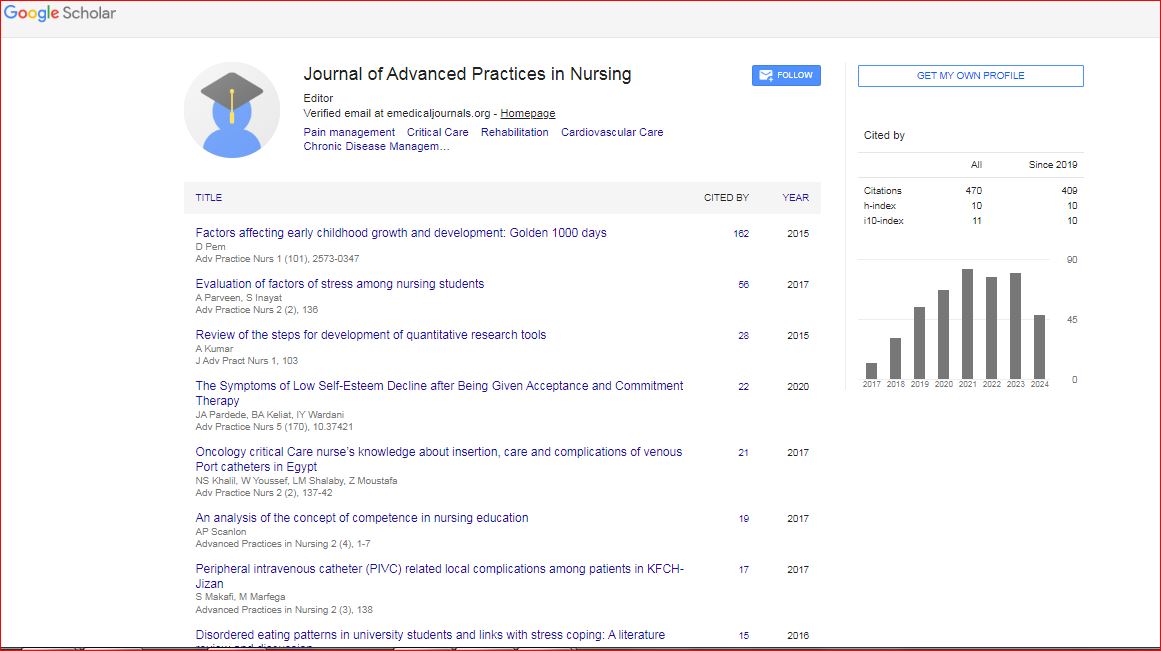
Journal of Advanced Practices in Nursing received 410 citations as per Google Scholar report