Commentary - (2025) Volume 9, Issue 5
Received: 01-Oct-2025, Manuscript No. ahbs-26-182522;
Editor assigned: 03-Oct-2025, Pre QC No. P-182522;
Reviewed: 17-Oct-2025, QC No. Q-182522;
Revised: 22-Oct-2025, Manuscript No. R-182522;
Published:
29-Oct-2025
, DOI: 10.37421/2952-8097.2025.9.334
Citation: Petersen, Lars. ”Technology Enhances Animal Health
and Welfare Monitoring.” J Anim Health Behav Sci 09 (2025):334.
Copyright: © 2025 Petersen L. This is an open-access article distributed under the terms of the Creative Commons Attribution License, which permits unrestricted use,
distribution and reproduction in any medium, provided the original author and source are credited.
The landscape of animal health and welfare is undergoing a profound transformation, driven by rapid advancements in technology that enable unprecedented levels of monitoring and insight. This technological revolution spans various animal sectors, from agriculture to wildlife conservation, promising more precise, proactive, and ethical management strategies. These innovations are not merely incremental improvements but represent a paradigm shift in how we understand and care for animals.
Automated data collection systems, powered by sophisticated sensors and artificial intelligence, are at the forefront of this evolution. They facilitate the early detection of diseases, the identification of stress indicators, and the recognition of deviations from normal behavioral patterns, thereby enhancing animal well-being. The integration of these technologies is proving crucial for developing more effective animal welfare management approaches across diverse environments and species. Wearable sensor technology has emerged as a powerful, non-invasive tool for the continuous monitoring of physiological and behavioral data in livestock. By leveraging devices such as accelerometers and GPS trackers, valuable insights can be gained into herd dynamics, individual animal activity, and early signs of distress or illness, leading to improved management practices and timely interventions. The application of machine learning algorithms, particularly in conjunction with computer vision techniques, is opening new avenues for monitoring animal welfare. Analyzing video footage from farms allows for the quantification of behavior, the detection of anomalies indicative of stress or disease, and the identification of welfare issues that might otherwise be overlooked, especially in large populations. Beyond visual and sensor-based methods, acoustic monitoring presents a cost-effective and non-intrusive approach to assessing animal welfare. By analyzing vocalizations, researchers can discern stress signals, social hierarchies, and health status, offering a valuable supplementary method for continuous herd monitoring and the refinement of husbandry practices. In the realm of wildlife, the integration of Geographic Information Systems (GIS) with remote sensing technologies is providing large-scale perspectives on animal health and behavior. Satellite imagery and GPS tracking are instrumental in understanding animal distribution, habitat utilization, and the potential spread of diseases, which are critical for conservation efforts and managing zoonotic risks. The deployment of RFID technology offers a means to meticulously track individual animal movements and social interactions within managed environments. This granular data allows for the analysis of behavioral patterns, such as dominance or submission, and the assessment of how environmental factors influence social dynamics, aiding in herd management and stress reduction. The Internet of Things (IoT) is revolutionizing animal agriculture by enabling the collection of real-time data on a multitude of parameters, including environmental conditions and animal activity. These interconnected systems are pivotal for predicting and mitigating disease outbreaks, optimizing feeding strategies, and ultimately enhancing overall animal welfare through advanced analytics. For companion animals, wearable inertial sensors, such as accelerometers and gyroscopes integrated into collars, provide detailed insights into their activity, gait, and rest patterns. This information is invaluable for monitoring recovery from injuries, detecting age-related mobility issues, and evaluating the effectiveness of behavioral interventions, contributing to improved pet care. As the deployment of these advanced monitoring technologies becomes more widespread, it is imperative to address the associated ethical considerations and data privacy challenges. Responsible data management, the development of appropriate animal consent models, and the mitigation of potential biases in AI algorithms are crucial for ensuring the ethical implementation and widespread acceptance of these powerful tools.The pervasive integration of technology into animal monitoring signifies a monumental leap forward in our ability to understand and manage animal health and behavior. Sensors and artificial intelligence are at the core of this transformation, enabling automated data collection that facilitates the early identification of diseases, stress signals, and deviations from normal behavioral patterns. This sophisticated approach to monitoring promises a future of more precise and proactive animal welfare management, applicable across a spectrum of settings, from intensive livestock farming to the delicate nuances of wildlife conservation.
Wearable sensors represent a key innovation, offering a non-invasive method for continuous data acquisition on physiological and behavioral metrics in livestock. Studies have demonstrated the efficacy of accelerometer and GPS data in identifying specific behaviors such as lameness, social interactions, and feeding patterns in cattle. This granular data provides invaluable insights for optimizing herd management and enabling early disease intervention, ultimately promoting personalized monitoring of individual animal well-being. The power of machine learning algorithms is being harnessed to analyze video footage from poultry farms, proving highly effective in detecting abnormal behaviors indicative of stress or illness. Computer vision techniques are employed to quantify activity levels, social interactions like pecking, and postural changes. This capability allows for the rapid identification of welfare concerns within large flocks, addressing issues that might otherwise remain undetected. Acoustic monitoring offers another non-intrusive and cost-effective method for assessing the welfare of various animal species, particularly pigs. By analyzing vocalizations, researchers can identify subtle stress signals, understand social dominance dynamics, and gain insights into an animal's health status. This approach contributes significantly to improved husbandry practices through continuous, low-impact monitoring. In the context of wildlife, the synergy between Geographic Information Systems (GIS) and remote sensing technologies is revolutionizing health and behavioral ecology studies. Satellite imagery and GPS tracking provide essential large-scale data on animal distribution, habitat use, and the identification of potential disease outbreak areas. This information is critically important for effective conservation strategies and for managing the risks associated with zoonotic diseases. The application of RFID technology is proving instrumental in tracking individual animal movements and social proximity within confined settings like feedlots. Analyzing the detailed movement patterns derived from RFID data enables the identification of specific behaviors, such as submissive or aggressive actions. Furthermore, it allows for the assessment of how environmental changes impact animal social dynamics, thereby aiding in the optimization of pen management and stress reduction. The Internet of Things (IoT) is central to the concept of smart animal farming, facilitating the collection of real-time data on a wide array of parameters. This includes not only environmental factors like temperature, humidity, and air quality but also detailed animal activity data. Such interconnected systems are instrumental in predicting and mitigating disease outbreaks, optimizing feeding regimes, and enhancing overall animal welfare through sophisticated predictive analytics. For the monitoring of sheep health and stress levels, drones equipped with thermal imaging cameras offer an innovative solution. Thermal imaging detects physiological changes associated with inflammation or discomfort, allowing for the rapid identification of individuals requiring attention without the need for direct handling. This non-intrusive approach significantly reduces stress on the animals. In the domain of companion animals, wearable inertial sensors, such as those found in collars containing accelerometers and gyroscopes, provide highly detailed insights into activity levels, gait patterns, and rest periods. This data is crucial for monitoring recovery from injuries, detecting early signs of age-related mobility issues, and assessing the efficacy of behavioral interventions, all contributing to improved pet care. As these technologies become more integrated into animal management, the ethical considerations and data privacy challenges become increasingly prominent. A thorough examination of responsible data management practices, the development of appropriate animal consent models where applicable, and a critical evaluation of potential biases in AI algorithms are paramount for ensuring the ethical application and successful adoption of these powerful monitoring tools.Technological advancements are revolutionizing animal health and welfare monitoring across diverse sectors. Automated systems using sensors and AI enable early disease detection and behavioral analysis. Wearable sensors provide continuous physiological data for livestock, while machine learning and computer vision analyze behavior in poultry. Acoustic monitoring offers non-intrusive welfare assessment, and GIS combined with remote sensing aids wildlife studies. RFID technology tracks individual movements in feedlots, and IoT devices enhance smart animal farming. Drones with thermal imaging monitor sheep health, and wearable sensors improve companion animal care. Ethical considerations and data privacy are crucial for responsible implementation.
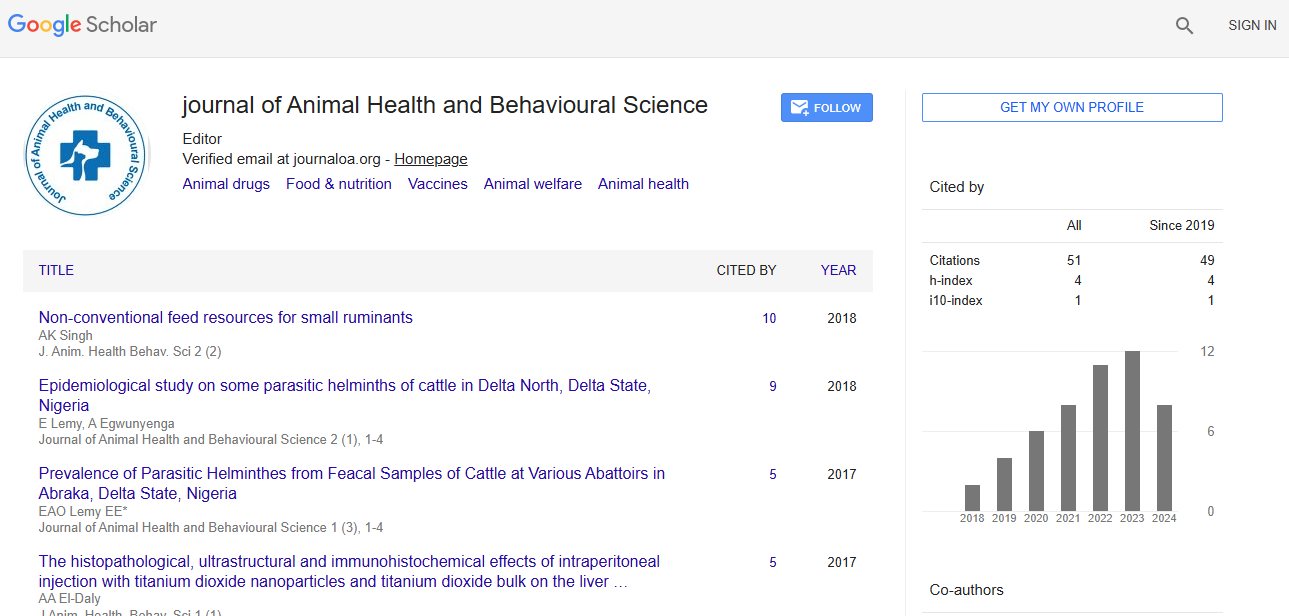
Journal of Animal Health and Behavioural Science received 38 citations as per Google Scholar report