Commentary - (2025) Volume 13, Issue 5
Received: 01-Oct-2025, Manuscript No. jaat-26-183174;
Editor assigned: 03-Oct-2026, Pre QC No. P-183174;
Reviewed: 17-Oct-2025, QC No. Q-183174;
Revised: 22-Oct-2025, Manuscript No. R-183174;
Published:
29-Oct-2025
, DOI: 10.37421/2329-6542.2025.13.372
Citation: Kuznetsova, Valeria. ”Technology Drives Lunar Science And Exploration.” J Astrophys Aerospace Technol 13 (2025):372.
Copyright: © 2025 Kuznetsova V. This is an open-access article distributed under the terms of the Creative Commons Attribution License, which permits unrestricted use, distribution and reproduction in any medium, provided the original author and source are credited.
The ongoing drive to explore and understand the Moon has spurred significant advancements in a wide array of technologies designed to facilitate scientific inquiry and future human endeavors. These technological leaps are intrinsically linked to the ambitious scientific objectives guiding lunar missions, pushing the boundaries of what is possible in this celestial frontier. Innovations in propulsion systems, for instance, are enabling faster transit times and greater payload capacities, allowing for more sophisticated scientific instruments to be deployed on the lunar surface or in orbit. Robotic exploration is at the forefront of lunar scientific discovery, with autonomous systems playing an increasingly critical role. Advances in artificial intelligence and machine learning are enhancing the capabilities of lunar rovers and landers, enabling them to navigate challenging terrains, avoid hazards, and collect valuable scientific data with minimal human intervention. This increased autonomy expands the reach and efficiency of lunar missions. The ability to utilize resources found on the Moon, known as in-situ resource utilization (ISRU), is paramount for the sustainability of long-term lunar exploration. Technologies focused on extracting water ice, producing oxygen, and employing lunar regolith for construction are crucial for establishing permanent bases and reducing the reliance on Earth-based resupply. This capability directly supports expanded scientific research. Advanced propulsion systems are a cornerstone of enhanced lunar science missions. Innovations such as electric and nuclear propulsion offer greater efficiency and power, facilitating missions that require extended stays or travel to distant lunar locations. These systems are vital for achieving a wider range of scientific goals. Miniaturization in sensor payload development is opening new avenues for high-resolution lunar science. Highly sensitive spectroscopic, imaging, and geophysical instruments are now being designed for smaller, more cost-effective landers and rovers. This trend allows for increased mission diversity and more comprehensive scientific coverage of the lunar surface. Lunar sample return missions represent a critical technological and scientific endeavor. The collection, containment, and return of lunar samples to Earth require sophisticated technologies that ensure sample integrity. The subsequent advanced analytical techniques applied to these samples provide invaluable insights into the early solar system and planetary evolution. The prospecting and characterization of water ice in the Moon's permanently shadowed regions (PSRs) is a key scientific objective, necessitating specialized technologies. Ground-penetrating radar, neutron spectrometers, and drills designed for icy environments are essential for determining the abundance and distribution of this vital resource. Understanding the Moon's magnetic field and its historical evolution is being advanced through sophisticated magnetometry technologies. Both orbital and surface missions are utilizing state-of-the-art instruments like superconducting quantum interference devices (SQUIDs) to map remnant magnetism and study the lunar dynamo. Establishing lunar observatories, particularly for radio astronomy, presents unique technological challenges and scientific opportunities. The radio-quiet environment of the lunar far side offers an unparalleled platform for studying the early universe, necessitating sensitive receivers and stable platforms. Finally, lunar geology itself offers a rich field for understanding planetary evolution, with technologies focused on geological mapping, seismic monitoring, and sample analysis aiming to unravel the Moon's differentiation history and impact processes. These studies are crucial for inferring conditions in the early solar system.
The technological advancements driving lunar exploration are intricately tied to the scientific questions that lunar missions seek to answer. The development of improved propulsion systems, for instance, directly impacts the ability to reach specific lunar destinations and deliver scientific payloads. Innovations in areas like ion thrusters and advanced chemical rockets are enabling faster transit and more precise orbital maneuvering, which are crucial for detailed surface characterization and the deployment of complex scientific instruments. Robotic systems are becoming increasingly sophisticated, with autonomous capabilities enabling them to perform complex tasks on the lunar surface. Artificial intelligence algorithms are being employed for autonomous navigation, hazard identification, and data collection, reducing the need for constant human control. This allows for more efficient scientific investigations, particularly in remote or hazardous areas. In-situ resource utilization (ISRU) technologies are not merely about survival; they are fundamental to enabling extended scientific operations. The ability to extract water ice for life support and propellant, or to use regolith for construction, significantly reduces the mass that needs to be launched from Earth, thereby lowering mission costs and increasing scientific return. This is especially important for long-duration scientific research. Advanced propulsion systems are enabling a new era of lunar science missions. Systems like solar-electric propulsion and, in the future, nuclear thermal propulsion, offer higher specific impulses, allowing for greater efficiency and the capability to transport heavier scientific payloads. This enables the deployment of larger telescopes, more sensitive detectors, and more robust surface exploration equipment. The miniaturization of sensor payloads is democratizing lunar science. By developing smaller, lighter, and more power-efficient instruments, it becomes feasible to equip a larger number of small landers and rovers with sophisticated scientific capabilities. This allows for greater spatial coverage and higher resolution data acquisition for mineralogical studies and volatile mapping. Sample return missions are a critical technology for fundamental scientific discovery. The ability to bring pristine lunar samples back to Earth allows for the application of highly advanced analytical techniques that are not feasible on the Moon. These analyses provide unparalleled insights into lunar formation, the early solar system, and the history of impacts. Prospecting for lunar water ice in permanently shadowed regions (PSRs) requires specialized technologies. Instruments like ground-penetrating radar can peer beneath the surface to detect subsurface ice, while neutron spectrometers can identify hydrogen-rich areas. Drills are then needed to collect samples for direct analysis, crucial for understanding the origin and distribution of lunar water. Studying the Moon's magnetic field provides clues about its internal structure and evolution. Advanced magnetometers, including those based on SQUID technology, are being deployed to map the remanent magnetization of the lunar crust and to investigate the remnants of a past lunar dynamo. This research helps us understand planetary core formation processes. Lunar observatories, particularly for radio astronomy, offer a unique scientific advantage due to the Moon's far side being shielded from Earth's radio emissions. Developing sensitive receivers and stable platforms that can operate in this environment is a significant technological undertaking, but it promises groundbreaking discoveries about the early universe. Finally, the study of lunar geology through advanced mapping and seismic monitoring technologies provides a window into the formation and evolution of terrestrial planets. By analyzing lunar rocks and seismic data, scientists can reconstruct the Moon's history, including its differentiation, magmatic activity, and impact history, offering vital context for understanding Earth's own past.
This collection of research highlights the symbiotic relationship between technological advancements and scientific objectives in lunar exploration. Key technological developments include improved propulsion systems, autonomous robotics, in-situ resource utilization (ISRU), advanced sensor payloads, and sophisticated sample return capabilities. These innovations are enabling scientists to pursue ambitious goals such as understanding the Moon's geological evolution, searching for water ice, studying its magnetic field, and even preparing for future human settlements. The articles emphasize how technological progress directly translates into enhanced scientific discovery and the expansion of lunar exploration frontiers. From high-resolution mapping and subsurface exploration to enabling long-duration missions and establishing lunar observatories, these technologies are critical for maximizing the scientific return from lunar missions.
None
None
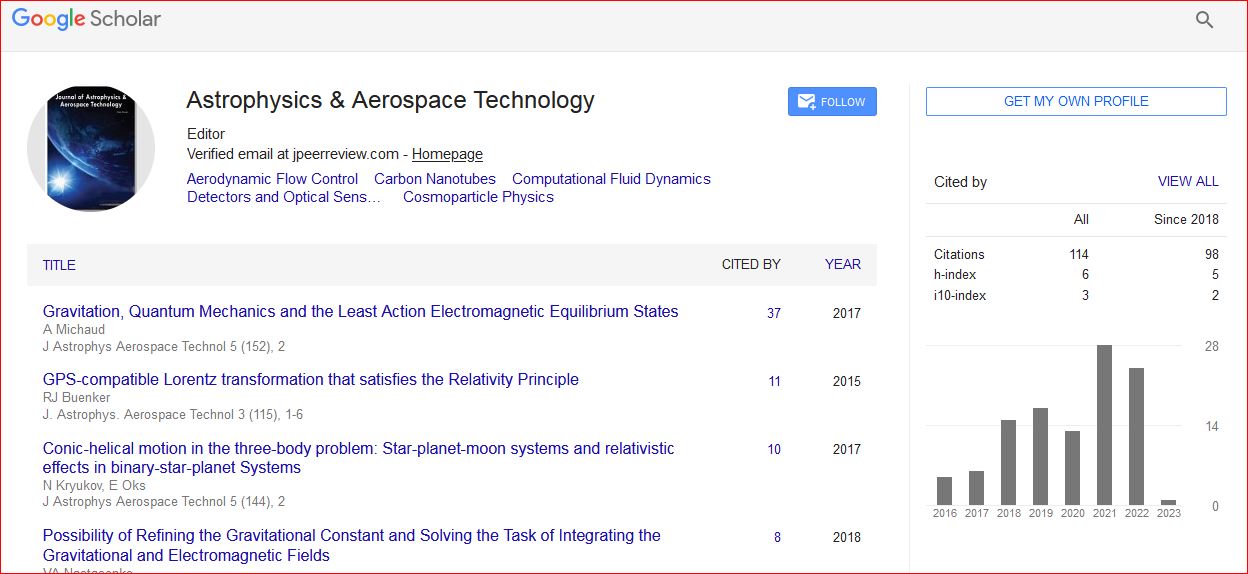
Astrophysics & Aerospace Technology received 114 citations as per Google Scholar report