Opinion - (2025) Volume 14, Issue 2
Received: 01-Mar-2025, Manuscript No. aim-25-177341;
Editor assigned: 03-Mar-2025, Pre QC No. P-177341;
Reviewed: 17-Mar-2025, QC No. Q-177341;
Revised: 24-Mar-2025, Manuscript No. R-177341;
Published:
31-Mar-2025
, DOI: 10.37421/2427-5162.2025.14.561
Citation: Gonzalez, Maria. ”TCM: Bridging Ancient Theory and Modern Practice.” Alt Integr Med 14 (2025):562.
Copyright: © 2025 Gonzalez M. This is an open-access article distributed under the terms of the Creative Commons Attribution License, which permits unrestricted use, distribution and reproduction in any medium, provided the original author and source are credited.
Traditional Chinese Medicine (TCM) is a comprehensive healthcare system rooted in ancient philosophies, providing a holistic framework for understanding health and disease. It elucidates foundational concepts such as Yin-Yang, Qi, Blood, Body Fluids, and the intricate functions of Zang-Fu organs. These principles collectively inform the diagnostic methods and diverse treatment strategies employed within the TCM paradigm, emphasizing a deep interconnectedness within the body and with the external environment [1].
Acupuncture, a prominent therapeutic modality within TCM, is subject to dual interpretations, encompassing both its traditional theoretical underpinnings and contemporary neuroscientific explanations. This dichotomy presents both challenges and valuable opportunities for researchers aiming to synthesize these distinct frameworks. Bridging the ancient wisdom with modern scientific understanding is crucial for fully comprehending and validating acupuncture's multifaceted therapeutic effects and mechanisms [2].
The application of Traditional Chinese Medicine extends to the management of complex chronic conditions, exemplified by chronic kidney disease. A systematic review has meticulously evaluated the efficacy and safety profile of various TCM herbal formulations specifically tailored for this condition. The findings consolidate existing evidence, highlighting potential therapeutic benefits while simultaneously identifying areas that necessitate more rigorous and extensive investigation to establish a robust evidence base [3].
Technological advancements, particularly in artificial intelligence (AI), are increasingly being integrated into the diagnostic landscape of Traditional Chinese Medicine. This integration is transforming traditional practices such as tongue diagnosis and pulse analysis, enhancing their precision and consistency. The application of AI holds considerable promise for standardizing diagnostic procedures, thereby contributing to the modernization and broader acceptance of TCM methodologies [4].
Syndrome differentiation stands as a fundamental diagnostic and treatment principle within Traditional Chinese Medicine, central to its personalized approach to patient care. This process involves the identification of specific patterns of disharmony within an individual, guiding the selection of appropriate therapeutic interventions. Understanding its theoretical basis and practical clinical application is essential for mastering the nuanced and effective strategies inherent in TCM [5].
Traditional Chinese Medicine has demonstrated a growing role within oncology, offering supplementary support to conventional cancer treatments. Research has focused on its efficacy in managing the often-debilitating side effects of mainstream therapies and potentially improving patient quality of life. The burgeoning evidence supports integrated approaches, though further rigorous studies are critical to solidify its evidence base and inform clinical guidelines [6].
Beyond treating existing ailments, Traditional Chinese Medicine places significant emphasis on proactive health maintenance and disease prevention. Its principles advocate for comprehensive well-being through various modalities, including specialized dietary therapy and tailored lifestyle adjustments. Specific TCM techniques are also utilized to foster robust health and significantly reduce the likelihood of disease onset, underscoring its preventative philosophy [7].
The ancient Zang-Fu organ theory, a cornerstone of Traditional Chinese Medicine, is undergoing contemporary reinterpretation to bridge historical descriptions with modern scientific understanding. This endeavor aims to integrate traditional conceptualizations of organ functions with current biological and physiological insights. Such a synthesis offers a richer, more comprehensive understanding, seeking to reconcile ancient wisdom with advancements in contemporary science [8].
Ensuring the quality of Traditional Chinese Medicine herbs and their derived products is paramount for their safety, efficacy, and eventual broader acceptance within healthcare systems. The complex nature of these botanical formulations presents unique challenges in establishing consistent quality control methods. Addressing these issues is vital for guaranteeing reliable therapeutic outcomes and building trust in TCM interventions [9].
Traditional Chinese Medicine offers a distinctive perspective on mental health and illness, interpreting psychological well-being through its unique theoretical framework. This perspective often links emotional imbalances with specific organ system disharmonies, diverging from conventional Western models. It provides a holistic lens through which to understand and address mental health challenges, proposing therapeutic strategies that target both mind and body [10].
The fundamental tenets of Traditional Chinese Medicine encompass a sophisticated understanding of the human body and its interactions with the environment. Core concepts like Yin-Yang duality, vital Qi, Blood, Body Fluids, and the intricate Zang-Fu organ system form the bedrock of its theoretical framework. These principles are not merely abstract but directly inform diagnostic approaches and therapeutic interventions, presenting a truly holistic view of health and pathology within TCM [1]. Acupuncture, a highly recognized therapeutic technique, is explored through a dualistic lens, integrating its traditional principles from Traditional Chinese Medicine with contemporary neuroscientific evidence. This dual examination elucidates the mechanisms underlying its effects, highlighting the ongoing effort to reconcile ancient practices with modern scientific inquiry. The aim is to achieve a more profound understanding of how acupuncture elicits its therapeutic benefits across various conditions [2]. An extensive systematic review and meta-analysis specifically investigates the efficacy and safety of Traditional Chinese Medicine herbal formulations in treating chronic kidney disease. This rigorous examination synthesizes data from numerous studies, providing critical insights into the potential therapeutic utility and safety profile of these complex botanical interventions. The review also identifies gaps in current research, indicating avenues for future investigations to solidify evidence [3]. The integration of Artificial Intelligence into Traditional Chinese Medicine diagnostics signifies a significant advancement in modernizing ancient practices. This review details how AI is being applied to enhance the accuracy and objectivity of diagnostic methods such as tongue and pulse analysis. By leveraging technology, TCM aims to improve the precision and standardization of its diagnostic processes, fostering greater consistency and reliability in clinical practice [4]. Syndrome differentiation is described as a cornerstone of Traditional Chinese Medicine, representing a personalized diagnostic and treatment strategy. This methodology involves the precise identification of unique patterns of disharmony within an individual, rather than merely focusing on isolated symptoms. The article elaborates on its theoretical foundations and practical application, underscoring its pivotal role in guiding effective and individualized therapeutic interventions in TCM [5]. In the realm of oncology, Traditional Chinese Medicine is increasingly recognized for its supportive role alongside conventional cancer treatments. A comprehensive review summarizes current research concerning TCM's effectiveness in mitigating adverse effects and improving patient quality of life during cancer therapy. This area of research emphasizes the potential benefits of integrated care models and delineates essential directions for future studies to strengthen the evidence base [6]. The preventative philosophy of Traditional Chinese Medicine is a crucial aspect of its healthcare model, focusing on the proactive maintenance of health rather than solely reacting to illness. This update explores various TCM principles and techniques, including dietary therapy and targeted lifestyle adjustments, designed to promote overall well-being. It details how these approaches are employed to prevent disease occurrence and foster long-term health [7]. A contemporary interpretation of the Zang-Fu theory, a fundamental concept in Traditional Chinese Medicine, is presented. This work endeavors to reconcile ancient descriptions of organ functions and interrelationships with the current understanding derived from modern biology and physiology. The goal is to create a more integrated and scientifically accessible framework for understanding these vital internal systems within the broader context of TCM [8]. The critical issue of quality control for Traditional Chinese Medicine herbs and their derivative products is thoroughly examined. This discussion highlights the inherent complexities and challenges in ensuring the consistent safety, therapeutic efficacy, and standardization of these natural compounds. Robust quality control measures are indispensable for enhancing the credibility, wider acceptance, and responsible integration of TCM products into global healthcare systems [9]. Traditional Chinese Medicine offers a distinct and holistic framework for understanding and addressing mental health concerns. This narrative review explores how TCM conceptualizes mental illness through the lens of emotional imbalances and internal organ system disharmonies. It provides valuable insights into TCM's comprehensive approach to psychological well-being, suggesting alternative therapeutic strategies that consider the mind-body connection [10].
Traditional Chinese Medicine (TCM) is a sophisticated ancient medical system built upon foundational theories like Yin-Yang, Qi, Blood, Body Fluids, and Zang-Fu organ concepts, guiding holistic diagnostics and personalized treatment strategies. Key therapeutic modalities such as acupuncture are explored through both traditional and modern scientific perspectives, aiming to bridge these frameworks for a comprehensive understanding of their therapeutic effects. TCM herbal formulations demonstrate potential in managing chronic conditions like kidney disease, though further rigorous research is needed. Modern advancements see artificial intelligence integrated into TCM diagnostics, enhancing the precision of traditional methods like tongue and pulse analysis. A core diagnostic principle, syndrome differentiation, emphasizes identifying unique patterns of disharmony for tailored interventions. Beyond individual treatments, TCM plays a supportive role in oncology, helping manage treatment side effects, and focuses significantly on disease prevention and health maintenance through lifestyle and diet. Contemporary efforts aim to integrate traditional Zang-Fu theory with modern biology. Ensuring quality control for TCM herbs is crucial for safety and efficacy, while TCM also offers a distinct, holistic perspective on mental health, linking emotional states to organ system balance. Overall, TCM presents a comprehensive, evolving approach to health and well-being.
None
None
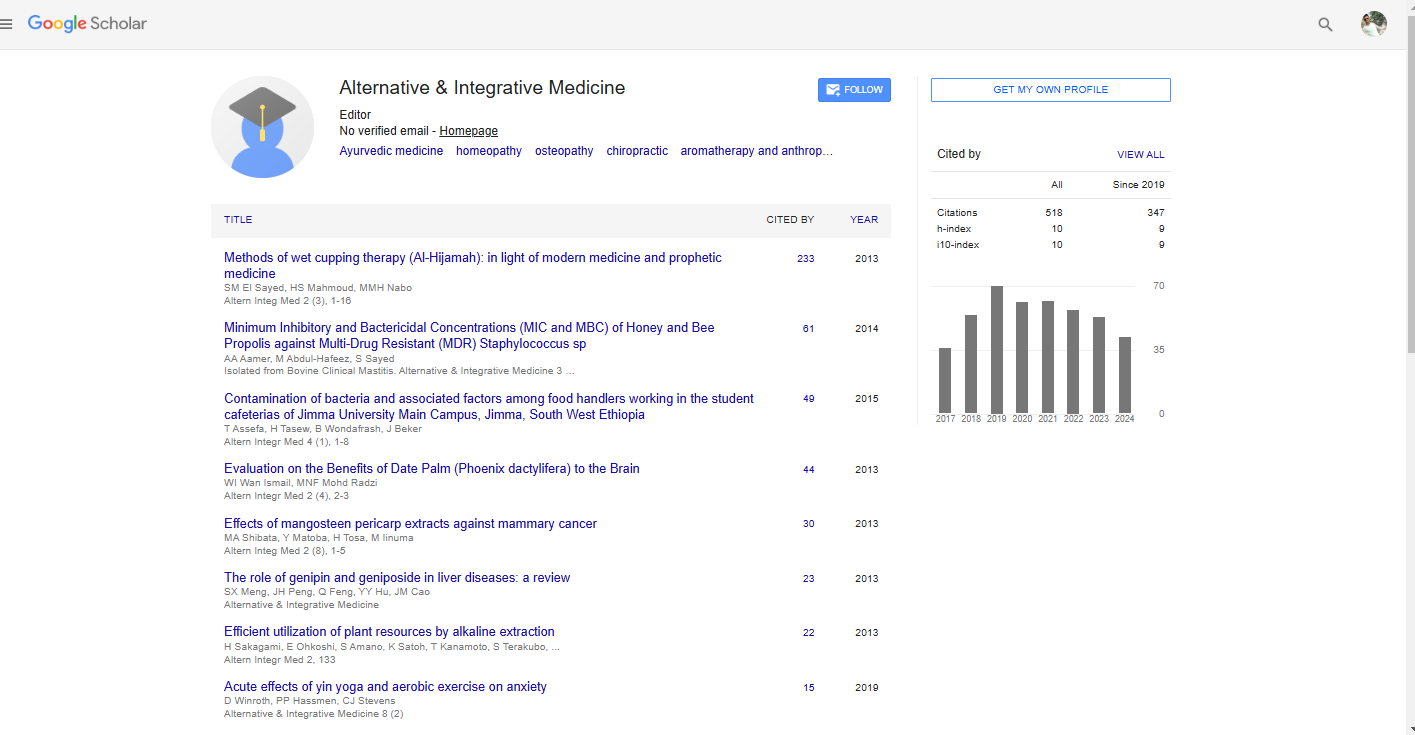
Alternative & Integrative Medicine received 476 citations as per Google Scholar report