Opinion - (2025) Volume 15, Issue 6
Received: 27-Nov-2025, Manuscript No. jmcj-25-176936;
Editor assigned: 01-Dec-2025, Pre QC No. P-176936;
Reviewed: 15-Dec-2025, QC No. Q-176936;
Revised: 22-Dec-2025, Manuscript No. R-176936;
Published:
29-Dec-2025
, DOI: 10.37421/2165-7912.2025.15.658
Citation: Krüger, Maximilian F. Tax Transparency Reshapes Global Finance and Investment.â J Mass Communicat Journalism 15(2025):658.
Copyright: © 2025 Krüger F. Maximilian This is an open-access article distributed under the terms of the Creative Commons Attribution License, which permits unrestricted
use, distribution and reproduction in any medium, provided the original author and source are credited.
In the current global economic climate, the importance of robust financial transparency and reporting mechanisms cannot be overstated. These systems are crucial for influencing corporate conduct and managing international capital flows, driving extensive academic research into their diverse impacts. Research has extensively delved into how Country-by-Country (CbC) Reporting influences the way multinational corporations handle their taxes and decide where to conduct their economic activities. CbC reporting provides tax authorities with more detailed financial information, which directly affects how firms strategize for income shifting and real investments across different countries. The findings show that while CbC reporting certainly boosts transparency, its effectiveness in curbing tax avoidance and changing investment decisions is complex, depending on specific company attributes and the scope of reporting[1].
The Common Reporting Standard (CRS) was established to fight tax evasion by enabling countries to exchange financial account information automatically. Studies explore how CRS impacts cross-border deposits. Evidence points to a significant drop in deposits held by non-resident individuals in countries that adopted the standard, proving its effectiveness in deterring undeclared offshore wealth and promoting greater financial transparency[2].
Another area of investigation focuses on whether CbC reporting actually succeeds in reducing income shifting by multinational corporations. Increased tax transparency, a direct result of CbC reporting, makes it increasingly difficult for companies to move profits to low-tax jurisdictions. This implies that having more visibility into tax-related information helps to control aggressive tax planning tactics, leading to a more equitable distribution of tax revenues worldwide[3].
Investigations also examine how CbC reporting affects multinational companies' decisions regarding investment locations. It assesses whether the enhanced tax transparency brought about by CbC reporting influences where companies choose to make their physical investments. The work offers insights into how tax reporting requirements can indirectly shape global capital allocation strategies and the economic presence of firms[4].
Regulatory reforms, especially those centered on information exchange and transparency, have a profound impact on cross-border lending. Scholars investigate how new reporting rules influence the willingness and capacity of banks to engage in international lending. Regulatory shifts aimed at increasing transparency can significantly alter the landscape of global financial flows and affect the operational choices of financial institutions[5].
Further studies explore how tax transparency reforms influence the repatriation of foreign earnings by multinational corporations. This research offers insights into whether stricter reporting requirements, intended to reduce tax avoidance, impact firms' decisions to bring profits back to their home countries. The conclusions suggest that these reforms lead to shifts in corporate financial strategies, consequently changing how capital moves across borders[6].
The impact of the Common Reporting Standard (CRS) on cross-border capital flows has also been a key focus. CRS, which enables the automatic exchange of financial account information, was introduced to combat offshore tax evasion. This work reveals that CRS has significantly decreased cross-border capital flows into tax havens, demonstrating its success in boosting financial transparency and combating illegal financial activities[7].
A critical area of research looks into the intricate connection between tax avoidance, financial development, and cross-border banking. It explores how different levels of financial development across countries influence how widespread tax avoidance strategies are within the cross-border banking sector. The findings underscore the importance of strong financial systems and effective regulatory reporting in reducing tax evasion and fostering financial stability in a globally connected economy[8].
Regarding market dynamics, research analyzes how automated information exchange, particularly through the Common Reporting Standard (CRS), affects stock markets. Authors investigate whether greater tax transparency influences corporate valuations and investor behavior. The evidence suggests that such reporting mechanisms impact market efficiency and capital allocation, as investors respond to the clearer picture of company tax affairs and potential shifts in tax avoidance opportunities[9].
Finally, the impact of Environmental, Social, and Governance (ESG) reporting on cross-border capital allocation is gaining prominence. As companies increasingly share their ESG performance, this research examines how this transparency influences investment flows across national borders. The findings indicate that solid and comparable ESG reporting plays a significant role in guiding international investment decisions, reflecting a growing investor demand for sustainable and responsible corporate practices[10].
Country-by-Country (CbC) Reporting serves as a crucial transparency measure that shapes how multinational companies manage their taxes and determine the geographical location of their economic activities. The detailed information provided by CbC reporting to tax authorities significantly influences firms’ strategies concerning income shifting and real investments across various jurisdictions [1]. While this initiative undeniably boosts transparency, its overall impact on reducing tax avoidance and altering investment decisions is nuanced, often varying based on specific company characteristics and the particular scope of reporting. Importantly, research shows CbC reporting makes it more challenging for corporations to engage in income shifting practices. The increased tax transparency directly hinders companies from moving profits to low-tax jurisdictions [3]. This heightened visibility into tax-related information actively works to curb aggressive tax planning strategies, thereby promoting a fairer global distribution of tax revenues. Moreover, CbC reporting also has a noticeable effect on multinational companies' decisions regarding where to invest, guiding global capital allocation strategies and impacting the economic footprint of firms [4].
The Common Reporting Standard (CRS) represents another vital international endeavor aimed at combating tax evasion, primarily through the automatic exchange of financial account information among participating countries. Studies consistently demonstrate that the CRS leads to a significant decrease in deposits held by non-resident individuals in jurisdictions that have adopted the standard [2]. This outcome powerfully deters undeclared offshore wealth and actively fosters greater financial transparency worldwide. Beyond just deposits, the CRS has significantly reduced cross-border capital flows into tax havens, effectively proving its capability in enhancing financial transparency and combating illicit financial activities [7]. Furthermore, the automated information exchange facilitated by CRS extends its influence to stock market dynamics. It impacts corporate valuations and investor behavior as market participants react to the enhanced clarity of company tax affairs and the potential shifts in tax avoidance opportunities, ultimately affecting market efficiency and capital allocation [9].
Broader regulatory reforms, especially those concentrating on information exchange and overall transparency, have profoundly reshaped cross-border lending activities. New reporting requirements directly influence the willingness and capacity of banks to engage in international lending. Regulatory changes specifically targeting greater transparency can fundamentally alter the landscape of global financial flows and significantly impact the operational decisions made by financial institutions [5]. These tax transparency reforms also play a crucial role in influencing the repatriation of foreign earnings by multinational corporations. Increased reporting requirements, specifically designed to reduce tax avoidance, affect how firms decide to bring profits back to their home countries. The findings suggest that these reforms lead to considerable shifts in corporate financial strategies, consequently changing the patterns of capital movement across international borders [6].
A critical area of ongoing research explores the intricate connection between tax avoidance, the level of financial development, and cross-border banking practices. This work investigates how varying levels of financial development across different countries influence the prevalence of tax avoidance strategies within the cross-border banking sector. The findings consistently highlight the immense importance of robust financial systems and the implementation of effective regulatory reporting. These elements are essential for mitigating tax evasion and for promoting financial stability within our highly interconnected global economy [8].
Finally, the impact of Environmental, Social, and Governance (ESG) reporting on cross-border capital allocation is rapidly gaining prominence. As companies increasingly disclose their ESG performance, this research examines how such transparency influences investment flows across national borders. The evidence indicates that robust and comparable ESG reporting can play a significant role in guiding international investment decisions, reflecting a growing investor demand for sustainable and responsible corporate practices globally [10]. These various transparency mechanisms, ranging from tax-specific to broader corporate disclosures, collectively underscore a global shift towards greater accountability and informed decision-making in international finance.
Tax transparency initiatives, particularly Country-by-Country (CbC) Reporting and the Common Reporting Standard (CRS), are fundamentally reshaping how multinational companies manage taxes and allocate economic activities globally. CbC reporting gives tax authorities more detailed insights, influencing firms’ strategies for income shifting and real investments across various jurisdictions. While it enhances transparency, its effectiveness in reducing tax avoidance and altering investment decisions is nuanced, varying by company characteristics and reporting scope. It also makes it harder for companies to shift profits to low-tax areas, curbing aggressive tax planning and impacting investment location decisions. The CRS, established to combat tax evasion through automated financial account information exchange, has led to a significant decrease in cross-border deposits by non-resident individuals, effectively deterring undeclared offshore wealth and boosting financial transparency. It has notably reduced capital flows into tax havens, combating illicit financial activities. This automated exchange also influences stock market dynamics, corporate valuations, and investor behavior as market efficiency adapts to clearer tax affairs. Beyond tax-specific reforms, broader regulatory changes in information exchange impact cross-border lending and global financial flows, altering corporate financial strategies and the repatriation of foreign earnings. The intricate link between tax avoidance, financial development, and cross-border banking highlights the need for robust regulatory reporting and stable financial systems. Additionally, Environmental, Social, and Governance (ESG) reporting is emerging as a critical transparency mechanism, guiding cross-border capital allocation driven by growing investor demand for sustainable practices. These diverse transparency measures collectively steer international finance and corporate conduct.
None
None
Jan CCMdJ, Rianne MMvdH, Peter WWvdP. "Country-by-Country Reporting, Tax Avoidance, and the Location of Economic Activity".Accounting, Organizations and Society 93 (2021):101265.
Indexed at, Google Scholar, Crossref
Marius B, Jonathan G, Michael BD. "The Impact of Common Reporting Standard on Cross-Border Deposits".J Public Econ 221 (2023):104860.
Indexed at, Google Scholar, Crossref
Johannes V, Martin R, Christina FFS. "Does country-by-country reporting reduce income shifting?".J Int Bus Stud 53 (2022):201-229.
Indexed at, Google Scholar, Crossref
Michelle H, Edward M, Jacob RJ. "Does Country-by-Country Reporting Affect Investment Location Decisions?".The Accounting Review 98 (2023):251-280.
Indexed at, Google Scholar, Crossref
Alexander FW, Philipp G, Philipp M. "The effects of regulatory reforms on cross-border lending".J Int Bus Stud 51 (2020):1251-1277.
Indexed at, Google Scholar, Crossref
Dhammika D, Nadine R, Jan FS. "Tax transparency reforms and the repatriation of foreign earnings".J Public Econ 208 (2022):104618.
Indexed at, Google Scholar, Crossref
Annette A, Niels J, Gabriel Z. "The Impact of Common Reporting Standard on Cross-Border Capital Flows".J Public Econ 171 (2019):1-13.
Indexed at, Google Scholar, Crossref
Yulei N, Shusong B, Junzhe L. "Tax Avoidance, Financial Development, and Cross-Border Banking".Emerg Mark Finance Trade 57 (2021):95-106.
Indexed at, Google Scholar, Crossref
Joël B, Gabriel C, Alan LH. "Automated information exchange and the stock market: Evidence from the common reporting standard".J Financial Econ 140 (2021):512-536.
Indexed at, Google Scholar, Crossref
Xiaoyan J, Li L, Bo L. "The Impact of ESG Reporting on Cross-Border Capital Allocation: A Global Perspective".J Int Financial Mark Inst Money 80 (2022):101602.
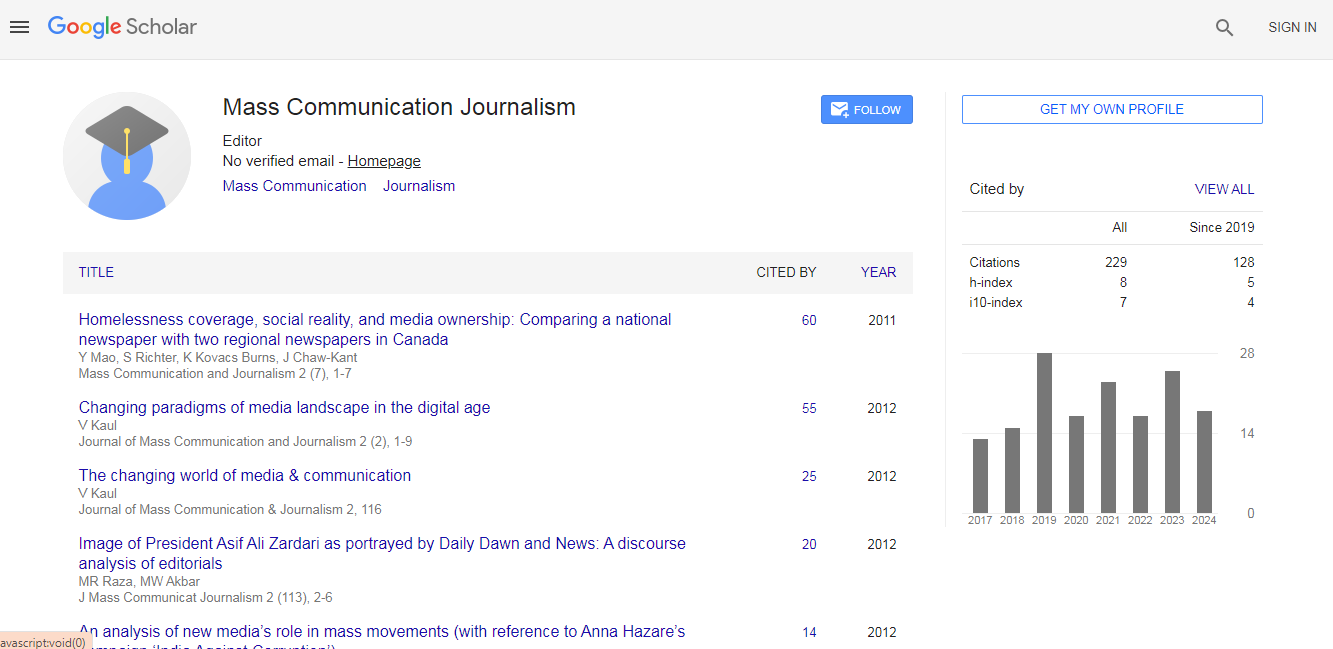
Journal of Mass Communication & Journalism received 205 citations as per Google Scholar report