Opinion - (2025) Volume 16, Issue 2
Received: 02-Mar-2025, Manuscript No. jpm-26-179348;
Editor assigned: 04-Mar-2025, Pre QC No. P-179348;
Reviewed: 18-Mar-2025, QC No. Q-179348;
Revised: 24-Mar-2025, Manuscript No. R-179348;
Published:
31-Mar-2025
, DOI: 10.37421/2090-0902.2025.16.524
Citation: Laurent, Camille. ”Symmetry And Group Theory: A Unifying Framework For Physics.” J Phys Math 16 (2025):524.
Copyright: © 2025 Laurent C. This is an open-access article distributed under the terms of the Creative Commons Attribution License, which permits unrestricted use, distribution and reproduction in any medium, provided the original author and source are credited.
The profound impact of symmetry and group theory on modern physical mathematics is a subject of extensive research, showcasing their application in diverse areas like quantum mechanics, condensed matter physics, and particle physics. These principles provide a powerful framework for understanding fundamental symmetries in nature, leading to simplified calculations and deeper insights into physical phenomena, particularly in the classification of states and particles [1].
The role of Lie groups and their representations in describing continuous symmetries, such as those found in spacetime and internal symmetries of elementary particles, is crucial. These mathematical structures are essential for formulating fundamental physical laws and predicting new particles and interactions, offering a sophisticated tool for theoretical physicists [2].
Furthermore, the application of group theory to crystallography and solid-state physics is paramount for understanding the symmetries of crystal lattices and their implications for material properties. Classifying space groups helps predict and explain phenomena like diffraction patterns, electronic band structures, and phase transitions, providing a foundational understanding of materials [3].
The significance of symmetry in quantum field theory, particularly in conserving currents and charges, is highlighted by Noether's theorem. This theorem directly links symmetries to conserved quantities, offering a profound connection between abstract mathematical principles and observable physical realities [4].
In quantum mechanics, permutation groups are vital for understanding identical particles. The symmetry of wave functions under particle exchange, governed by the permutation group, dictates whether particles are bosons or fermions, a fundamental distinction in physics [5].
The application of discrete group theory in topological phases of matter is also a key area of study. The symmetries of a material can lead to robust topological properties, such as protected edge states, which are of great interest for future electronic and quantum computing applications [6].
The role of gauge symmetry in the Standard Model of particle physics is fundamental. Local gauge symmetries dictate the fundamental forces and particles, providing a unified and consistent framework for describing electromagnetic, weak, and strong interactions [7].
A group-theoretic approach to understanding renormalization group flows in quantum field theory is also prevalent. Symmetries can constrain these flows, leading to a deeper understanding of critical phenomena and the behavior of physical systems at different scales [8].
The exploration of exceptional Lie groups in theoretical physics, particularly in string theory and grand unification models, is an active research frontier. These less common but highly symmetric structures offer potential avenues for unifying fundamental forces and describing exotic particles [9].
Finally, the connection between symmetry breaking and phase transitions in statistical mechanics is well-established. Changes in symmetry at critical points lead to distinct macroscopic behaviors, offering a powerful framework for understanding phenomena like superconductivity and magnetism [10].
The article delves into the profound impact of symmetry and group theory on modern physical mathematics, showcasing their application in diverse areas like quantum mechanics, condensed matter physics, and particle physics. It highlights how group theory provides a powerful framework for understanding fundamental symmetries in nature, leading to simplified calculations and deeper insights into physical phenomena, particularly in the classification of states and particles [1].
The paper explores the role of Lie groups and their representations in describing continuous symmetries, such as those found in spacetime and internal symmetries of elementary particles. It demonstrates how these mathematical structures are essential for formulating fundamental physical laws and predicting new particles and interactions, offering a sophisticated tool for theoretical physicists [2].
This research investigates the application of group theory to crystallography and solid-state physics, specifically in understanding the symmetries of crystal lattices and their implications for material properties. It shows how classifying space groups helps predict and explain phenomena like diffraction patterns, electronic band structures, and phase transitions, providing a foundational understanding of materials [3].
The article examines the role of symmetry in quantum field theory, particularly in conserving currents and charges. It illustrates how Noether's theorem, a cornerstone of theoretical physics, directly links symmetries to conserved quantities, offering a profound connection between abstract mathematical principles and observable physical realities [4].
This paper discusses the use of permutation groups in quantum mechanics, especially for identical particles. It explains how the symmetry of wave functions under particle exchange, governed by the permutation group, dictates whether particles are bosons or fermions, a fundamental distinction in physics [5].
The study investigates the application of discrete group theory in topological phases of matter. It demonstrates how the symmetries of a material can lead to robust topological properties, such as protected edge states, which are of great interest for future electronic and quantum computing applications [6].
This work explores the role of gauge symmetry in the Standard Model of particle physics. It explains how local gauge symmetries dictate the fundamental forces and particles, providing a unified and consistent framework for describing electromagnetic, weak, and strong interactions [7].
The article presents a group-theoretic approach to understanding renormalization group flows in quantum field theory. It shows how symmetries can constrain these flows, leading to a deeper understanding of critical phenomena and the behavior of physical systems at different scales [8].
This paper examines the role of exceptional Lie groups in theoretical physics, particularly in string theory and grand unification models. It explores how these less common but highly symmetric structures offer potential avenues for unifying fundamental forces and describing exotic particles [9].
The research discusses the connection between symmetry breaking and phase transitions in statistical mechanics. It demonstrates how changes in symmetry at critical points lead to distinct macroscopic behaviors, offering a powerful framework for understanding phenomena like superconductivity and magnetism [10].
This collection of research highlights the pervasive and fundamental role of symmetry and group theory across various branches of physics. It covers applications in quantum mechanics for understanding particle statistics, in condensed matter physics for material properties and topological phases, and in particle physics for formulating fundamental laws and describing forces. Key concepts like Lie groups, Noether's theorem, and gauge symmetry are explored, demonstrating how abstract mathematical symmetries lead to concrete physical predictions and classifications. The research emphasizes the unifying power of these principles in simplifying complex problems and revealing deeper connections within the physical world. From crystallography to quantum field theory, symmetry provides an indispensable framework for scientific inquiry and advancement.
None
None
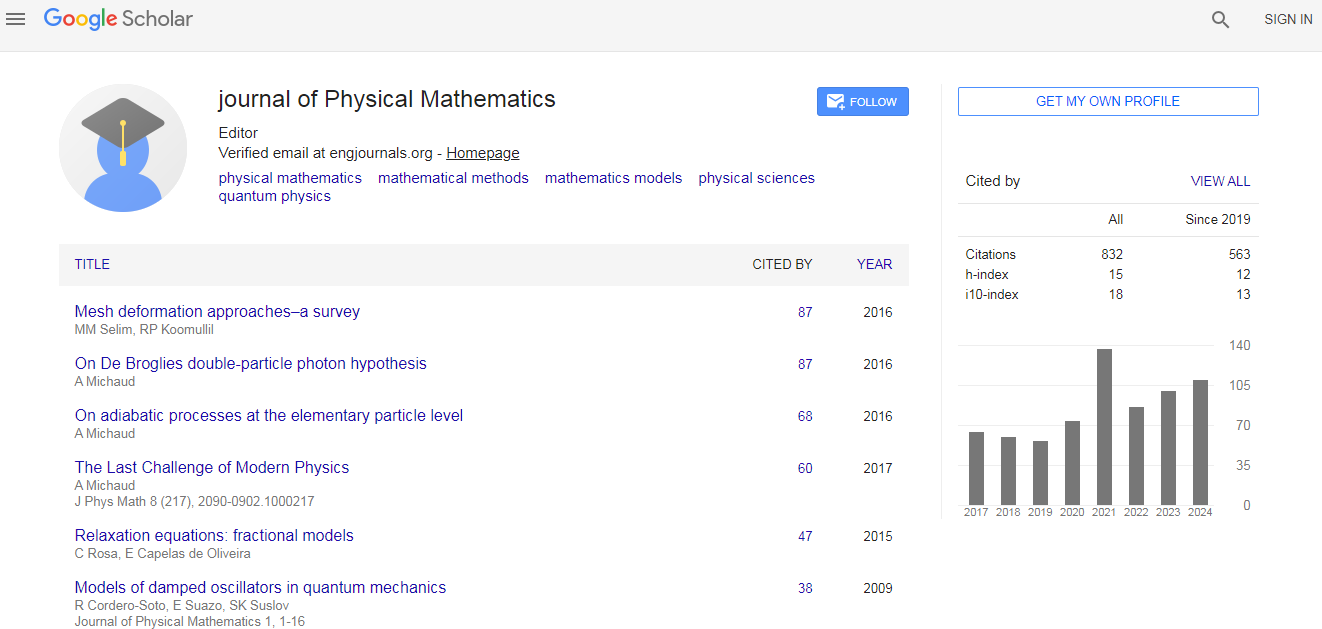
Physical Mathematics received 686 citations as per Google Scholar report