Perspective Article - (2025) Volume 16, Issue 6
Received: 01-Nov-2025, Manuscript No. hycr-25-175049;
Editor assigned: 03-Nov-2025, Pre QC No. P-175049;
Reviewed: 17-Nov-2025, QC No. Q-175049;
Revised: 24-Nov-2025, Manuscript No. R-175049;
Published:
01-Dec-2025
, DOI: 10.37421/2157-7587.2025.16.631
Citation: Nakamura, Yuki. ”Sustainable Urban Stormwater: Solutions, Resilience, Innovation.” Hydrol Current Res 16 (2025):631
Copyright: © 2025 Nakamura Y. This is an open-access article distributed under the terms of the Creative Commons Attribution License, which permits unrestricted use,
distribution and reproduction in any medium, provided the original author and source are credited.
This paper offers a comprehensive review of nature-based solutions (NBS) in urban stormwater management. It delves into the environmental, social, and economic advantages of these approaches, positioning them as sustainable alternatives to traditional infrastructure. The research highlights how NBS can significantly enhance urban resilience and promote holistic sustainability[1].
This systematic review comprehensively evaluates the performance of green infrastructure in managing urban stormwater. It focuses on how these solutions impact both the volume and pollution levels of runoff, synthesizing evidence across various green infrastructure types. The findings offer critical insights into optimizing urban water management strategies[2].
This study investigates the effectiveness of green infrastructure in controlling stormwater runoff pollution within a university campus in China. It provides a practical case study demonstrating how integrated green solutions can significantly reduce pollutant loads and manage runoff volumes in urbanized settings. The findings offer valuable insights for similar urban development projects[3].
This review article explores the current state of stormwater harvesting and reuse in urban environments. It identifies both the significant challenges, such as water quality concerns and regulatory hurdles, and the numerous opportunities for integrating stormwater into sustainable urban water cycles. The paper underscores its potential for water supply augmentation and enhanced urban resilience[4].
This systematic review and meta-analysis rigorously assesses the performance of various low impact development (LID) practices in urban stormwater management. It quantifies the effectiveness of LIDs in reducing runoff volume and pollutant loads, providing critical data for evidence-based planning and design. The study emphasizes the broad applicability and environmental benefits of these decentralized solutions[5].
This review critically examines urban stormwater management policies and their influence on the adoption and implementation of green infrastructure. It identifies policy gaps, regulatory challenges, and successful frameworks that promote sustainable stormwater practices. The paper highlights the necessity of integrated governance for effective green infrastructure deployment and urban resilience[6].
This review synthesizes research on the effectiveness of biofiltration systems in removing emerging contaminants from urban stormwater runoff. It explores various biofilter designs, media compositions, and their capabilities in treating a wide range of pollutants, including pharmaceuticals and personal care products. The study highlights biofilters as a promising, sustainable solution for improving stormwater quality[7].
This review focuses on the advancements in real-time monitoring and modeling of urban stormwater quality. It evaluates various sensor technologies, data acquisition methods, and modeling approaches used to capture dynamic changes in stormwater composition. The paper highlights the critical role of these technologies in informing adaptive management strategies and protecting receiving water bodies[8].
This critical review synthesizes current knowledge on the presence and fate of microplastics and associated heavy metals in urban stormwater runoff. It discusses their sources, pathways, and environmental implications, highlighting the emerging threat these contaminants pose to aquatic ecosystems. The paper emphasizes the urgent need for effective mitigation strategies and enhanced treatment technologies[9].
This review addresses the critical issue of aging stormwater infrastructure in urban areas. It discusses the challenges posed by deteriorating systems, including increased flood risk and environmental degradation, and explores various solutions for enhancing sustainability and resilience. The paper advocates for integrated planning, smart technologies, and robust maintenance programs to upgrade urban drainage networks[10].
Urban stormwater management presents a complex challenge, one increasingly met by innovative, sustainable solutions. Nature-based solutions (NBS), green infrastructure (GI), and low impact development (LID) practices are key among these, demonstrating significant potential for enhancing urban resilience. Research shows NBS offers comprehensive environmental, social, and economic advantages, positioning them as vital alternatives to traditional infrastructure. These approaches can profoundly improve a city's ability to cope with stormwater events and foster overall sustainability [1]. Green infrastructure, specifically, has been evaluated for its effectiveness in managing both the volume and pollution levels of urban runoff, providing critical insights for optimizing water management strategies [2]. A practical case study further illustrates how integrated green solutions, even on a university campus, can notably reduce pollutant loads and manage runoff volumes in urban settings, offering valuable lessons for similar development projects [3].
The performance of LID practices for urban stormwater management has been rigorously assessed through systematic reviews and meta-analyses. These studies quantify the effectiveness of LIDs in reducing runoff volume and pollutant loads, delivering essential data for evidence-based planning and design. The broad applicability and environmental benefits of these decentralized solutions are consistently emphasized, showcasing their utility across diverse urban landscapes [5].
Beyond runoff quantity, the quality of stormwater is a major concern. Biofiltration systems, for instance, have been found effective in removing emerging contaminants, including pharmaceuticals and personal care products. Various biofilter designs and media compositions have been explored for their capabilities in treating a wide range of pollutants, underscoring biofilters as a promising, sustainable solution for improving stormwater quality [7]. However, the presence and fate of microplastics and associated heavy metals in urban stormwater runoff remain a critical issue. Their sources, pathways, and environmental implications pose an emerging threat to aquatic ecosystems, demanding urgent mitigation strategies and enhanced treatment technologies [9].
Managing stormwater effectively also involves advanced monitoring and strategic resource utilization. Advancements in real-time monitoring and modeling are crucial for understanding dynamic changes in stormwater composition. Various sensor technologies, data acquisition methods, and modeling approaches play a critical role in informing adaptive management strategies, ultimately protecting receiving water bodies from pollution [8]. Furthermore, stormwater harvesting and reuse offer significant opportunities for integrating stormwater into sustainable urban water cycles, potentially augmenting water supply and enhancing resilience. However, this promising area faces considerable challenges, including water quality concerns and regulatory hurdles that require careful navigation to unlock its full potential [4].
Effective policy frameworks are indispensable for the widespread adoption and successful implementation of sustainable stormwater management practices. A critical review of urban stormwater management policies reveals existing gaps and regulatory challenges, alongside successful frameworks that promote sustainable practices. Integrated governance is highlighted as a necessity for effective green infrastructure deployment and strengthening urban resilience [6]. Overlaying these challenges is the pervasive issue of aging stormwater infrastructure in many urban areas. Deteriorating systems lead to increased flood risk and environmental degradation. To combat this, comprehensive solutions are proposed, advocating for integrated planning, smart technologies, and robust maintenance programs to upgrade urban drainage networks and ensure long-term sustainability [10]. Addressing these interconnected issues collectively is essential for creating resilient and sustainable urban environments.
The collective research highlights diverse aspects of urban stormwater management, emphasizing sustainable and resilient approaches. Papers review nature-based solutions (NBS), green infrastructure (GI), and low impact development (LID) practices, demonstrating their effectiveness in managing runoff volume and pollutant loads. These studies underscore the environmental, social, and economic benefits of such solutions, advocating for their role in enhancing urban resilience and holistic sustainability. Further research delves into specific treatment methods, like biofiltration systems, for removing emerging contaminants from stormwater. The challenge of microplastics and associated heavy metals is also critically reviewed, identifying sources and urging effective mitigation strategies. Monitoring advancements, including real-time technologies and modeling, are explored as vital tools for adaptive management and protecting water bodies. Discussions extend to strategic considerations like stormwater harvesting and reuse, identifying both opportunities and obstacles such as water quality and regulatory issues. The broader policy landscape influencing GI implementation is also examined, highlighting gaps and successful frameworks for sustainable practices. Finally, the critical issue of aging stormwater infrastructure is addressed, proposing integrated planning, smart technologies, and robust maintenance for upgrading urban drainage networks and ensuring long-term sustainability. Together, these works present a comprehensive picture of current challenges and innovative solutions in urban stormwater management.
None
None
Indexed at, Google Scholar, Crossref
Indexed at, Google Scholar, Crossref
Indexed at, Google Scholar, Crossref
Indexed at, Google Scholar, Crossref
Indexed at, Google Scholar, Crossref
Indexed at, Google Scholar, Crossref
Indexed at, Google Scholar, Crossref
Indexed at, Google Scholar, Crossref
Indexed at, Google Scholar, Crossref
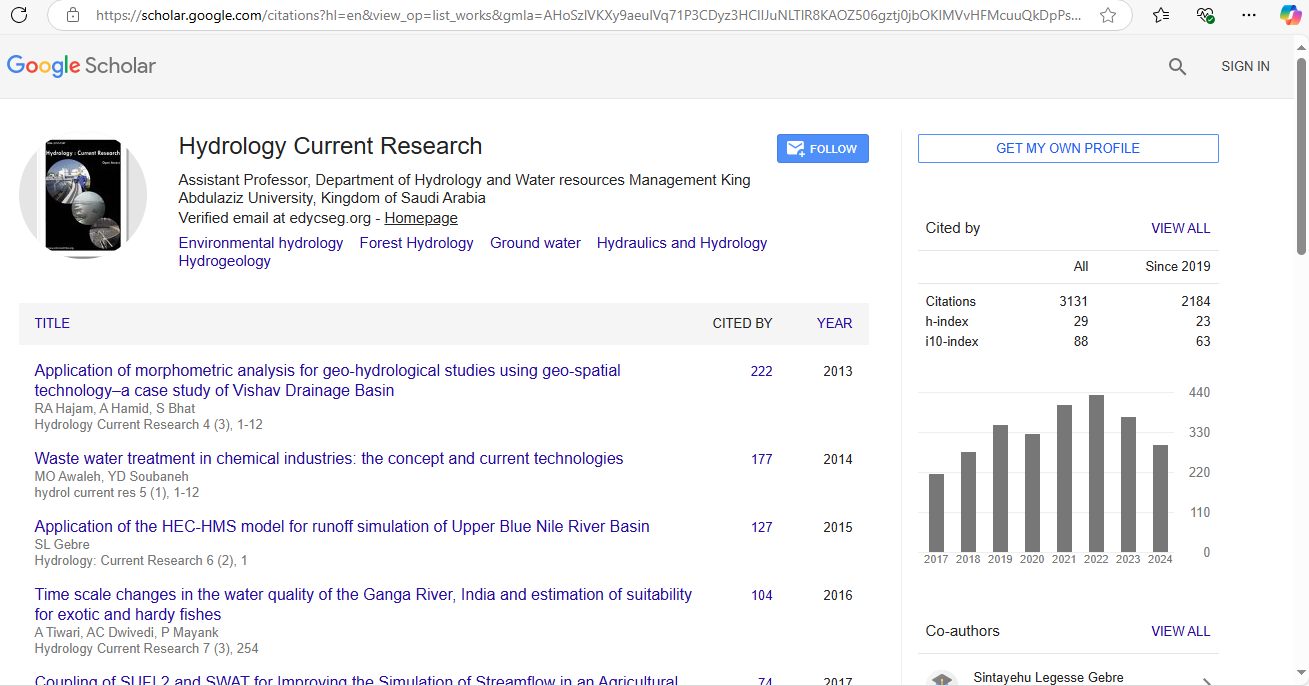
Hydrology: Current Research received 2843 citations as per Google Scholar report