Perspective - (2025) Volume 15, Issue 5
Received: 01-Sep-2025, Manuscript No. jtese-26-184251;
Editor assigned: 03-Sep-2025, Pre QC No. P-184251;
Reviewed: 17-Sep-2025, QC No. Q-184251;
Revised: 22-Sep-2025, Manuscript No. R-184251;
Published:
29-Sep-2025
, DOI: 10.37421/2165-8064.2025.15.674
Citation: Khan, Ayesha. ”Sustainable Textiles: Technology, Ethics, and Circularity.” J Textile Sci Eng 15 (2025):674.
Copyright: © 2025 Khan A. This is an open-access article distributed under the terms of the Creative Commons Attribution License, which permits unrestricted use, distribution and reproduction in any medium, provided the original author and source are credited.
The textile industry stands at a critical juncture, facing increasing scrutiny regarding its environmental and social footprint. This necessitates a fundamental shift towards sustainable practices across the entire supply chain, a transition that is both challenging and presents significant opportunities for innovation and growth. The imperative to move away from traditional manufacturing methods, which have historically contributed to issues like water pollution, substantial carbon emissions, and concerning labor practices, is becoming undeniable [1].
Technological advancements are playing a pivotal role in enabling this transformation. The integration of digital tools, such as blockchain for enhanced transparency and artificial intelligence for optimized resource management, is proving crucial in creating more efficient and traceable supply chains. These innovations not only address environmental concerns but also contribute to improved operational efficiency and ethical oversight [2].
Material innovation represents another cornerstone of sustainable textile manufacturing. The development and adoption of recycled, biodegradable, and bio-based fibers offer promising alternatives to conventional materials, significantly reducing the environmental burden associated with their production and disposal. This area of research is vital for driving impactful environmental improvements [3].
Beyond environmental considerations, the socio-economic dimensions of textile supply chains are equally important. Ensuring fair labor practices, promoting ethical working conditions, and fostering positive community engagement are integral to achieving true sustainability. This requires a holistic approach that considers the well-being of all stakeholders involved in the production process [4].
The circular economy paradigm offers a transformative framework for the textile industry, moving away from linear models of production and consumption towards regenerative systems. By focusing on product design for longevity, effective recycling, and waste minimization, the industry can unlock new value streams and significantly reduce its environmental impact [5].
Within the manufacturing process, dyeing and finishing are particularly resource-intensive stages, often associated with high water consumption and chemical pollution. The exploration and implementation of eco-friendly alternatives, such as waterless dyeing and bio-based dyes, are essential for mitigating these environmental impacts and fostering a greener industry [6].
Transparency and traceability are fundamental enablers of sustainable textile manufacturing. Technologies that provide end-to-end visibility of the supply chain allow for verification of material origins, assurance of ethical production, and credible communication of sustainability efforts to consumers. This builds trust and accountability throughout the value chain [7].
Policy and regulatory frameworks are crucial in driving the adoption of sustainable practices. International agreements, national legislation, and industry standards shape environmental, social, and governance performance, incentivizing responsible behavior and penalizing non-compliance. Harmonized regulations are key to creating a fair playing field for all businesses [8].
Consumer demand is a powerful catalyst for change in the textile industry. Understanding consumer perceptions of sustainability, their willingness to pay for eco-friendly products, and the influence of clear labeling is vital. Educating consumers and providing credible information can significantly boost market demand for sustainable options [9].
Finally, the integration of sustainable practices within small and medium-sized enterprises (SMEs) presents unique challenges and opportunities. Supporting SMEs through collaborative initiatives, access to funding, and appropriate technologies is essential for ensuring that sustainability efforts are widespread and inclusive across the entire industry [10].
The imperative for textile manufacturers to embrace sustainable supply chain practices is thoroughly explored, highlighting the detrimental environmental and social consequences of conventional methods, including water pollution, carbon emissions, and labor exploitation. Strategies such as circular economy models, ethical sourcing, eco-friendly processing, and transparent traceability are presented as key mitigation measures, emphasizing that sustainability yields both ethical and economic benefits through waste reduction, enhanced reputation, and regulatory compliance [1].
This paper delves into the technological advancements propelling sustainable textile manufacturing, particularly the role of digital tools in supply chain management. It examines how blockchain technology ensures transparency and traceability from raw material to finished product, combating counterfeiting and guaranteeing ethical labor practices, while AI and IoT optimize resource use, reduce energy consumption, and improve waste management, all vital for achieving sustainability and efficiency [2].
The critical role of material innovation in constructing sustainable textile supply chains is investigated, focusing on the development and application of recycled, biodegradable, and bio-based fibers as alternatives to resource-intensive conventional materials. The environmental footprint analysis of these novel materials across their lifecycle addresses challenges and opportunities for industrial-scale adoption, underscoring material science's potential for significant environmental gains [3].
This study scrutinizes the socio-economic facets of sustainable textile supply chains, concentrating on fair labor and community engagement. It analyzes ethical implications of globalized production, including working conditions, wages, and worker empowerment, proposing frameworks for social responsibility through certifications, codes of conduct, and direct community engagement, asserting that true sustainability must balance environmental protection with social equity [4].
The circular economy is presented as a transformative approach for the textile sector, outlining principles for designing products for longevity and recyclability, establishing efficient collection and sorting systems for post-consumer textiles, and employing innovative fiber regeneration and upcycling methods. Case studies demonstrate the economic viability of circular models in minimizing waste, conserving resources, and creating new value streams [5].
This research critically evaluates the environmental impacts of traditional textile dyeing and finishing processes, particularly concerning water usage and chemical pollution, and investigates advanced eco-friendly alternatives. It assesses the performance, scalability, and environmental advantages of methods like waterless dyeing and bio-based dyes, providing a pathway for the industry to diminish its ecological footprint in this critical manufacturing stage [6].
The significance of supply chain transparency and traceability in achieving sustainable textile manufacturing is examined, exploring how technologies like RFID, QR codes, and blockchain offer end-to-end visibility. This allows brands to verify material origins, ensure ethical production, and communicate sustainability efforts, while also discussing implementation challenges and the benefits of increased accountability and trust in complex global networks [7].
This paper reviews the global regulatory landscape and policy interventions influencing sustainable textile supply chains, analyzing the impact of international agreements, national laws, and industry standards on ESG performance. It discusses how policy can incentivize sustainable practices, penalize non-compliance, and foster innovation, emphasizing the need for harmonized regulations to ensure a competitive and level playing field for sustainable businesses [8].
The article concentrates on consumer behavior and demand for sustainable textile products, investigating consumer perceptions, willingness to pay for eco-friendly garments, and the impact of labeling and marketing. It analyzes how consumer awareness and purchasing decisions can drive sustainable practices across the supply chain, highlighting the importance of consumer education and clear, credible sustainability information in fostering market demand [9].
This study examines the challenges and strategies for implementing sustainable practices in textile SMEs, identifying resource constraints, lack of technical expertise, and limited market access as key barriers. It proposes practical solutions, including collaboration, access to funding and training, and the adoption of cost-effective sustainable technologies, stressing the importance of supporting SMEs for broad industry-wide sustainability adoption [10].
This collection of research explores the multifaceted landscape of sustainable textile manufacturing. It highlights the critical need for environmental and social responsibility, moving away from traditional, impactful practices. Key areas of focus include the integration of advanced technologies like blockchain and AI for supply chain transparency and efficiency, the development of innovative eco-friendly materials, and the implementation of circular economy principles to minimize waste and maximize resource utilization. The importance of fair labor practices, ethical sourcing, and community engagement is emphasized, alongside the role of sustainable dyeing and finishing techniques in reducing ecological footprints. Furthermore, the research addresses the influence of consumer demand, the impact of regulatory frameworks, and the specific challenges faced by small and medium-sized enterprises in adopting sustainable supply chain management. Ultimately, these studies collectively advocate for a comprehensive and collaborative approach to achieving a truly sustainable textile industry.
None
None
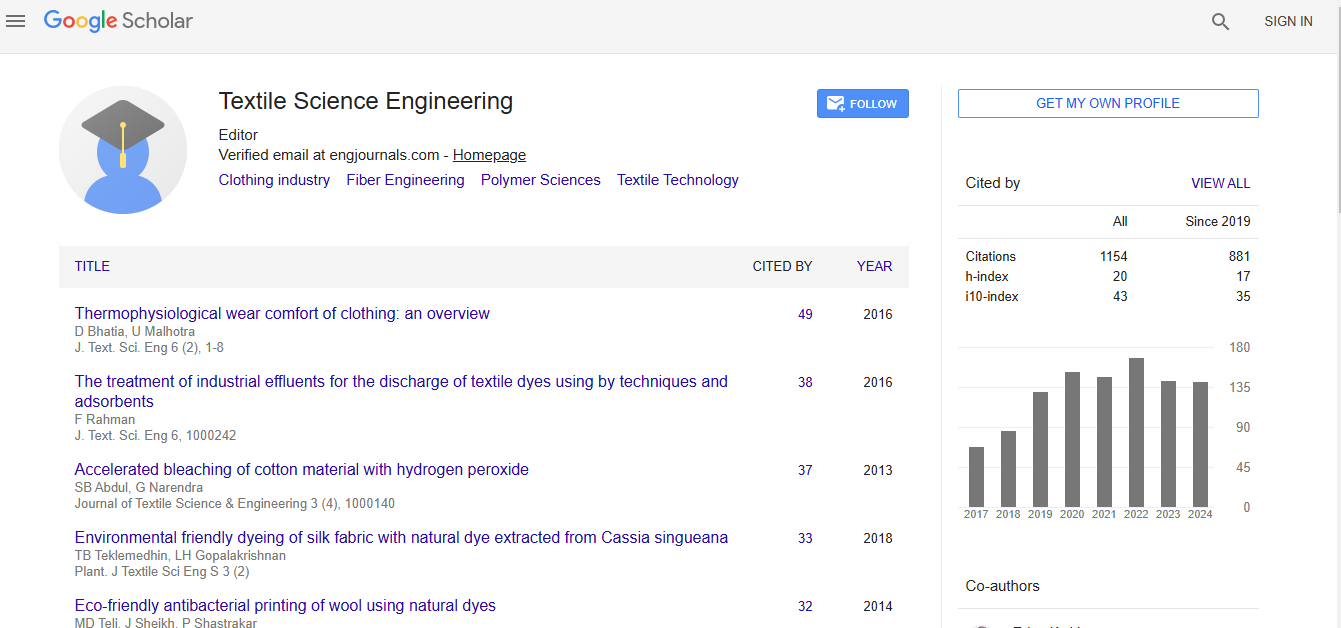
Journal of Textile Science & Engineering received 1008 citations as per Google Scholar report