Perspective - (2025) Volume 15, Issue 3
Received: 01-May-2025, Manuscript No. jcde-25-175378;
Editor assigned: 05-May-2025, Pre QC No. P-175378;
Reviewed: 19-May-2025, QC No. Q-175378;
Revised: 22-May-2025, Manuscript No. R-175378;
Published:
29-May-2025
, DOI: 10.37421/2165-784X.2025.15.607
Citation: Zhao, Ming. ”Sustainable, Smart, Resilient Urban Mobility
Planning.” J Civil Environ Eng 15 (2025):607.
Copyright: © 2025 Zhao M. This is an open-access article distributed under the terms of the Creative Commons Attribution License, which permits unrestricted use, distribution
and reproduction in any medium, provided the original author and source are credited.
This paper develops a holistic framework for assessing the sustainability of urban transportation systems. It integrates environmental, economic, and social dimensions, offering a practical tool for planners to evaluate and guide policy towards more sustainable urban mobility solutions, moving beyond traditional performance metrics[1].
This review provides a thorough look at resilience in public transportation systems, summarizing existing research on concepts, assessment methods, and strategies for improvement. It highlights gaps and outlines critical directions for future studies, which is essential for making transit networks more robust against disruptions[2].
The paper systematically reviews the concept of smart mobility within smart cities, identifying key technologies, applications, and challenges. It emphasizes the integration of information and communication technologies to create efficient, sustainable, and user-centric urban transportation[3].
This systematic review explores how transportation planning is incorporating climate change adaptation measures. It highlights the growing recognition of climate risks to infrastructure and operations, emphasizing the need for robust strategies to build resilient transportation systems in the face of environmental shifts[4].
The paper conducts a scoping review on active transportation planning, focusing on its health impacts and crucial equity considerations. It demonstrates how promoting walking and cycling can improve public health outcomes, but stresses the importance of equitable access to infrastructure and safe environments for all community members[5].
This review examines the progress in data-driven urban transportation planning, identifying how big data and advanced analytics are transforming decision-making. It discusses the current capabilities, benefits, and future challenges in leveraging vast datasets to optimize urban mobility and infrastructure[6].
This systematic review focuses on the methodological approaches used to study transportation equity and accessibility. It highlights the diverse analytical tools and frameworks applied to understand disparities in access to transportation services, offering insights for more equitable planning[7].
The paper offers a policy and planning perspective on the integration of autonomous vehicles (AVs) into urban transportation systems. It explores potential impacts on traffic, infrastructure, and urban form, suggesting policy considerations for cities to effectively manage the transition to widespread AV adoption[8].
This review synthesizes current knowledge on urban freight transportation planning, examining policies, challenges, and opportunities in this often-overlooked area. It addresses issues like congestion, emissions, and last-mile delivery, proposing strategies for more efficient and sustainable urban logistics[9].
The paper provides a comprehensive review of frameworks and indicators used for evaluating Sustainable Urban Mobility Plans (SUMPs). It critically assesses various methodologies, helping planners understand effective ways to measure the success and impact of their mobility strategies in achieving urban sustainability goals[10].
This paper develops a holistic framework for assessing the sustainability of urban transportation systems. It integrates environmental, economic, and social dimensions, offering a practical tool for planners to evaluate and guide policy towards more sustainable urban mobility solutions, moving beyond traditional performance metrics. This review provides a thorough look at resilience in public transportation systems, summarizing existing research on concepts, assessment methods, and strategies for improvement. It highlights gaps and outlines critical directions for future studies, which is essential for making transit networks more robust against disruptions. The paper systematically reviews the concept of smart mobility within smart cities, identifying key technologies, applications, and challenges. It emphasizes the integration of information and communication technologies to create efficient, sustainable, and user-centric urban transportation [1, 2, 3].
This systematic review explores how transportation planning is incorporating climate change adaptation measures. It highlights the growing recognition of climate risks to infrastructure and operations, emphasizing the need for robust strategies to build resilient transportation systems in the face of environmental shifts. The paper conducts a scoping review on active transportation planning, focusing on its health impacts and crucial equity considerations. It demonstrates how promoting walking and cycling can improve public health outcomes, but stresses the importance of equitable access to infrastructure and safe environments for all community members [4, 5].
This review examines the progress in data-driven urban transportation planning, identifying how big data and advanced analytics are transforming decision-making. It discusses the current capabilities, benefits, and future challenges in leveraging vast datasets to optimize urban mobility and infrastructure. This systematic review focuses on the methodological approaches used to study transportation equity and accessibility. It highlights the diverse analytical tools and frameworks applied to understand disparities in access to transportation services, offering insights for more equitable planning [6, 7].
The paper offers a policy and planning perspective on the integration of autonomous vehicles (AVs) into urban transportation systems. It explores potential impacts on traffic, infrastructure, and urban form, suggesting policy considerations for cities to effectively manage the transition to widespread AV adoption. This review synthesizes current knowledge on urban freight transportation planning, examining policies, challenges, and opportunities in this often-overlooked area. It addresses issues like congestion, emissions, and last-mile delivery, proposing strategies for more efficient and sustainable urban logistics [8, 9].
The paper provides a comprehensive review of frameworks and indicators used for evaluating Sustainable Urban Mobility Plans (SUMPs). It critically assesses various methodologies, helping planners understand effective ways to measure the success and impact of their mobility strategies in achieving urban sustainability goals [10].
Recent research in urban transportation planning explores a range of critical topics to foster sustainable and resilient urban environments. A holistic framework helps assess the sustainability of urban transportation systems, integrating environmental, economic, and social factors for policy guidance. Resilience in public transportation is thoroughly examined, identifying assessment methods and strategies crucial for making transit networks robust against disruptions. The field also systematically reviews smart mobility within smart cities, highlighting how Information and Communication Technologies (ICT) create efficient, sustainable, and user-centric urban transport. Climate change adaptation measures are increasingly integrated into transportation planning, recognizing risks to infrastructure and the need for resilient systems. Discussions extend to active transportation planning, focusing on health impacts and equity, promoting walking and cycling while stressing fair access. Data-driven approaches are transforming urban planning, using big data and analytics to optimize mobility and infrastructure. Methodological reviews address transportation equity and accessibility, understanding disparities and informing equitable planning. The integration of autonomous vehicles into urban systems is analyzed for its policy and planning implications. Lastly, urban freight transportation planning addresses challenges like congestion and emissions, while comprehensive reviews evaluate frameworks for Sustainable Urban Mobility Plans (SUMPs) to measure their impact on urban sustainability.
1. Mohammad ST, Ardeshir M, Mohammad RT. "Evaluating the sustainability of urban transportation systems: A comprehensive assessment framework".Sustainable Cities and Society 58 (2020):102148.
Indexed at, Google Scholar, Crossref
2. Amirhosein G, Mohammad ES, Navid H. "Resilience of public transportation systems: A comprehensive review and future research agenda".Reliability Engineering & System Safety 216 (2021):108031.
Indexed at, Google Scholar, Crossref
3. Fathis-salam A, Mohammed B, Adil EM. "Smart mobility in smart cities: A systematic review".Sustainable Cities and Society 82 (2022):103889.
Indexed at, Google Scholar, Crossref
4. Farshid A, Mohammad ES, Navid H. "Climate change adaptation in transportation planning: A systematic literature review".Transportation Research Part D: Transport and Environment 119 (2023):103755.
Indexed at, Google Scholar, Crossref
5. Karen S, Sarah NS, Sarah M. "Planning for active transportation: A scoping review of health impacts and equity considerations".Journal of Transport & Health 32 (2023):101659.
Indexed at, Google Scholar, Crossref
6. Zirui L, Jiancheng X, Qing-He T. "Data-driven urban transportation planning: A review of recent advances and future challenges".Cities 129 (2022):103859.
Indexed at, Google Scholar, Crossref
7. Xinyu Y, Fan Z, Yi L. "Examining transportation equity and accessibility: A systematic review of methodological approaches".Transport Policy 100 (2021):1-13.
Indexed at, Google Scholar, Crossref
8. Yanan S, Jinjun T, Zhongzhen Y. "Autonomous vehicles and urban transportation planning: A policy and planning perspective".Transport Policy 89 (2020):12-25.
Indexed at, Google Scholar, Crossref
9. Eleni N, Anna R, Konstantinos NL. "Urban freight transportation planning: A review of policies, challenges, and opportunities".Transport Policy 139 (2023):1-15.
Indexed at, Google Scholar, Crossref
10. Georgia N, Christina C, Konstantinos NL. "Evaluating Sustainable Urban Mobility Plans (SUMPs): A comprehensive review of assessment frameworks and indicators".Sustainable Cities and Society 100 (2024):104975.
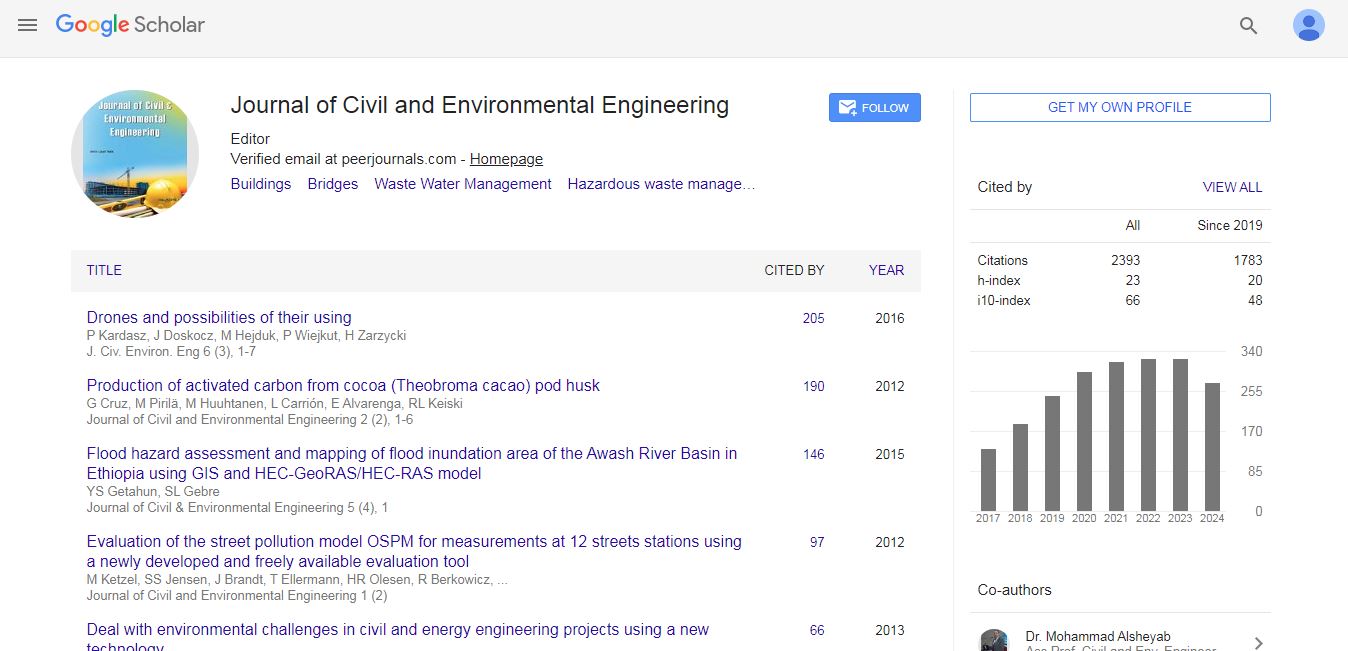
Journal of Civil and Environmental Engineering received 1798 citations as per Google Scholar report