Short Communication - (2025) Volume 14, Issue 6
Received: 01-Dec-2025, Manuscript No. idse-26-183639;
Editor assigned: 03-Dec-2025, Pre QC No. P-183639;
Reviewed: 17-Dec-2025, QC No. Q-183639;
Revised: 22-Dec-2025, Manuscript No. R-183639;
Published:
29-Dec-2025
, DOI: 10.37421/2168-9768.2025.14.526
Citation: Lee, Min-Jae. ”Sustainable Irrigation and Drainage
Systems for Agriculture.” Irrigat Drainage Sys Eng 14 (2025):526.
Copyright: © 2025 Lee M. This is an open-access article distributed under the terms of the Creative Commons Attribution License, which permits unrestricted use, distribution
and reproduction in any medium, provided the original author and source are credited.
The advancement of sustainable agriculture necessitates a meticulous approach to water management, with irrigation and drainage systems playing a pivotal role in optimizing resource utilization and minimizing environmental impact. The integrated design and evaluation of these systems are paramount, considering a complex interplay of hydrological, soil, crop, and environmental factors to ensure optimal performance and long-term viability [1].
Furthermore, the efficacy of subsurface drainage systems is crucial for managing waterlogged conditions and preventing detrimental soil salinization. Investigating advanced modeling techniques for simulating their performance under diverse rainfall intensities and soil types offers valuable insights into predicting drainage rates, groundwater fluctuations, and potential nutrient leaching, thereby guiding design optimization for enhanced agricultural productivity and reduced environmental risks [2].
In parallel, the efficiency of surface irrigation methods, particularly furrow irrigation, remains a significant area of focus. Research into design principles and performance evaluation of these systems explores the impact of advanced furrow design and water application strategies on water savings and crop yield, providing practical recommendations for refining traditional practices through metrics like water application uniformity and deep percolation losses [3].
Micro-irrigation systems, encompassing drip and sprinkler technologies, are instrumental in enhancing water use efficiency, especially in arid and semi-arid regions. A comprehensive evaluation of their design parameters, influencing uniformity, water delivery, and energy consumption, alongside their impact on soil moisture and crop physiology, offers crucial guidance for their optimized adoption [4].
The fundamental role of gravity drainage systems in mitigating waterlogging and salinity in irrigated lands cannot be overstated. Evaluating different drainage network designs and their effectiveness in controlling water tables and ameliorating soil conditions underscores the importance of integrated watershed management for sustainable drainage solutions [5].
The pervasive influence of climate change on agricultural water management demands adaptive strategies for irrigation system design and performance. Analyzing shifts in precipitation patterns and evapotranspiration necessitates the development of resilient systems that can ensure water security for agriculture under evolving climatic conditions [6].
For large-scale agricultural operations, the integration of advanced technologies like remote sensing and Geographic Information Systems (GIS) is revolutionizing the design and evaluation of irrigation networks. These tools facilitate crop water requirement monitoring, system performance assessment, and the identification of improvement areas, ultimately leading to more efficient water management practices [7].
Beyond technical considerations, the economic viability of irrigation and drainage systems is a critical determinant of their widespread adoption. An economic evaluation of different designs, analyzing costs, benefits, and farm profitability, provides a framework for selecting solutions that balance economic productivity with environmental sustainability [8].
The design and evaluation of on-farm drainage systems are specifically tailored to address localized issues such as poor soil aeration and salinity buildup. Emphasizing proper system design for effective water table control is essential for maintaining soil health and ensuring optimal crop development [9].
Finally, in water-scarce environments, the integration of water harvesting and supplemental irrigation systems offers a promising avenue for enhancing agricultural resilience. Optimizing system components to maximize water capture and efficient application is key to improving crop yields under drought stress [10].
The critical importance of integrated irrigation and drainage systems for sustainable agriculture is underscored by studies that meticulously examine their design and evaluation. These systems require a holistic approach, incorporating hydrological, soil, crop, and environmental considerations to achieve optimal performance, minimize water loss, and mitigate pollution from agricultural runoff [1].
Advanced modeling techniques are being employed to simulate the performance of subsurface drainage systems, particularly under varying rainfall intensities and soil conditions. This research provides a framework for evaluating drainage rates, groundwater table fluctuations, and the potential for nutrient leaching, offering valuable guidance for optimizing subsurface drainage design to enhance agricultural productivity while minimizing environmental risks [2].
The design principles and performance evaluation of efficient surface irrigation systems, with a specific focus on furrow irrigation, are being refined. Investigations into advanced furrow designs and water application strategies aim to maximize water savings and crop yields, utilizing metrics such as water application uniformity and deep percolation losses to improve traditional practices [3].
Micro-irrigation systems, including drip and sprinkler irrigation, are crucial for enhancing water use efficiency in arid and semi-arid regions. The design parameters influencing uniformity, water delivery, and energy consumption are being analyzed, along with their impact on soil moisture distribution and crop physiological responses, to optimize their adoption [4].
The role of gravity drainage systems in managing waterlogging and salinity in irrigated agricultural lands is extensively studied. Evaluations of various drainage network designs assess their effectiveness in lowering water tables and improving soil conditions, highlighting the necessity of integrated watershed management for sustainable drainage solutions [5].
The impact of climate change on irrigation systems is a significant concern, necessitating adaptive strategies. Studies focus on how changes in precipitation patterns and evapotranspiration affect irrigation system design and performance, proposing adaptive measures to ensure agricultural water security in the face of future climate scenarios [6].
The application of remote sensing and GIS technologies is transforming the design and evaluation of large-scale irrigation networks. These tools enable the monitoring of crop water requirements, the assessment of system performance, and the identification of areas requiring improvement, leading to more efficient water management practices [7].
Economic considerations are vital for the successful implementation of irrigation and drainage systems. Research evaluates the costs, benefits, and impacts on farm profitability of different designs, providing a framework for selecting economically viable and environmentally sustainable solutions [8].
On-farm drainage systems are specifically designed to address issues such as poor soil aeration and salinity buildup. The evaluation of these systems emphasizes the importance of proper design for effective water table control, which is crucial for maintaining soil health and promoting crop vitality [9].
Finally, integrated approaches to water harvesting and supplemental irrigation are being developed to enhance agricultural resilience in water-scarce environments. The focus is on optimizing system components to maximize water capture and ensure efficient application, thereby improving crop yields during drought conditions [10].
This collection of research focuses on the design and evaluation of various irrigation and drainage systems crucial for sustainable agriculture. Studies explore integrated systems, subsurface drainage modeling, efficient surface irrigation techniques like furrow irrigation, and micro-irrigation for arid regions. The impact of gravity drainage on waterlogging and salinity control, climate change adaptation in irrigation design, and the use of remote sensing and GIS for large-scale networks are also investigated. Economic evaluations of system designs and the specific design of on-farm drainage for soil health are examined. Furthermore, approaches integrating water harvesting and supplemental irrigation are presented to enhance resilience in water-scarce environments.
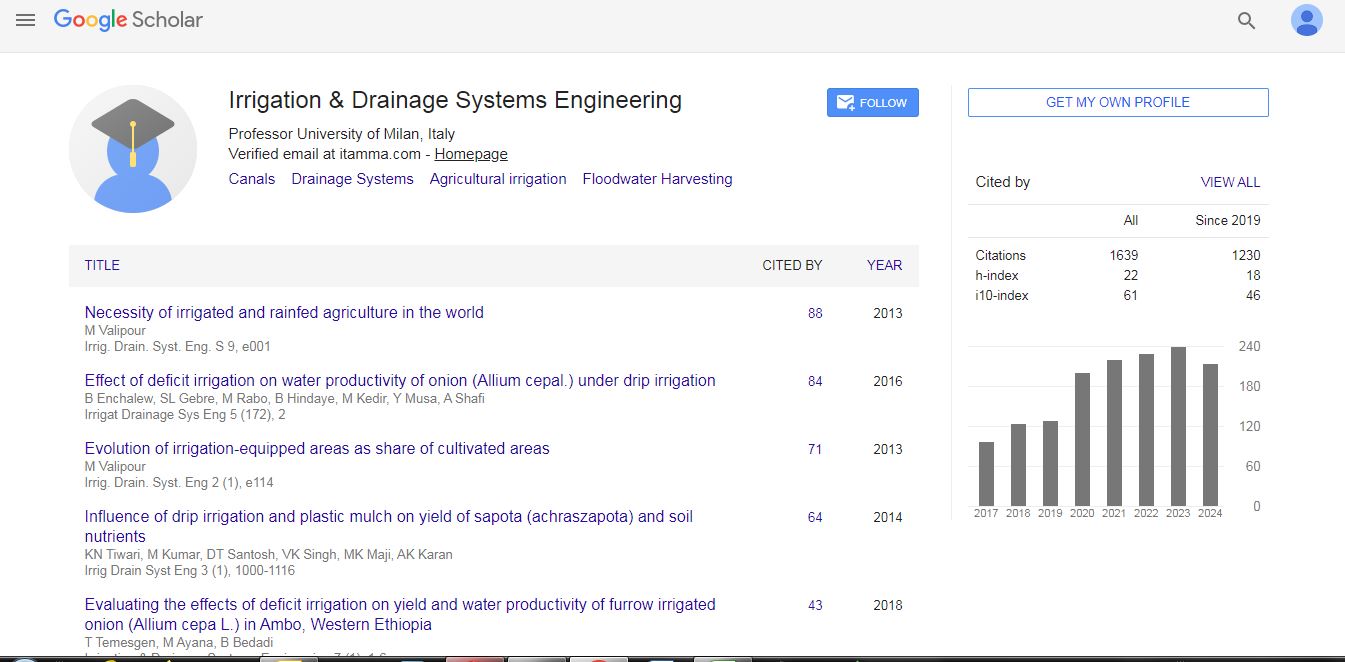
Irrigation & Drainage Systems Engineering received 835 citations as per Google Scholar report