Perspective - (2025) Volume 14, Issue 6
Received: 01-Dec-2025, Manuscript No. idse-26-183636;
Editor assigned: 03-Dec-2025, Pre QC No. P-183636;
Reviewed: 17-Dec-2025, QC No. Q-183636;
Revised: 22-Dec-2025, Manuscript No. R-183636;
Published:
29-Dec-2025
, DOI: 10.37421/2168-9768.2025.14.523
Citation: Reed, Jonathan. ”Sustainable Irrigation and Drainage:
Smart, Resilient Agriculture.” Irrigat Drainage Sys Eng 14 (2025):523.
Copyright: © 2025 Reed J. This is an open-access article distributed under the terms of the Creative Commons Attribution License, which permits unrestricted use, distribution
and reproduction in any medium, provided the original author and source are credited.
The engineering of irrigation and drainage systems is a cornerstone of modern agriculture, aimed at optimizing water management for enhanced crop production and resource sustainability. Fundamental principles guide the design of these systems, with a strong emphasis on hydrological analysis and understanding the intricate relationships between soil, water, and plants. This approach ensures that appropriate irrigation technologies are selected to maximize crop yields while simultaneously minimizing water wastage and mitigating adverse environmental impacts. Key aspects involve the efficient conveyance, application, and removal of water, alongside considerations for the economic and environmental viability of diverse system designs [1].
The integration of smart technologies represents a significant advancement in contemporary irrigation practices, particularly through the development and deployment of sensor-based networks. These networks facilitate real-time monitoring and automated control of irrigation processes. By leveraging data analytics from sensors monitoring soil moisture, weather conditions, and crop physiological states, irrigation scheduling can be precisely optimized, leading to improved water use efficiency and reduced operational expenditures. The ongoing evolution of these intelligent and adaptive irrigation infrastructures faces certain challenges but holds immense promise for future water resource management [2].
Effective drainage systems are crucial for agricultural lands, particularly in managing waterlogged conditions and fostering healthier soil environments. Research compares various subsurface drainage techniques, such as tile and mole drainage, with surface drainage methods. Performance evaluation under differing soil types and rainfall patterns highlights the importance of appropriate design in preventing issues like soil erosion, salinity buildup, and nutrient leaching, thereby ensuring sustained agricultural productivity [3].
Micro-irrigation techniques, including drip and sprinkler systems, play a vital role in boosting water use efficiency, especially in arid and semi-arid regions. A thorough understanding of their design principles, installation needs, and operational requirements is essential. These systems offer substantial benefits by reducing overall water consumption, facilitating precise fertilizer application (fertigation), and ultimately increasing crop yield and quality, positioning them as indispensable elements for sustainable agricultural development [4].
Hydrological modeling offers advanced techniques for simulating water flow and solute transport within agricultural watersheds, providing critical insights for irrigation and drainage system design. The application of integrated hydrological models allows for the assessment of how various management practices influence water resources and water quality. Such modeling aids in optimizing system design and operation to proactively address environmental risks, including eutrophication and groundwater contamination [5].
Designing efficient and sustainable irrigation and drainage systems for smallholder farming presents unique challenges and opportunities. Socio-economic factors significantly influence the adoption of new technologies, and community participation in system design and management is paramount for success. Practical recommendations often involve developing context-specific solutions that directly address the needs of smallholder farmers, ultimately aiming to improve livelihoods and enhance food security through improved water management practices [6].
Energy efficiency in agricultural pumping systems is a critical consideration for the overall design and operational cost-effectiveness of irrigation schemes. Analyzing different pump types, power sources, and system configurations helps identify strategies for minimizing energy consumption. The integration of renewable energy sources, such as solar-powered pumps, emerges as a promising avenue for enhancing the sustainability and economic feasibility of irrigation practices [7].
The environmental impacts of irrigation and drainage systems are a significant concern, particularly concerning water quality and the health of aquatic ecosystems. Managing nutrient and pesticide runoff, addressing salinity issues, and mitigating the effects of altered flow regimes require careful consideration. The development and implementation of best management practices and nature-based solutions are essential for minimizing these negative consequences and promoting a more environmentally responsible approach to agricultural water management [8].
Advanced irrigation scheduling techniques are continuously evolving, integrating sophisticated tools like weather forecasting, crop modeling, and remote sensing data. Evaluating the effectiveness of these diverse scheduling methods is crucial for optimizing water application and improving crop performance across various agricultural settings. Emphasis is placed on developing adaptive and site-specific strategies to maximize both water use efficiency and economic returns for farmers [9].
Climate change poses substantial challenges to the design and performance of irrigation and drainage systems, impacting water availability through altered precipitation patterns, rising temperatures, and changes in evapotranspiration rates. Adapting system designs, including enhancing water storage capabilities and developing more resilient drainage infrastructure, is crucial for ensuring long-term food security in the face of these climatic shifts [10].
The foundational principles of irrigation and drainage systems engineering are critical for effective agricultural water management. Optimal design considerations focus on leveraging hydrological analysis and understanding soil-water-plant dynamics to select appropriate technologies that boost crop yields while conserving water and minimizing environmental harm. Essential components include the efficient transport, application, and removal of water, with a constant eye on the economic and ecological sustainability of the chosen system designs [1].
Modern irrigation systems are increasingly incorporating smart technologies, exemplified by sensor-based networks designed for real-time data acquisition and automated control. This paradigm shift allows for sophisticated data analytics derived from soil moisture, weather, and crop sensors, enabling precise irrigation scheduling. Such advancements not only enhance water use efficiency but also contribute to a reduction in operational costs. While challenges remain in developing truly intelligent and adaptive systems, the trajectory points towards more responsive and efficient water management infrastructures [2].
Agricultural drainage systems are meticulously designed to counteract waterlogging and enhance soil health. Comparative analyses of subsurface techniques like tile and mole drainage against surface drainage methods are vital. Evaluating their performance across varied soil types and rainfall intensities underscores the necessity of precise design to prevent soil degradation, salinity, and nutrient loss, thereby safeguarding long-term agricultural productivity [3].
Micro-irrigation, encompassing drip and sprinkler systems, has emerged as a highly effective strategy for improving water productivity, particularly in water-scarce arid and semi-arid environments. Comprehensive knowledge of their design principles, installation prerequisites, and operational nuances is key. These systems offer significant advantages in water conservation, efficient nutrient delivery (fertigation), and enhanced crop output and quality, making them indispensable for sustainable agriculture [4].
Hydrological modeling provides a powerful framework for simulating water movement and the transport of dissolved substances within agricultural catchments. The use of integrated hydrological models allows for a comprehensive assessment of how different management strategies impact water resources and quality. This analytical capability is instrumental in optimizing system designs and operational protocols to mitigate potential environmental hazards such as eutrophication and groundwater contamination [5].
Addressing the specific needs of smallholder farmers requires a nuanced approach to designing efficient and sustainable irrigation and drainage solutions. Recognizing the influence of socio-economic factors on technology adoption and prioritizing community involvement in system planning and execution are crucial. The development of tailored, context-specific solutions is paramount for improving farmer livelihoods and bolstering food security through effective water management [6].
Energy consumption in agricultural pumping systems is a major operational factor in irrigation. Research into various pump types, power sources, and system configurations aims to pinpoint strategies for energy reduction. The integration of renewable energy, particularly solar-powered pumps, presents a viable pathway to increase the sustainability and economic feasibility of irrigation operations [7].
The environmental consequences of irrigation and drainage systems, especially concerning water quality and ecological balance, necessitate careful examination. The management of nutrient and pesticide runoff, salinity control, and the regulation of hydrological regimes are critical challenges. The implementation of best management practices and nature-based solutions is fundamental to minimizing detrimental environmental impacts and fostering sustainable agricultural water management [8].
Innovative irrigation scheduling techniques are being developed, incorporating advanced forecasting, crop simulation models, and remote sensing data. Rigorous evaluation of these methods is essential to determine their efficacy in optimizing water application and enhancing crop yields across diverse agricultural landscapes. The focus is on promoting adaptive, site-specific scheduling strategies that maximize both water use efficiency and economic returns [9].
Climate change introduces significant uncertainties for irrigation and drainage systems, altering hydrological cycles and water availability. Projected shifts in precipitation, temperature, and evapotranspiration necessitate proactive adaptation strategies. These include designing systems with increased water storage capacity and improved resilience in drainage infrastructure to safeguard food production in a changing global climate [10].
This compilation of research addresses various facets of irrigation and drainage systems engineering for sustainable agriculture. It covers fundamental principles, the integration of smart technologies for optimized water management, and the performance evaluation of different drainage techniques. The role of micro-irrigation in enhancing water use efficiency, hydrological modeling for resource management, and context-specific solutions for smallholder farmers are explored. Furthermore, the research examines energy efficiency in pumping systems, the environmental impacts of these systems and mitigation strategies, advanced irrigation scheduling techniques, and the crucial adaptations required due to climate change. Collectively, these studies highlight the multifaceted approach needed to ensure efficient, sustainable, and resilient agricultural water management.
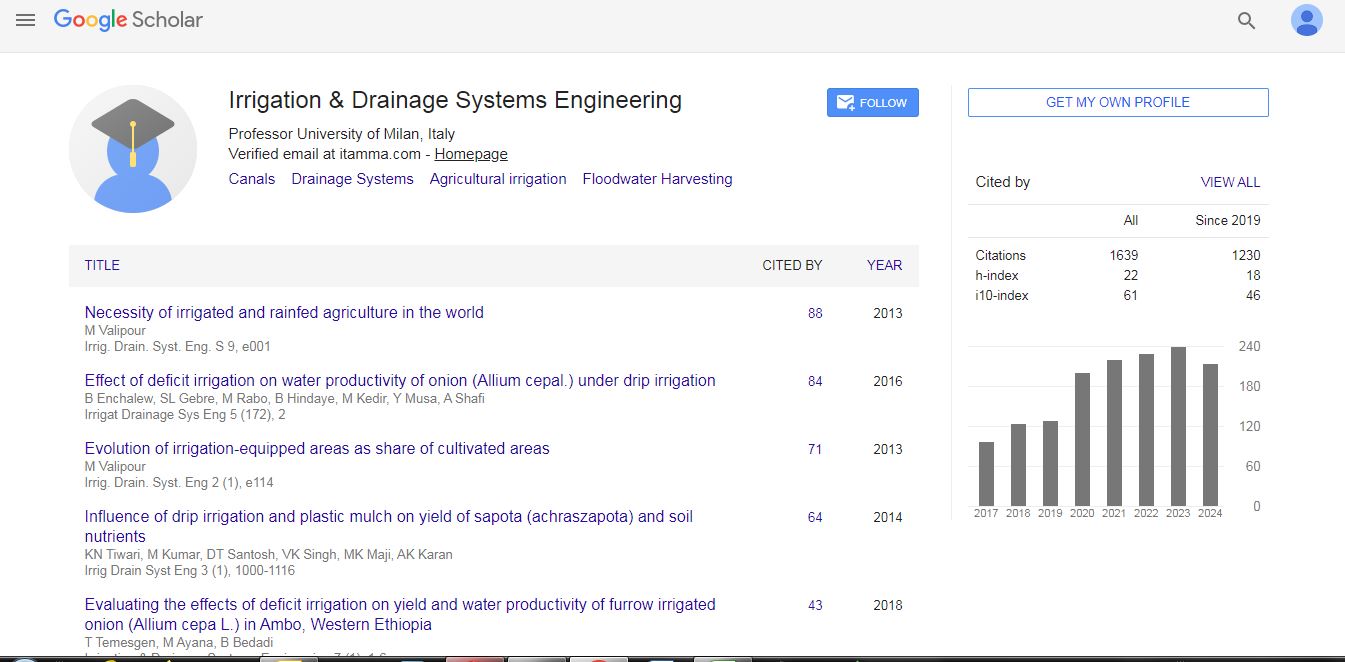
Irrigation & Drainage Systems Engineering received 835 citations as per Google Scholar report