Commentary - (2025) Volume 14, Issue 4
Received: 01-Aug-2025, Manuscript No. idse-26-182829;
Editor assigned: 04-Aug-2025, Pre QC No. P-182829;
Reviewed: 18-Aug-2025, QC No. Q-182829;
Revised: 22-Aug-2025, Manuscript No. R-182829;
Published:
29-Aug-2025
, DOI: 10.37421/2168-9768.2025.14.499
Citation: Siddiqui, Abdul Rahman. ”Sustainable Irrigation and
Drainage: Integrated Approaches for Agriculture.” Irrigat Drainage Sys Eng 14
(2025):499.
Copyright: © 2025 Siddiqui R. Abdul This is an open-access article distributed under the terms of the Creative Commons Attribution License, which permits unrestricted use,
distribution and reproduction in any medium, provided the original author and source are credited.
The fundamental importance of robust irrigation and drainage infrastructure in bolstering agricultural productivity and ensuring effective water resource management cannot be overstated. Addressing the inherent complexities in planning, designing, and implementing these systems requires a holistic approach that seamlessly integrates hydrological, soil, and agronomic considerations. Sustainable strategies, increasingly reliant on modern technological advancements and active community engagement, are paramount for guaranteeing the long-term efficacy and viability of irrigation and drainage networks, especially in regions grappling with water scarcity and the escalating impacts of climate change [1].
In response to these challenges, the development of smart irrigation systems has emerged as a critical area of research. These systems leverage advanced sensor networks and sophisticated data analytics to enable real-time monitoring of vital parameters such as soil moisture, weather patterns, and specific crop water requirements. By optimizing water application precisely where and when it is needed, these technologies significantly reduce water wastage and concurrently enhance crop yields, underscoring their role in more efficient water management [2].
Furthermore, the management of waterlogged lands presents a unique set of agricultural challenges, where subsurface drainage plays a pivotal role. Investigations into the design principles and performance of subsurface drainage systems reveal their substantial capacity to ameliorate soil conditions. By efficiently removing excess water, mitigating salinity issues, and improving root zone aeration, these systems are instrumental in revitalizing unproductive agricultural areas and offer valuable insights for optimizing drainage strategies across diverse soil and hydrological environments [3].
Complementing on-the-ground infrastructure, the integration of remote sensing and Geographic Information Systems (GIS) offers powerful tools for sophisticated irrigation network management. These technologies facilitate comprehensive mapping of existing infrastructure, enable precise assessment of water distribution, aid in the detection of leakages, and support the optimization of operational strategies. The application of spatial data analysis through remote sensing and GIS significantly contributes to enhancing both the efficiency and equity of irrigation water delivery systems [4].
The development and modernization of irrigation and drainage infrastructure extend beyond technical considerations to encompass significant socio-economic impacts within rural communities. Improvements in these systems have been directly linked to tangible benefits such as increased agricultural incomes, enhanced food security, and broader rural development initiatives. However, realizing these benefits hinges on effectively navigating challenges related to community participation, robust institutional frameworks, and the equitable distribution of project-related advantages [5].
Optimizing water use efficiency at the farm level is a critical component of sustainable agriculture, and significant advancements have been made in irrigation scheduling methods. By comparing conventional practices with water-saving techniques like deficit and precision irrigation, research demonstrates the potential for substantial water conservation without compromising crop productivity. This guidance is vital for selecting the most appropriate scheduling methods tailored to specific agricultural systems [6].
Beyond agricultural and economic considerations, the environmental ramifications of irrigation and drainage infrastructure demand careful attention. Negative impacts, including salinization, eutrophication, and alterations to natural hydrological regimes, necessitate proactive mitigation strategies. A commitment to integrated water resource management that prioritizes ecological sustainability alongside agricultural development is crucial for minimizing the environmental footprint of these essential systems [7].
To ensure the effective and efficient operation of irrigation and drainage networks, advanced computational tools for modeling and simulation are increasingly employed. These tools enable detailed analysis of hydraulic performance, facilitate the optimization of design parameters, and provide predictive capabilities for system behavior under diverse operational scenarios. Accurate modeling is indispensable for ensuring uniform water distribution and preventing issues like waterlogging or drought stress [8].
The escalating threat of climate change poses significant challenges to the resilience of existing irrigation systems. Altered precipitation patterns and a greater frequency of extreme weather events necessitate the evaluation and implementation of adaptive strategies. This includes infrastructure modifications designed to maintain agricultural productivity and water security, emphasizing the importance of forward-thinking planning and investment in climate-resilient solutions [9].
Finally, the performance and management of on-farm irrigation systems, particularly those employing micro-irrigation technologies, are crucial for overall water resource optimization. Analyzing factors influencing water use efficiency at the farm level and promoting best practices in system design, operation, and maintenance are key to enhancing agricultural sustainability. Efficient on-farm systems are foundational for maximizing the impact of broader water management efforts [10].
The critical need for effective irrigation and drainage infrastructure to enhance agricultural productivity and water resource management is a central theme in contemporary agricultural science. The intricate process of planning, designing, and developing these essential systems necessitates a comprehensive integration of hydrological, soil, and agronomic principles. To ensure the long-term sustainability and efficiency of irrigation and drainage networks, particularly in water-scarce regions facing the challenges of climate change, the adoption of sustainable approaches, including advanced technologies and active community involvement, is highlighted as crucial [1].
The evolution towards 'smart' agricultural practices has led to a significant focus on the development of sophisticated irrigation systems. These systems are characterized by the integration of advanced sensor networks and robust data analytics capabilities. The real-time monitoring of key environmental indicators, such as soil moisture content, prevailing weather conditions, and the specific water requirements of crops, allows for the optimization of water application. This precise control not only minimizes water wastage but also leads to substantial improvements in crop yields, thereby playing a vital role in effective water resource management [2].
In agricultural landscapes prone to waterlogging, the implementation of subsurface drainage systems is a cornerstone for improving soil health and boosting crop production. Studies exploring the fundamental design principles and detailed performance evaluations of these systems have demonstrated their profound effectiveness. By facilitating the removal of excess water, reducing soil salinity levels, and enhancing aeration within the root zone, subsurface drainage offers a viable solution for reclaiming and optimizing the productivity of affected lands, providing valuable insights for diverse soil and hydrological conditions [3].
The strategic application of remote sensing and Geographic Information Systems (GIS) has emerged as a powerful methodology for the effective management of extensive irrigation networks. These advanced technologies enable the detailed mapping of existing infrastructure assets, facilitate accurate assessments of water distribution patterns, aid in the identification of system leakages, and support the optimization of operational strategies. The integration of spatial data analysis through these tools offers significant advantages in improving the overall efficiency and ensuring the equitable delivery of irrigation water [4].
The socio-economic dimensions associated with the development and modernization of irrigation and drainage infrastructure in rural settings are of considerable importance. Enhanced infrastructure has been shown to catalyze significant positive outcomes, including increased agricultural incomes for farmers, improved food security for communities, and the promotion of broader rural development. Nevertheless, the successful realization of these benefits is contingent upon addressing critical challenges such as fostering robust community participation, establishing effective institutional arrangements, and ensuring the equitable sharing of project benefits [5].
Efforts to conserve water in agriculture have increasingly focused on the performance evaluation of various irrigation scheduling methods, particularly those incorporating water-saving technologies and precisely tailored to crop water needs. Comparative analyses between traditional irrigation practices and advanced techniques like deficit irrigation and precision irrigation have consistently revealed significant potential for water savings without compromising crop yields. This research provides essential guidance for selecting the most suitable irrigation scheduling methods for a wide array of agricultural systems [6].
The environmental consequences stemming from the construction and operation of irrigation and drainage infrastructure are a critical area of research. Particular attention is given to the impacts on water quality and the health of aquatic ecosystems, including issues like salinization, eutrophication, and the disruption of natural hydrological cycles. The development and implementation of effective mitigation strategies are essential, underscoring the imperative for integrated water resource management that holistically balances agricultural development with ecological sustainability [7].
Advanced computational techniques, specifically modeling and simulation of water flow, are increasingly indispensable for understanding and optimizing the performance of irrigation and drainage networks. These sophisticated tools allow for in-depth analysis of hydraulic performance, the fine-tuning of design parameters, and the prediction of system behavior under a spectrum of operational conditions. Accurate and reliable modeling is fundamental to ensuring efficient water distribution and preventing detrimental effects such as waterlogging or crop stress due to insufficient water availability [8].
In the context of a changing global climate, the resilience of irrigation systems is a paramount concern. Research is actively exploring how to enhance the capacity of these systems to withstand and adapt to altered precipitation patterns and the increased frequency of extreme weather events. Evaluating adaptive strategies and necessary infrastructure modifications is crucial for maintaining both agricultural productivity and water security, emphasizing the need for proactive planning and strategic investments in climate-resilient infrastructure [9].
The management and performance of on-farm irrigation systems, encompassing micro-irrigation technologies, are vital for achieving optimized water use efficiency. Research in this area analyzes the multifaceted factors that influence water efficiency at the farm level and proposes evidence-based best practices for system design, operational management, and ongoing maintenance. The effectiveness of these on-farm systems is foundational to the success of broader water resource management strategies and the advancement of agricultural sustainability [10].
This collection of research highlights the critical importance of effective irrigation and drainage infrastructure for sustainable agriculture. Studies explore the challenges and opportunities in developing these systems, emphasizing the integration of hydrological, soil, and agronomic factors, along with sustainable approaches and community participation. The advancement of smart irrigation systems using sensor networks and data analytics is discussed as a means to optimize water use and improve crop yields. The role of subsurface drainage in improving soil health on waterlogged lands and the application of remote sensing and GIS for irrigation network management are examined. Socio-economic impacts, including increased income and rural development, are analyzed alongside challenges in community engagement. Research also covers performance evaluation of irrigation scheduling methods for water conservation, environmental impacts and mitigation strategies, modeling and simulation of water flow for efficient distribution, enhancing the resilience of irrigation systems to climate change, and the management of on-farm irrigation systems for improved water use efficiency. Collectively, these studies underscore the need for integrated approaches to water resource management that balance productivity, sustainability, and resilience.
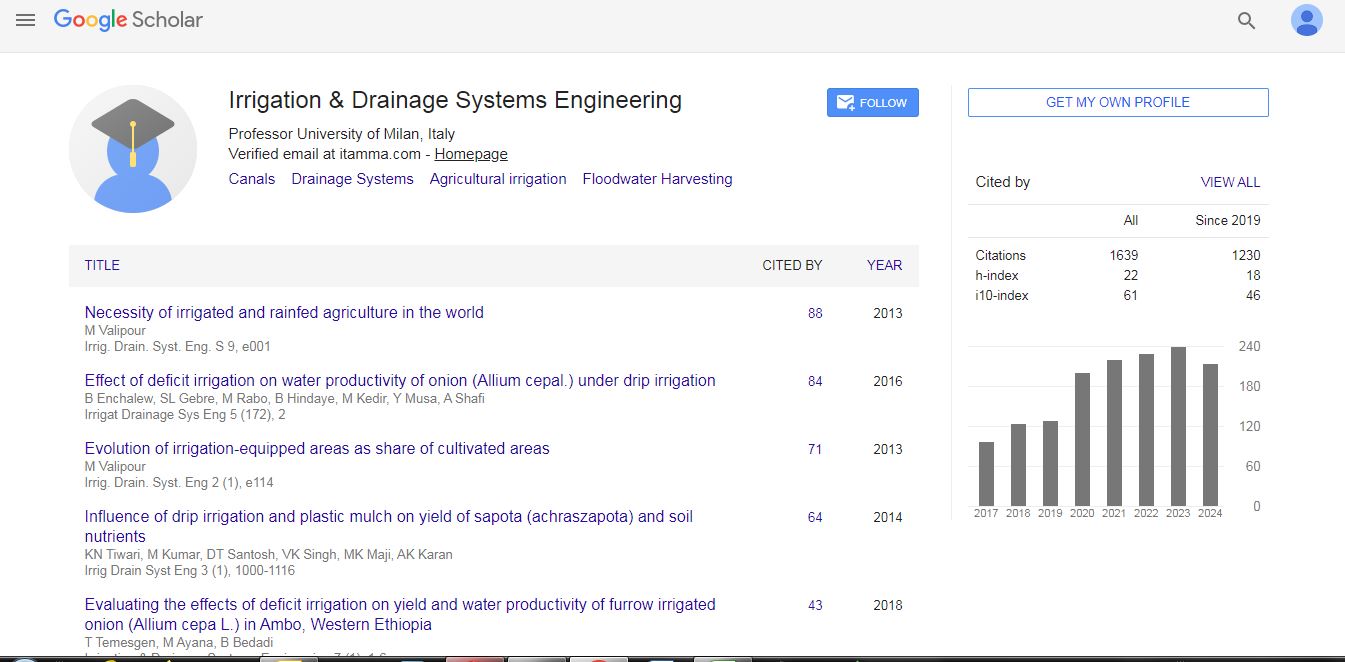
Irrigation & Drainage Systems Engineering received 835 citations as per Google Scholar report