Perspective - (2025) Volume 14, Issue 3
Received: 01-Jun-2025, Manuscript No. idse-26-182814;
Editor assigned: 03-Jun-2025, Pre QC No. P-182814;
Reviewed: 17-Jun-2025, QC No. Q-182814;
Revised: 23-Jun-2025, Manuscript No. R-182814;
Published:
30-Jun-2025
, DOI: 10.37421/2168-9768.2025.14.493
Citation: Papadopoulou, Sofia. ”Sustainable Irrigation and
Drainage for Arid Lands.” Irrigat Drainage Sys Eng 14 (2025):493.
Copyright: © 2025 Papadopoulou S. This is an open-access article distributed under the terms of the Creative Commons Attribution License, which permits unrestricted use,
distribution and reproduction in any medium, provided the original author and source are credited.
The imperative for enhancing agricultural productivity in arid and semi-arid regions, where water scarcity is a pervasive challenge, has driven significant advancements in irrigation and drainage technologies. These regions, often characterized by high temperatures, low rainfall, and fragile ecosystems, require sophisticated management strategies to ensure sustainable food production. The adoption of water-saving technologies is paramount, with drip irrigation and subsurface irrigation emerging as critical solutions for minimizing water loss and optimizing crop yields. These methods deliver water directly to the root zone, thereby reducing evaporation and runoff. The challenges of salinity management and soil erosion also loom large in these environments, necessitating integrated approaches that combine engineering solutions with well-considered agronomic practices. The efficacy of these strategies depends heavily on context-specific designs that account for local hydrological conditions, soil types, and climatic variability to foster sustainable agricultural development [1].
Subsurface drainage plays a pivotal role in mitigating the detrimental effects of soil salinization and managing water tables in arid environments. Its design and performance evaluation are central to maintaining soil health and agricultural productivity. Properly designed and maintained subsurface drainage systems have demonstrated a remarkable ability to lower the water table, effectively reduce soil salinity levels, and consequently enhance crop resilience, particularly under water-scarce conditions. Beyond their agronomic benefits, the economic viability and environmental implications of implementing these drainage systems are also crucial considerations for widespread adoption and long-term sustainability. The careful planning and execution of such systems are key to overcoming the challenges posed by arid land agriculture [2].
The optimization of water application through deficit irrigation strategies has become a focal point for high-value crops cultivated in semi-arid regions. This approach involves carefully managing water stress levels and adjusting irrigation scheduling to achieve a balance between water conservation and yield. The synergistic effects of different water stress levels and irrigation timing on yield, water use efficiency, and fruit quality are extensively examined. Research indicates that judiciously managed deficit irrigation, when integrated with precision irrigation techniques, can lead to substantial reductions in water consumption without compromising crop yields significantly. This offers a promising sustainable pathway for agricultural systems operating under severe water limitations. The importance of real-time monitoring and adaptive management strategies further enhances the effectiveness of these deficit irrigation approaches [3].
On-farm rainwater harvesting techniques offer a valuable complement to conventional irrigation in arid and semi-arid environments, particularly for supplemental irrigation purposes. These methods explore the design and implementation of various systems, such as micro-catchments and contour bunds, to capture and conserve rainfall. Their impact on soil moisture conservation and the availability of water for crops is a key area of investigation. These rainwater harvesting techniques hold significant potential for augmenting irrigation water supplies, thereby reducing the dependency on conventional, often scarce, water sources. They also play a critical role in improving the resilience of rainfed agriculture in drought-prone areas, offering both economic and environmental benefits through better water resource utilization [4].
The integration of advanced technologies, specifically remote sensing and geographic information systems (GIS), is revolutionizing irrigation management in arid regions. These tools enable precise monitoring of crop water status, identification of areas experiencing water stress, and optimization of irrigation scheduling. Satellite imagery and GIS capabilities allow for a data-driven approach to irrigation, significantly improving water application accuracy and minimizing water waste. This enhanced precision contributes directly to the overall sustainability of irrigation systems, particularly in large-scale agricultural operations where efficient resource allocation is crucial. The adoption of these technologies marks a significant step towards smarter and more sustainable farming [5].
The selection and application of different mulch materials significantly influence soil moisture conservation and crop yield in semi-arid environments. Comparative studies examining the effectiveness of organic mulches, such as straw and wood chips, against plastic mulches reveal their distinct impacts on reducing soil evaporation, suppressing weed growth, and moderating soil temperatures. The findings consistently show that mulching, regardless of the material, substantially improves soil water retention and consequently enhances crop performance. This makes mulching a highly valuable practice for water conservation in arid and semi-arid agriculture. Furthermore, the research considers the cost-effectiveness and environmental implications associated with various mulch types, aiding in informed decision-making [6].
Managing saline groundwater for irrigation presents a considerable challenge in arid regions, where freshwater resources are limited. Various treatment technologies, including reverse osmosis and electrodialysis, are explored to render saline water suitable for agricultural use. Alongside these technological solutions, land management strategies such as leaching and drainage are also critical. The research underscores the necessity of integrated approaches to effectively mitigate the adverse impacts of saline irrigation water on soil health and crop productivity. Sustainable water resource management is highlighted as a cornerstone for ensuring agricultural viability in these water-stressed areas, emphasizing a holistic view of water use [7].
Pressurized irrigation systems, encompassing drip and micro-sprinkler irrigation, are evaluated for their efficacy in enhancing water use efficiency within arid and semi-arid agricultural contexts. Performance evaluations focus on the impact of various system designs, emitter types, and operating pressures on water distribution uniformity and the precise delivery of water to crops. These systems offer distinct advantages over traditional irrigation methods, primarily through significant water savings, improved energy efficiency, and enhanced crop yield. Their adoption contributes directly to more sustainable agricultural practices by maximizing the benefit derived from every drop of water applied, a crucial factor in water-limited environments [8].
The utilization of treated wastewater for irrigation in arid and semi-arid regions is gaining traction as a strategic approach to conserve precious freshwater resources. Studies assessing the quality of treated wastewater and its subsequent impact on soil properties and crop growth are vital for responsible implementation. Treated wastewater can serve as a viable alternative irrigation source, provided that stringent treatment standards and careful management practices are rigorously adhered to. This ensures that potential risks to soil health and human well-being are effectively mitigated. The economic and environmental benefits, including reduced pressure on freshwater supplies, further support this sustainable practice [9].
Artificial drainage plays an essential role in the reclamation of waterlogged and salinized soils, particularly within arid agricultural areas where these issues are frequently encountered. The research delves into various drainage design considerations, installation techniques, and maintenance strategies necessary for effective soil reclamation. It is demonstrated that well-designed and implemented drainage systems are indispensable for improving soil aeration, significantly reducing salinity levels, and restoring soil fertility. Ultimately, these improvements are critical for enhancing crop productivity and fostering sustainable land use in these inherently challenging agricultural environments [10].
Irrigation and drainage systems engineering is a field dedicated to the design, development, and management of water resources for agriculture. In arid and semi-arid regions, where water is a scarce and precious commodity, the efficiency of these systems is paramount to ensuring food security and environmental sustainability. The challenges faced in these environments are multifaceted, ranging from low precipitation and high evaporation rates to issues of soil salinization, erosion, and water table fluctuations. Addressing these challenges requires a holistic approach that integrates advanced technologies with sound agronomic practices [1].
The management of water tables and the prevention of soil salinization are critical concerns in irrigated arid lands. Subsurface drainage systems have been identified as a key solution to these problems. Their design and implementation require a thorough understanding of soil physics, hydrology, and crop physiology. The effectiveness of these systems lies in their ability to lower the water table and facilitate the leaching of accumulated salts from the root zone, thereby improving soil conditions for crop growth. The economic and environmental implications of these systems must also be carefully evaluated to ensure their long-term viability [2].
Precision agriculture techniques, including deficit irrigation, are increasingly being adopted to optimize water use in water-limited environments. Deficit irrigation strategies involve applying less water than is theoretically required by the crop at certain growth stages, a practice that can lead to significant water savings without substantial yield losses, especially for high-value crops. The success of these strategies hinges on precise irrigation scheduling and the application of water at critical stages of crop development. Real-time monitoring and adaptive management systems are essential for the effective implementation of deficit irrigation [3].
Rainwater harvesting represents a traditional yet highly effective method for supplementing irrigation water in arid and semi-arid regions. By capturing and storing rainfall, farmers can reduce their reliance on conventional water sources and enhance the resilience of their agricultural systems. Various on-farm techniques, such as the construction of micro-catchments and contour bunds, have been developed to maximize water collection and minimize losses. These methods contribute to improved soil moisture conservation and increase the availability of water for crops, particularly during dry spells [4].
The advent of remote sensing and GIS technologies has revolutionized the way irrigation is managed in arid agricultural systems. These tools provide valuable information on crop water status, soil moisture content, and variations in crop health across large agricultural areas. By analyzing satellite imagery and other geospatial data, farmers and water managers can identify areas that require irrigation and optimize the timing and amount of water applied, thereby reducing water waste and improving overall irrigation efficiency. This precision approach is vital for sustainable water management [5].
Soil moisture conservation is a critical aspect of successful agriculture in semi-arid regions, and mulching has proven to be a highly effective practice. By covering the soil surface with organic or plastic materials, evaporation is significantly reduced, leading to increased soil water availability. Mulching also helps to suppress weed growth, moderate soil temperatures, and improve soil structure. The choice of mulch material can influence its effectiveness and cost, requiring careful consideration of local conditions and economic factors [6].
The management of saline groundwater for irrigation purposes poses a significant challenge in arid regions. The high salt content of groundwater can lead to soil salinization, reduced crop yields, and long-term degradation of agricultural land. Various treatment technologies and management strategies are being explored to address this issue. These include physical and chemical treatment methods for the water, as well as agronomic practices like improved drainage and leaching to manage salt accumulation in the soil [7].
Pressurized irrigation systems, such as drip and micro-sprinkler systems, are recognized for their high water-use efficiency in arid and semi-arid climates. These systems deliver water directly to the plant root zone, minimizing losses due to evaporation and runoff. The precise control over water application allows for optimized irrigation scheduling and ensures that crops receive the exact amount of water they need, leading to improved crop growth and higher yields. Their adoption is a key component of sustainable irrigation practices [8].
The reuse of treated wastewater for irrigation offers a sustainable solution to water scarcity in arid and semi-arid regions. By treating municipal wastewater to appropriate quality standards, it can be safely used to irrigate crops, thereby conserving freshwater resources. However, careful monitoring and management are essential to prevent potential risks associated with the presence of pathogens or contaminants in the treated water. This approach contributes to a more circular economy in water management [9].
Artificial drainage systems are fundamental for reclaiming waterlogged and salinized soils, which are common problems in arid agricultural lands. These systems facilitate the removal of excess water and dissolved salts from the soil profile, thereby improving soil aeration, reducing salinity, and restoring soil fertility. Effective drainage is crucial for enhancing crop productivity and ensuring the long-term sustainability of agricultural land use in these challenging environments [10].
The critical role of efficient irrigation and drainage systems in arid and semi-arid regions is underscored by the adoption of water-saving technologies such as drip and subsurface irrigation, which are instrumental in reducing water loss and boosting crop yields. These advancements are crucial for sustainable agriculture in environments facing water scarcity. The challenges of salinity management and soil erosion are addressed through integrated engineering and agronomic practices, emphasizing context-specific designs that consider local hydrological conditions, soil types, and climate variability for enduring agricultural development [1].
Subsurface drainage systems are extensively analyzed for their impact on soil salinization and water table management in arid environments. This research details the design principles and performance evaluations of various subsurface drainage setups, highlighting their effects on crop productivity and soil physicochemical properties. The findings confirm that appropriately designed and maintained subsurface drainage can effectively lower water tables, decrease soil salinity, and improve crop resilience in water-scarce regions. The economic feasibility and environmental consequences of these systems are also integral to their assessment [2].
Optimization of water application through deficit irrigation strategies is explored for high-value crops in semi-arid regions. This study examines the interplay of different water stress levels and irrigation scheduling on yield, water use efficiency, and fruit quality. It demonstrates that managed deficit irrigation, combined with precision irrigation techniques, can significantly cut water consumption without substantial yield reductions, presenting a sustainable solution for water-limited agriculture. The necessity of real-time monitoring and adaptive management is also highlighted [3].
On-farm rainwater harvesting techniques are evaluated for their performance in providing supplemental irrigation in arid and semi-arid environments. The research covers the design and implementation of systems like micro-catchments and contour bunds, assessing their influence on soil moisture conservation and crop water availability. These methods are shown to enhance irrigation water supply, lessen reliance on conventional sources, and bolster the resilience of rainfed agriculture in drought-prone areas, offering both economic and environmental advantages [4].
The integration of remote sensing and GIS for efficient irrigation management in arid regions is a key focus. This approach leverages satellite imagery and GIS tools to monitor crop water status, pinpoint areas of water stress, and refine irrigation scheduling. The benefits include enhanced water application accuracy, reduced water wastage, and improved overall sustainability of irrigation systems, particularly for large-scale agricultural operations. These technologies facilitate data-driven decision-making for optimized water use [5].
The influence of diverse mulch materials on soil moisture conservation and crop yield in semi-arid conditions is investigated. A comparison of organic mulches (straw, wood chips) and plastic mulches reveals their effectiveness in reducing soil evaporation, controlling weeds, and stabilizing soil temperatures. The results indicate that mulching significantly improves soil water retention and crop performance, making it a valuable practice for water conservation in arid and semi-arid agriculture. Cost-effectiveness and environmental impact are also considered [6].
Challenges in managing saline groundwater for irrigation in arid regions are addressed through an examination of various treatment technologies and land management strategies. Techniques such as reverse osmosis and electrodialysis, alongside land management practices like leaching and drainage, are discussed. The research stresses the critical need for integrated approaches to mitigate the negative effects of saline irrigation water on soil health and crop productivity, emphasizing sustainable water resource management in water-stressed areas [7].
Pressurized irrigation systems, specifically drip and micro-sprinkler irrigation, are assessed for their contribution to water-use efficiency in arid and semi-arid agriculture. The evaluation focuses on how different system designs, emitter types, and operating pressures affect water distribution uniformity and crop water delivery. These systems offer substantial benefits over conventional methods in terms of water savings, energy efficiency, and crop yield improvement, promoting more sustainable agricultural practices [8].
The application of treated wastewater for irrigation in arid and semi-arid regions is explored as a strategy for conserving freshwater resources. The study assesses the quality of treated wastewater and its impact on soil properties and crop growth. It highlights the potential of treated wastewater as a viable alternative irrigation source, contingent upon appropriate treatment standards and management practices to mitigate risks to soil and human health. Economic and environmental benefits are also considered [9].
Artificial drainage is examined for its role in reclaiming waterlogged and salinized soils in arid agricultural areas. The paper discusses design considerations, installation techniques, and maintenance strategies for drainage systems. It demonstrates that effective drainage is vital for enhancing soil aeration, reducing salinity, and restoring soil fertility, thereby improving crop productivity and promoting sustainable land use in challenging environments [10].
This compilation of research focuses on enhancing agricultural sustainability in arid and semi-arid regions through advanced irrigation and drainage techniques. Key areas explored include the adoption of water-saving technologies like drip and subsurface irrigation, crucial for minimizing water loss and maximizing crop yields. The studies also address significant challenges such as salinity management and soil erosion, proposing integrated solutions that combine engineering and agronomic practices. Subsurface drainage is highlighted for its effectiveness in controlling soil salinization and managing water tables. Deficit irrigation strategies and precision agriculture tools like remote sensing and GIS are presented as methods to optimize water application and improve water use efficiency. Rainwater harvesting techniques offer a supplementary water source, while the use of treated wastewater for irrigation is explored as a means to conserve freshwater. Mulching practices are examined for their role in soil moisture conservation. Finally, artificial drainage is emphasized for its importance in reclaiming waterlogged and salinized soils, ultimately contributing to improved crop productivity and sustainable land use in water-scarce environments.
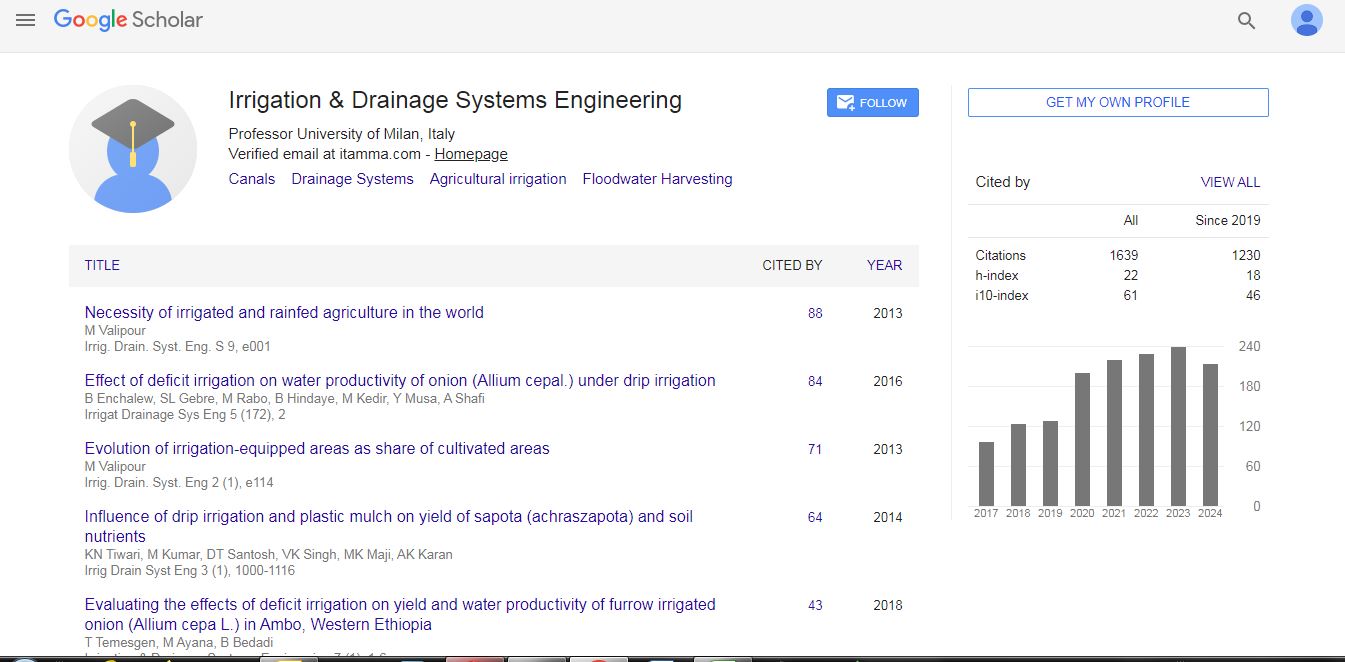
Irrigation & Drainage Systems Engineering received 835 citations as per Google Scholar report