Brief Report - (2025) Volume 14, Issue 5
Received: 01-Oct-2025, Manuscript No. idse-26-183621;
Editor assigned: 03-Oct-2025, Pre QC No. P-183621;
Reviewed: 17-Oct-2025, QC No. Q-183621;
Revised: 22-Oct-2025, Manuscript No. R-183621;
Published:
29-Oct-2025
, DOI: 10.37421/2168-9768.2025.14.508
Citation: Rossi, Emilia. "Sustainable Irrigation and Drainage for
Agricultural Productivity." Irrigat Drainage Sys Eng 14 (2025):508.
Copyright: © 2025 Rossi E. This is an open-access article distributed under the terms of the Creative Commons Attribution License, which permits unrestricted use, distribution
and reproduction in any medium, provided the original author and source are credited.
The planning and design of irrigation and drainage systems are foundational to modern agriculture, ensuring optimal crop production and resource management. Comprehensive principles guide these endeavors, encompassing site assessment, understanding crop water needs, and evaluating water sources to create effective systems. The critical balance between water application and efficient drainage is paramount to prevent detrimental issues like waterlogging and salinity, underscoring the necessity of thoughtful design [1].
In the face of increasing water scarcity, advanced design strategies for efficient irrigation systems are becoming indispensable. Precision irrigation techniques, such as drip and micro-sprinkler systems, play a crucial role in maximizing water use efficiency. The integration of soil moisture monitoring and weather-based scheduling further optimizes water delivery, minimizes waste, and enhances crop yields, reflecting a shift towards more intelligent agricultural practices [2].
Drainage systems are vital for maintaining the health of agricultural soils and preventing salinization, particularly in irrigated areas. Various design methodologies, including surface and subsurface drainage, are employed and their effectiveness is assessed under diverse environmental conditions. Proper drainage is essential for improving soil aeration, nutrient availability, and root development, all contributing to sustainable agricultural productivity [3].
The integration of cutting-edge technologies, such as remote sensing and geographical information systems (GIS), offers innovative approaches to optimize irrigation and drainage system design. Satellite imagery and aerial data facilitate the mapping of soil properties, water bodies, and topography, enabling more precise planning and targeted interventions, leading to efficient resource allocation and reduced environmental impact [4].
Subsurface drainage systems are particularly critical for managing groundwater levels and ameliorating waterlogged conditions in agricultural lands. Different types of subsurface drainage, including tile and mole drains, are examined, with guidelines provided for their spacing, depth, and gradient based on specific soil and drainage requirements. Effective installation and consistent maintenance are emphasized for long-term system functionality [5].
Pressurized irrigation systems, including sprinkler and drip irrigation, offer significant advantages in water savings and yield improvement over traditional gravity-fed methods. Their hydraulic performance is governed by principles of pressure distribution and water application uniformity. Challenges such as emitter clogging and energy consumption are important considerations in their design and management [6].
The impact of climate change necessitates adaptable and robust drainage designs to mitigate its effects on agricultural lands. Changing precipitation patterns and extreme weather events demand strategies for managing increased runoff, preventing soil erosion, and maintaining soil moisture balance. Climate-smart irrigation and drainage solutions are crucial for agricultural resilience [7].
Beyond technical considerations, the socio-economic aspects of irrigation and drainage system planning are of significant importance. Cost-benefit analyses, community participation, and the impact on livelihoods and food security are integral to project success. Ensuring equitable water distribution and stakeholder involvement promotes long-term sustainability [8].
On-farm irrigation system design and management present unique challenges in diverse agricultural landscapes, requiring flexible and adaptable solutions. These systems must cater to variations in soil types, topography, and crop rotations. The use of low-cost technologies and local materials can enhance accessibility and sustainability, especially in developing regions [9].
Open channel irrigation systems, commonly found in canals and ditches, require careful hydraulic design and performance analysis. Principles of flow measurement, conveyance, and distribution are key. Factors like channel roughness, sedimentation, and seepage influence flow efficiency, and design strategies aim to minimize water losses and ensure uniform delivery [10].
The fundamental principles of irrigation and drainage system planning and design are thoroughly explored, covering site assessment, crop water requirements, and water source evaluation. The critical need to balance water application with efficient drainage to prevent waterlogging and salinity is highlighted, alongside the integration of technological advancements for improved water management and sustainable, climate-resilient approaches [1].
Addressing the critical issue of water scarcity, this paper delves into advanced design strategies for efficient irrigation systems, with a focus on precision irrigation techniques like drip and micro-sprinkler systems. The impact of soil moisture monitoring and weather-based scheduling on optimizing water delivery, minimizing losses, and improving crop yields is examined, along with the importance of integrated water management at farm and regional levels [2].
This study underscores the crucial role of drainage systems in maintaining soil health and preventing salinization in irrigated agricultural lands. It reviews various drainage design methodologies, including surface and subsurface drainage, and assesses their effectiveness under different soil and climatic conditions. The paper emphasizes how proper drainage enhances soil aeration, nutrient availability, and root development, contributing to sustainable agricultural production, and also discusses the economic and environmental implications of effective drainage [3].
Research is presented on the integration of remote sensing and geographical information systems (GIS) for the optimized design of irrigation and drainage systems. The utility of satellite imagery and aerial data for mapping soil properties, delineating water bodies, and assessing land topography is demonstrated, informing more precise system planning and efficient resource allocation with reduced environmental impact [4].
The design principles for subsurface drainage systems are investigated, focusing on their importance in managing groundwater levels and improving soil conditions in waterlogged areas. Different types of subsurface drainage, such as tile and mole drains, are examined, with guidelines for spacing, depth, and gradient based on soil hydraulic properties and drainage requirements. The article stresses the importance of proper installation and maintenance for long-term effectiveness and sustainability [5].
The performance and design of pressurized irrigation systems, specifically sprinkler and drip irrigation, are analyzed. Hydraulic principles governing pressure distribution, emitter selection, and water application uniformity are discussed. The advantages of pressurized systems in water savings and crop yield improvement are highlighted, alongside potential challenges like clogging and energy requirements [6].
This article examines the critical role of drainage in mitigating the impacts of climate change on agricultural lands, discussing how changing precipitation patterns and extreme weather events necessitate robust and adaptable drainage designs. Strategies for managing increased runoff, preventing soil erosion, and maintaining soil moisture balance under altered climatic conditions are explored, emphasizing the need for climate-smart irrigation and drainage solutions [7].
The socio-economic aspects of irrigation and drainage system planning and design are addressed, including cost-benefit analyses of different system types, the significance of community participation in project design, and the impact of these systems on livelihoods and food security. The authors highlight the necessity of equitable water distribution and stakeholder involvement to ensure long-term success and sustainability of irrigation and drainage infrastructure [8].
This research investigates the challenges and opportunities in designing and managing on-farm irrigation systems for diverse agricultural landscapes, emphasizing the need for flexible and adaptable designs that can accommodate varying soil types, topography, and crop rotations. The exploration of low-cost technologies and local materials aims to improve the accessibility and sustainability of irrigation solutions, particularly in developing regions [9].
An in-depth analysis of the hydraulic performance of open channel irrigation systems is provided, covering principles of flow measurement, conveyance, and distribution in canals and ditches. Factors affecting flow efficiency, such as channel roughness, sedimentation, and seepage, are discussed, along with design strategies for minimizing water losses and ensuring uniform water delivery to agricultural fields [10].
This collection of research explores various facets of irrigation and drainage systems crucial for sustainable agriculture. Key themes include fundamental planning and design principles, the application of precision technologies to enhance water use efficiency, and the vital role of drainage in maintaining soil health and preventing salinization. The integration of advanced tools like remote sensing and GIS for optimized system design is discussed, alongside specific considerations for subsurface and pressurized irrigation systems. The impact of climate change on drainage needs and the socio-economic factors influencing project success are also examined. Furthermore, the research addresses on-farm irrigation system design for diverse agricultural settings and the hydraulic performance of open channel systems, all contributing to efficient water management and increased agricultural productivity.
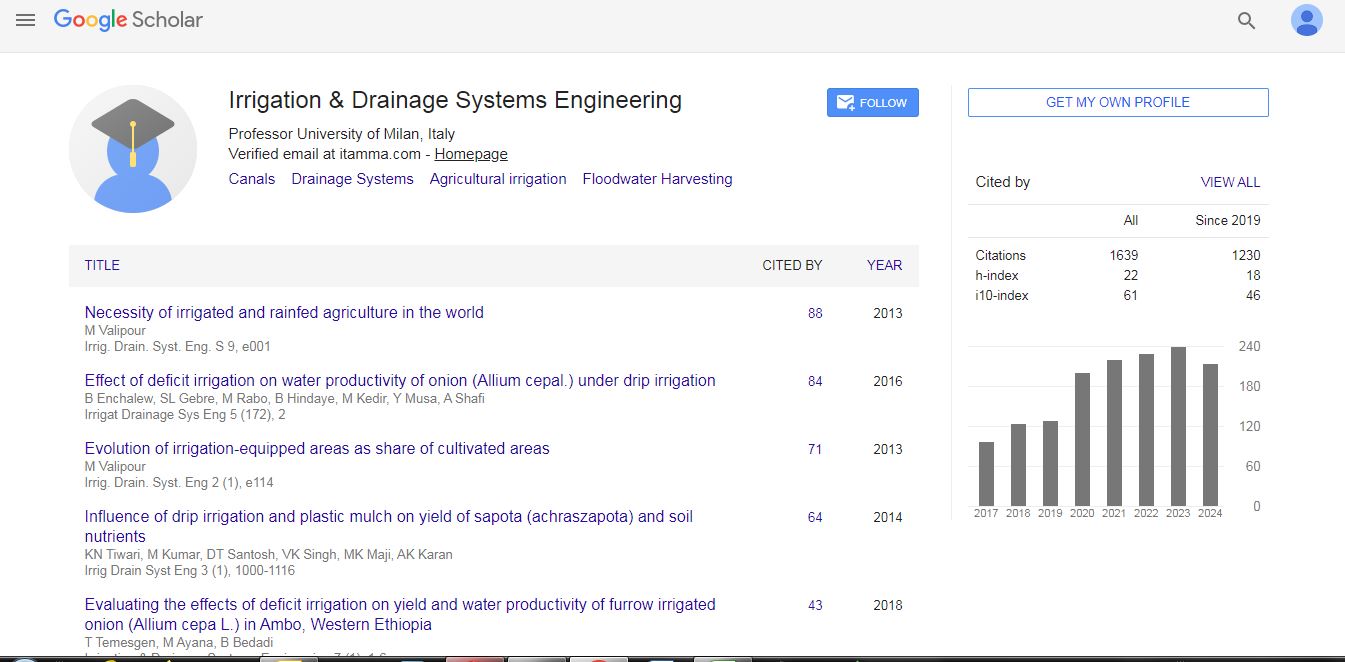
Irrigation & Drainage Systems Engineering received 835 citations as per Google Scholar report