Commentary - (2025) Volume 15, Issue 6
Received: 03-Nov-2025, Manuscript No. jcde-25-177528;
Editor assigned: 05-Nov-2025, Pre QC No. P-177528;
Reviewed: 19-Nov-2025, QC No. Q-177528;
Revised: 24-Nov-2025, Manuscript No. R-177528;
Published:
01-Dec-2025
, DOI: 10.37421/2165-784X.2025.15.633
Citation: Cabrera, Jose Luis. ”Sustainable Future: Complex
Paths, Equitable Solutions.” J Civil Environ Eng 15 (2025):633.
Copyright: © 2025 Cabrera L. Jose This is an open-access article distributed under the terms of the Creative Commons Attribution License, which permits unrestricted use,
distribution and reproduction in any medium, provided the original author and source are credited.
Small Island Developing States (SIDS) are on the front lines of climate change, facing unique challenges like rising sea levels and extreme weather. What this review highlights is that successful adaptation hinges on integrating traditional knowledge with modern strategies, while overcoming significant hurdles such as limited funding and institutional capacity. Building resilience in these vulnerable regions requires urgent, collaborative action, emphasizing localized, community-led initiatives for a sustainable future.[1] The circular economy concept is really key for achieving the Sustainable Development Goals (SDGs). This review makes it clear that while there's a growing understanding of their intertwined nature, the practical implementation and measurement of their combined impact remain complex. Future efforts need to bridge theoretical frameworks with real-world case studies, focusing on how circular practices can directly accelerate progress across various SDGs, moving beyond just environmental benefits.[2] Shifting global energy systems towards sustainability is a massive undertaking, as this analysis points out. While renewable energy adoption is accelerating, significant challenges persist, including grid infrastructure limitations, energy storage issues, and geopolitical factors. What this really means is that strong, coherent policy frameworks, international cooperation, and technological innovation are critical to navigate this transition effectively and secure a truly sustainable energy future.[3]
Building truly sustainable cities involves a complex interplay of environmental, social, and economic factors. This review highlights that while urbanization presents huge opportunities for innovation, it also brings challenges like resource depletion and inequality. The key insight here is that smart urban planning, integrating green infrastructure, community participation, and resilient governance, is essential for shaping urban environments that can thrive sustainably for generations to come.[4] Reimagining our food systems is vital because planetary health and human health are deeply linked, this article shows. The takeaway here is that current agricultural practices often harm both, leading to environmental degradation and malnutrition. Transitioning to sustainable food systems requires holistic approaches think diverse diets, reduced food waste, and regenerative agriculture to nourish populations while respecting ecological boundaries.[5] Preserving global biodiversity is a pressing challenge, and this research highlights how digital innovation and data science offer powerful new tools. By leveraging advanced technologies like AI, remote sensing, and big data analytics, we can monitor species more effectively, predict conservation risks, and implement targeted interventions. This means moving beyond traditional methods to a more data-driven, precise approach to safeguarding ecosystems for sustainable futures.[6] Education plays a fundamental role in shaping sustainable futures, a point this bibliometric analysis underscores. The connection between Education for Sustainable Development (ESD) and the Sustainable Development Goals (SDGs) is strong, yet this research shows more practical integration and impact assessment are needed. The big takeaway is that fostering critical thinking, systems thinking, and participatory skills through ESD is crucial for empowering individuals to contribute meaningfully to achieving the SDGs.[7] Adopting green technologies is central to sustainable development, this comprehensive review points out. While these innovations offer solutions for reducing environmental impact, their widespread adoption faces barriers like high initial costs and lack of supportive policies. Here's the thing: unlocking their full potential requires governments, industries, and consumers to collaborate, creating incentives and frameworks that accelerate the transition to a greener economy.[8] As we move towards sustainable futures, ensuring social equity is paramount. This review highlights that sustainability transitions often have uneven impacts, potentially exacerbating existing inequalities. What this really means is that justice frameworks like distributive, procedural, and recognitional justice must be intentionally integrated into policy-making to ensure that the benefits of green initiatives are shared fairly, and burdens aren't disproportionately placed on vulnerable communities.[9] Digitalization offers a dual-edged sword for sustainability, this review shows. While it can drive efficiency, foster innovation, and enable smarter resource management, there are also concerns about its energy consumption and potential for digital divides. Let's break it down: strategic deployment of digital technologies, coupled with strong governance and equitable access, is crucial to harness its positive impacts while mitigating negative ones, paving the way for a truly sustainable digital future.[10]Achieving sustainable development is a complex, multifaceted challenge, demanding integrated approaches across environmental, social, and economic dimensions. Small Island Developing States (SIDS), for example, are uniquely vulnerable to climate change impacts like rising sea levels and extreme weather [1]. Their adaptation strategies must blend traditional knowledge with modern methods, overcoming obstacles such as limited funding and institutional capacity. Building resilience here requires urgent, localized, and community-led initiatives. Similarly, urban environments present both opportunities and challenges for sustainability, from resource depletion to inequality [4]. Smart urban planning, green infrastructure, and resilient governance are key to fostering cities that can thrive for generations.
The global shift toward sustainable energy is another massive undertaking. While renewable energy adoption is increasing, significant hurdles remain, including limitations in grid infrastructure, energy storage, and geopolitical factors [3]. Effective navigation of this transition hinges on strong policy frameworks, international cooperation, and continuous technological innovation. Green technologies are central to reducing environmental impact, yet their widespread adoption is slowed by high initial costs and insufficient supportive policies [8]. Governments, industries, and consumers must collaborate to create the necessary incentives and frameworks to accelerate a greener economy.
Reimagining our food systems is vital, recognizing the deep interconnectedness of planetary and human health [5]. Current agricultural practices often degrade the environment and contribute to malnutrition. A holistic transformation toward sustainable food systems necessitates diverse diets, reduced food waste, and regenerative agricultural practices that respect ecological boundaries while nourishing populations. The circular economy concept is equally crucial for achieving the Sustainable Development Goals (SDGs) [2]. While the link is understood, practical implementation and measuring combined impact remain complex. Future efforts need to bridge theoretical frameworks with real-world case studies, showcasing how circular practices can directly accelerate progress across various SDGs, extending beyond just environmental benefits.
Digitalization offers powerful tools for sustainability, providing opportunities for efficiency, innovation, and smarter resource management [10]. However, its energy consumption and potential for digital divides are concerns. Strategic deployment, strong governance, and equitable access are crucial for maximizing positive impacts and mitigating negative ones. This technological leverage extends to biodiversity conservation, where digital innovation and data science, including Artificial Intelligence (AI), remote sensing, and big data analytics, enable more effective monitoring, risk prediction, and targeted interventions [6]. This marks a shift toward a data-driven, precise approach to safeguarding ecosystems.
Education plays a fundamental role in shaping sustainable futures, particularly through Education for Sustainable Development (ESD) [7]. There's a strong connection between ESD and the SDGs, though more practical integration and impact assessment are needed. Fostering critical thinking, systems thinking, and participatory skills through ESD empowers individuals to contribute meaningfully to achieving the SDGs. Additionally, ensuring social equity is paramount in sustainability transitions [9]. These transitions can have uneven impacts, potentially exacerbating existing inequalities. Justice frameworks, such as distributive, procedural, and recognitional justice, must be intentionally integrated into policy-making to ensure fair distribution of benefits and burdens, preventing disproportionate impacts on vulnerable communities.
The path to a sustainable future is complex, requiring multifaceted strategies across various global challenges. This includes climate adaptation in vulnerable regions like Small Island Developing States (SIDS) through integrating traditional knowledge and modern solutions. Sustainable urban development demands smart planning and community participation, while transitioning to renewable energy faces infrastructure and policy hurdles. Transforming food systems involves holistic approaches for planetary and human health, and the circular economy is key for Sustainable Development Goal (SDG) achievement. Digitalization and data science offer powerful tools for biodiversity conservation and efficiency, though their deployment needs careful governance. Crucially, Education for Sustainable Development (ESD) empowers individuals, and integrating social equity frameworks ensures fair transitions, addressing the high costs of green technologies and potential digital divides.
1. Md. SI, Mohammed A, Md. RI. "Climate change adaptation in small island developing states (SIDS): A systematic review of strategies and barriers".Environ Sci Policy 151 (2024):103632.
Indexed at, Google Scholar, Crossref
2. Jing X, Wenqing W, Zhaoyuan C. "A systematic review of circular economy and sustainable development goals: Current knowledge and future research agenda".J Clean Prod 429 (2023):139265.
Indexed at, Google Scholar, Crossref
3. Md. WM, Md. MA, Md. EA. "Global energy transition toward sustainable futures: Trends, challenges, and policy implications".Renew Energy 219 (2023):119335.
Indexed at, Google Scholar, Crossref
4. Muhammad I, Ali H, Abdul M. "Understanding the future of sustainable urban development: A systematic review of challenges and opportunities".Sustain Cities Soc 100 (2024):104958.
Indexed at, Google Scholar, Crossref
5. Junaidi, P.S. A, Harikrishnan. "Sustainable food systems transformation: Interconnectedness of planetary and human health".Front Sustain Food Syst 7 (2023):1269395.
Indexed at, Google Scholar, Crossref
6. K. KMLKM, S. CSP, P. LTPJ. "Accelerating biodiversity conservation through digital innovation and data science".Sci Rep 14 (2024):2261.
Indexed at, Google Scholar, Crossref
7. Juan MA, David CD, Beatriz SR. "Education for Sustainable Development (ESD) and the Sustainable Development Goals (SDGs): A Bibliometric Analysis".Sustainability 15 (2023):11181.
Indexed at, Google Scholar, Crossref
8. M. AK, N. ARC, S. HKI. "Green technology adoption and sustainable development: A comprehensive review and future research agenda".Int J Energy Econ Policy 14 (2024):1-13.
Indexed at, Google Scholar, Crossref
9. T. JMvdB, E. ESKvdM, L. BVvdP. "Advancing social equity in sustainability transitions: A systematic review of justice frameworks and policy implications".Environ Innov Soc Transit 49 (2023):100778.
Indexed at, Google Scholar, Crossref
10. Ana-Maria S, Mihaela B, Aniela P. "Digitalization for a Sustainable Future: A Comprehensive Review of Its Impact on Environmental, Social, and Economic Dimensions".Sustainability 15 (2023):16298.
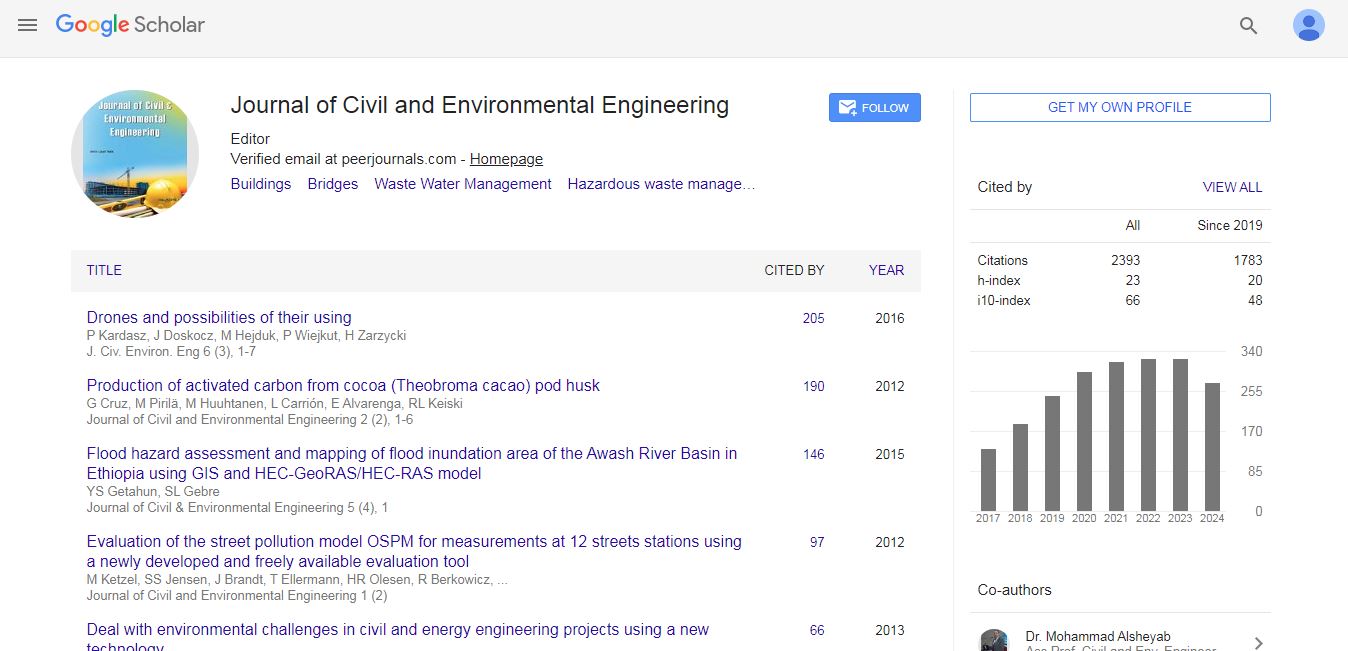
Journal of Civil and Environmental Engineering received 1798 citations as per Google Scholar report