Opinion - (2025) Volume 15, Issue 5
Received: 01-Sep-2025, Manuscript No. jcde-25-177512;
Editor assigned: 03-Sep-2025, Pre QC No. P-177512;
Reviewed: 17-Sep-2025, QC No. Q-177512;
Revised: 22-Sep-2025, Manuscript No. R-177512;
Published:
29-Sep-2025
, DOI: 10.37421/2165-784X.2025.15.625
Citation: Al-Mutairi, Zainab. ”Sustainable Chemical Manufacturing:
Decarbonization and Circularity.” J Civil Environ Eng 15 (2025):625.
Copyright: © 2025 Al-Mutairi Z. This is an open-access article distributed under the terms of the Creative Commons Attribution License, which permits unrestricted use,
distribution and reproduction in any medium, provided the original author and source are credited.
This article explores the landscape of sustainable hydrogen production methods, delving into various green technologies like electrolysis, photocatalysis, and biomass gasification. It critically assesses their efficiency, environmental impact, and economic feasibility. The discussion extends to hydrogen's pivotal role in decarbonizing key sectors of the chemical industry, illustrating how it can replace fossil fuels in processes like ammonia synthesis and hydrocarbon production. What this really means is achieving a cleaner energy future for chemical manufacturing[1].
This piece reviews the advancements in catalytic conversion of carbon dioxide into valuable chemicals. It highlights various catalytic systems, including heterogeneous, homogeneous, electrocatalytic, and photocatalytic approaches, focusing on their mechanisms and effectiveness in producing chemicals such as methanol, syngas, and cyclic carbonates. The goal here is turning a major greenhouse gas into useful industrial feedstock, addressing climate change and resource scarcity simultaneously[2].
This paper examines process intensification and modularization concepts in chemical engineering. It elucidates how these strategies lead to more compact, energy-efficient, and inherently safer chemical plants. The article covers various techniques like microreactors, reactive distillation, and membrane reactors, illustrating their application across different scales of chemical production. What this really means is designing plants that are smaller, smarter, and greener[3].
This article highlights the recent progress in biocatalytic synthesis of chiral chemicals, essential building blocks for pharmaceuticals and agrochemicals. It discusses the discovery of novel enzymes, engineering strategies to enhance enzyme activity and selectivity, and process optimization techniques for more sustainable and efficient production. The key insight here is that biological catalysts offer a greener and more precise path to complex molecules than traditional chemical synthesis[4].
This work explores the use of graphene-based materials in environmental chemical technology, specifically for water treatment. It details their application in adsorption and photocatalysis to remove various pollutants, leveraging their unique surface area and electronic properties. The authors discuss synthesis methods and the challenges for practical, large-scale deployment. What this really means is developing materials that can make our water cleaner using advanced carbon forms[5].
This paper discusses the transformative impact of machine learning on optimizing chemical reactions. It surveys various ML algorithms applied to tasks like predicting reaction outcomes, optimizing reaction conditions, and designing novel catalysts, showcasing how these computational tools significantly accelerate discovery and improve efficiency in chemical synthesis. The core idea is using data science to make chemical R&D much faster and more targeted[6].
This review focuses on chemical recycling technologies for plastic waste, emphasizing their crucial role in advancing a circular economy. It specifically details pyrolysis, gasification, and hydrolysis, explaining their mechanisms, advantages, and limitations in recovering valuable chemicals and fuels from waste plastics. The discussion here is about turning plastic waste into new resources, moving away from linear consumption[7].
This article discusses the sustainable production of biofuels and biochemicals from lignocellulosic biomass, a core aspect of green chemical technology. It explores various valorization strategies, including both thermochemical and biochemical pathways, highlighting the challenges in feedstock pretreatment, optimizing process efficiency, and ensuring economic viability. The overarching theme is harnessing plant waste for renewable energy and chemicals[8].
This review examines the application of microfluidic reactors in advanced chemical synthesis. It underscores their advantages, such as precise control over reaction conditions, enhanced heat and mass transfer, and improved safety profiles. The discussion covers various reactor designs and their utility in producing fine chemicals and pharmaceuticals, along with the obstacles facing industrial scale-up. Here's the thing, these small-scale reactors offer big advantages for complex chemical manufacturing[9].
This article reviews advanced membrane technologies for carbon capture and separation, a critical process for mitigating climate change. It discusses different membrane materials and configurations, evaluating their CO2 selectivity and permeability, and outlining current research efforts aimed at improving their performance and economic viability for industrial applications. What this really means is developing efficient filters to reduce carbon emissions from industrial sources[10].
Modern chemical engineering is deeply focused on sustainable practices, particularly in energy and resource management. This includes developing green technologies for hydrogen production like electrolysis, photocatalysis, and biomass gasification to help decarbonize crucial chemical industry sectors such as ammonia synthesis and hydrocarbon production [1]. A complementary effort involves the catalytic conversion of carbon dioxide into valuable chemicals, including methanol, syngas, and cyclic carbonates, using heterogeneous, homogeneous, electrocatalytic, and photocatalytic systems. This approach tackles both climate change and resource scarcity by transforming a major greenhouse gas into useful industrial feedstock [2].
Efficiency and safety in chemical production are being redefined by process intensification and modularization concepts. These strategies lead to more compact, energy-efficient, and inherently safer chemical plants by integrating techniques like microreactors, reactive distillation, and membrane reactors across various production scales [3].
For complex molecule synthesis, biocatalysis offers a greener and more precise alternative to traditional methods. Recent progress in biocatalytic synthesis of chiral chemicals, essential for pharmaceuticals and agrochemicals, relies on discovering novel enzymes, enhancing their activity and selectivity through engineering, and optimizing processes for sustainable output [4]. Furthermore, the application of microfluidic reactors in advanced chemical synthesis provides precise control over reaction conditions, improved heat and mass transfer, and enhanced safety profiles, particularly useful for producing fine chemicals and pharmaceuticals, though industrial scale-up faces challenges [9].
Environmental chemical technology is advancing rapidly, especially in water treatment and waste valorization. Graphene-based materials, with their unique surface area and electronic properties, are being explored for adsorption and photocatalysis to remove diverse pollutants from water, promising cleaner water through advanced carbon forms [5]. Addressing plastic waste, chemical recycling technologies like pyrolysis, gasification, and hydrolysis are crucial for a circular economy, converting waste plastics into valuable chemicals and fuels [7]. In a similar vein, lignocellulosic biomass, often considered plant waste, is being valorized for the sustainable production of biofuels and biochemicals through thermochemical and biochemical pathways, contributing to renewable energy and chemical sources [8].
The chemical industry is also embracing digitalization and advanced technologies for climate change mitigation. Machine learning is making a transformative impact on optimizing chemical reactions, utilizing algorithms to predict outcomes, optimize conditions, and design novel catalysts. This significantly accelerates discovery and improves efficiency in chemical synthesis by using data science for faster, more targeted research and development [6]. Crucially, advanced membrane technologies are under review for carbon capture and separation, offering efficient filters to reduce carbon emissions from industrial sources. Research focuses on improving CO2 selectivity, permeability, and economic viability of these membrane materials and configurations for large-scale industrial applications [10].
Sustainable chemical manufacturing is a central theme, exploring green hydrogen production via electrolysis, photocatalysis, and biomass gasification to decarbonize industry sectors like ammonia synthesis. Advances in converting carbon dioxide into valuable chemicals such as methanol and syngas are crucial for addressing climate change and resource scarcity, utilizing diverse catalytic systems. Process intensification and modularization concepts are transforming chemical engineering, leading to compact, energy-efficient, and safer plants through techniques like microreactors and reactive distillation. Biocatalysis offers a greener, more precise route for synthesizing chiral chemicals for pharmaceuticals, driven by novel enzyme discovery and optimization strategies. Graphene-based materials show promise in environmental technology, specifically for water treatment, employing adsorption and photocatalysis to remove pollutants. Machine learning is revolutionizing chemical reaction optimization, accelerating discovery and improving efficiency by predicting outcomes and designing catalysts. Chemical recycling technologies like pyrolysis and gasification are vital for a circular economy, converting plastic waste into new resources. The sustainable production of biofuels and biochemicals from lignocellulosic biomass is key for renewable energy, overcoming challenges in feedstock pretreatment and process efficiency. Microfluidic reactors present significant advantages for advanced chemical synthesis, offering precise control, enhanced heat/mass transfer, and improved safety. Advanced membrane technologies are being developed for efficient carbon capture and separation, essential for reducing industrial emissions and mitigating climate change.
1. Md GK, Abul KMBI, Shiplu S. "Sustainable Hydrogen Production and Its Application in Chemical Industry".Catalysts 12 (2022):517.
Indexed at, Google Scholar, Crossref
2. Yanli Z, Xiaojuan H, Hongming Z. "Recent advances in catalytic conversion of CO2 into value-added chemicals".J. Energy Chem. 59 (2021):627-642.
Indexed at, Google Scholar, Crossref
3. Iftekhar AK, Jing-Xin Y, Pengcheng JY. "Process Intensification and Modularization in Chemical Engineering".Chem. Eng. Sci. 252 (2022):117540.
Indexed at, Google Scholar, Crossref
4. Wenyan H, Guowei L, Wei S. "Recent Progress in Biocatalytic Synthesis of Chiral Chemicals".Catalysts 11 (2021):1361.
Indexed at, Google Scholar, Crossref
5. Yaohui H, Guoping C, Jiahuan L. "Recent advances in graphene-based materials for adsorption and photocatalysis in water treatment".Environ. Sci.: Nano 8 (2021):1864-1886.
Indexed at, Google Scholar, Crossref
6. Jiewei L, Xiaohui L, Chao C. "Machine learning for chemical reaction optimization: Recent advances and future directions".Chin. J. Catal. 43 (2022):1205-1224.
Indexed at, Google Scholar, Crossref
7. Jing W, Hao-Wen C, Li-Wei F. "Chemical recycling of plastics: A review on pyrolysis, gasification, and hydrolysis technologies".Resour. Conserv. Recycl. 180 (2022):106198.
Indexed at, Google Scholar, Crossref
8. Hanyun X, Xiaojun S, Ming L. "Sustainable Production of Biofuels and Biochemicals from Lignocellulosic Biomass".Ind. Eng. Chem. Res. 62 (2023):1-17.
Indexed at, Google Scholar, Crossref
9. Xinchao L, Qiang W, Zhaohua J. "Microfluidic Reactors for Advanced Chemical Synthesis: Design, Applications, and Challenges".Chem. Eng. J. 451 (2023):138980.
Indexed at, Google Scholar, Crossref
10. Zhenggang S, Yanan L, Liang L. "Advanced membrane technology for carbon capture and separation: A review".J. Membr. Sci. 669 (2023):121303.
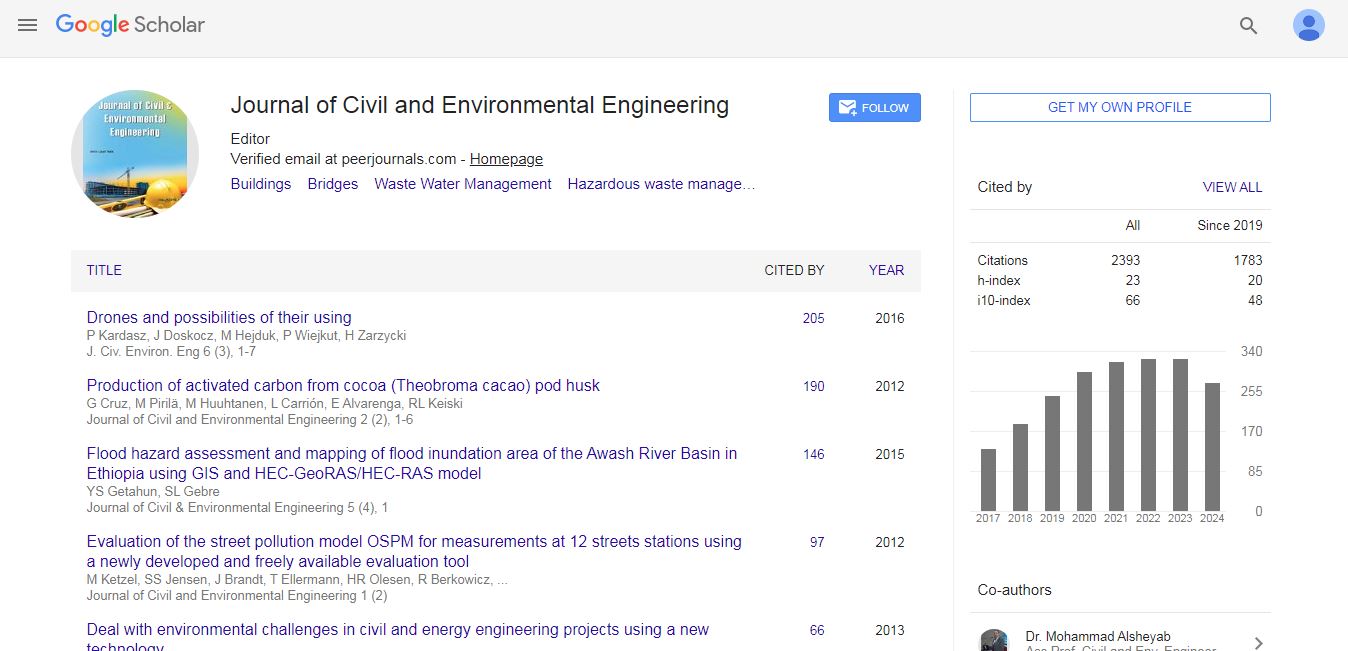
Journal of Civil and Environmental Engineering received 1798 citations as per Google Scholar report