Opinion - (2025) Volume 14, Issue 5
Received: 02-Oct-2025, Manuscript No. jeom-26-188190;
Editor assigned: 06-Oct-2025, Pre QC No. P-188190;
Reviewed: 20-Oct-2025, QC No. Q-188190;
Revised: 23-Oct-2025, Manuscript No. R-188190;
Published:
30-Oct-2025
, DOI: 10.37421/2169-026X.2025.14.551
Citation: Nowak, Katarzyna. ”Sustainability Drives Entrepreneurial Advantage and Performance.” J Entrepren Organiz Manag 14 (2025):551.
Copyright: © 2025 Nowak K. This is an open-access article distributed under the terms of the Creative Commons Attribution License, which permits unrestricted use, distribution and reproduction in any medium, provided the original author and source are credited.
Entrepreneurial firms are increasingly recognizing the strategic imperative of integrating sustainability into their fundamental business operations and decision-making processes. This integration is often driven by a confluence of internal values and external pressures that shape a firm's strategic direction and competitive posture. Understanding these drivers is crucial for comprehending how new ventures can achieve both economic success and positive societal and environmental impact. One significant driver for embedding sustainability is the recognition of market opportunities that arise from growing consumer and investor demand for environmentally and socially responsible products and services. Entrepreneurial firms, with their inherent agility, are well-positioned to capitalize on these emerging markets and develop innovative solutions that address sustainability challenges. This proactive approach can lead to distinct competitive advantages and foster long-term growth. [1] The relationship between a firm's orientation towards sustainability and its overall entrepreneurial performance is a key area of research. Studies suggest that a strong sustainability orientation can act as a catalyst for improved resource acquisition and foster innovation. By embracing sustainability, firms can enhance their attractiveness to investors and partners, while simultaneously stimulating the development of novel products and processes that lead to superior financial and non-financial outcomes. [2] External forces, particularly institutional pressures, play a pivotal role in influencing how small and medium-sized enterprises (SMEs), including entrepreneurial ventures, adopt sustainability strategies. These pressures can manifest in coercive forms, such as regulatory mandates, mimetic forms, where firms imitate successful peers, and normative forms, stemming from professional standards and industry expectations. Internalizing these pressures often leads to more comprehensive sustainability practices. [3] Dynamic capabilities are essential for entrepreneurial new ventures to effectively navigate the evolving landscape of sustainability demands and integrate them into their business models. Capabilities such as agility, learning, and sensing allow firms to adapt to changing environmental regulations, consumer preferences, and market trends. By developing and deploying these capabilities, ventures can achieve a sustainable competitive advantage through eco-innovative strategies. [4] Corporate Social Responsibility (CSR) is a critical tool for entrepreneurial firms seeking to enhance their legitimacy in the marketplace. Proactive engagement in CSR activities, especially those aligned with a firm's core competencies and stakeholder expectations, can build significant trust and reputation. This enhanced legitimacy is vital for attracting investment, talent, and customer loyalty in highly competitive environments. [5] The principles of the circular economy offer a promising framework for entrepreneurial firms aiming to develop sustainable business models. Strategies such as extending product longevity, embracing remanufacturing, and valorizing waste are central to this approach. Adopting a circular economy model not only minimizes environmental impact but also creates new revenue streams and improves resource efficiency, thereby providing a competitive edge. [6] Stakeholder pressure serves as a significant influence on the sustainability performance of entrepreneurial firms. Engaging with diverse stakeholders, including customers, employees, and investors, can motivate firms to set and achieve more ambitious sustainability goals. Proactive responses to stakeholder demands often result in improved environmental and social outcomes, alongside enhanced financial returns. [7] Implementing sustainable supply chain management presents both challenges and opportunities for entrepreneurial ventures. Success in this area often hinges on effective collaboration with suppliers and customers, coupled with the development of robust information systems. Firms that integrate sustainability into their supply chains can realize cost savings, bolster brand reputation, and gain a competitive advantage. [8] The entrepreneurial orientation of a firm profoundly influences its commitment to sustainability. A strong entrepreneurial spirit, characterized by innovation, proactiveness, and a willingness to take risks, often translates into a greater inclination to pursue ambitious sustainable strategies. Such firms are more likely to integrate environmental and social goals into their core competitive strategies. [10]
The embedding of sustainability into the core strategies of entrepreneurial firms is a multifaceted process influenced by various internal and external factors. Market opportunities, driven by increasing demand for sustainable products, are a significant catalyst for firms to innovate and develop eco-friendly solutions, thereby gaining a competitive edge [1].
The alignment of a firm's orientation with sustainability principles is crucial, as it can enhance resource acquisition and foster innovation, ultimately leading to improved financial and non-financial performance outcomes for growth-oriented ventures [2].
Institutional pressures, encompassing regulatory mandates, the imitation of successful peers, and adherence to professional standards, significantly shape the sustainability strategies adopted by entrepreneurial firms and SMEs. When these pressures are internalized, they can drive the adoption of more comprehensive sustainability practices, leading to enhanced legitimacy and operational efficiency [3].
The development of dynamic capabilities, such as agility and learning, is fundamental for entrepreneurial ventures to adapt to evolving sustainability demands and integrate them into their business models, enabling them to achieve a sustainable competitive advantage through eco-innovative strategies [4].
Corporate Social Responsibility (CSR) plays a vital role in building the legitimacy of entrepreneurial firms. By proactively engaging in CSR activities that align with their core competencies and stakeholder expectations, these firms can cultivate trust and enhance their reputation. This increased legitimacy is essential for attracting crucial investment, talent, and customer loyalty in competitive markets [5].
The application of circular economy principles offers a pathway for entrepreneurial firms to create sustainable business models, focusing on strategies like product longevity and waste valorization. This approach not only minimizes environmental impact but also generates new revenue streams and improves resource efficiency, thereby providing a competitive advantage [6].
Stakeholder pressure is a considerable factor influencing the sustainability performance of entrepreneurial firms. Active engagement with stakeholders, including customers, employees, and investors, can motivate firms to pursue more ambitious sustainability goals. This proactive response to stakeholder demands often results in improved environmental and social outcomes, concurrently with enhanced financial returns [7].
The management of sustainable supply chains in entrepreneurial ventures involves specific challenges and opportunities, emphasizing the importance of collaboration with suppliers and customers, alongside robust information systems. Successful integration of sustainability into supply chains can yield cost savings and bolster brand reputation [8].
Eco-innovation serves as a critical mediator between environmental management practices and the financial performance of entrepreneurial firms. The adoption of formal environmental management systems and engagement in environmental initiatives positively influences eco-innovation, which in turn leads to improved profitability. This pathway allows entrepreneurial firms to achieve both environmental and economic benefits [9].
Finally, the entrepreneurial orientation of a firm, characterized by proactiveness, innovation, and risk-taking, directly influences its commitment to sustainability. Firms with a strong entrepreneurial orientation are more inclined to adopt ambitious environmental and social goals and integrate them into their competitive strategies [10].
Entrepreneurial firms increasingly integrate sustainability into their strategies due to market opportunities, regulatory pressures, and founder values. A strong sustainability orientation enhances resource acquisition and innovation, leading to improved performance. Dynamic capabilities and Corporate Social Responsibility are crucial for building legitimacy and competitive advantage. Circular economy principles offer sustainable business models, while stakeholder pressure drives ambitious sustainability goals. Proactive engagement in environmental management and a strong entrepreneurial orientation facilitate the achievement of both environmental and economic benefits.
None
None
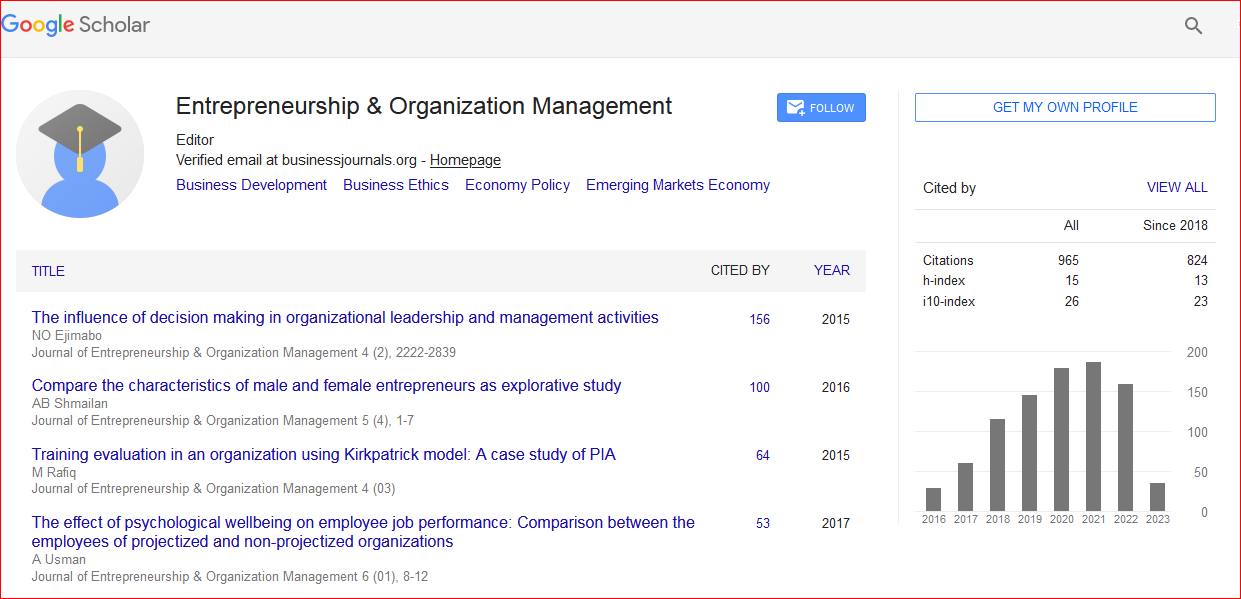
Entrepreneurship & Organization Management received 1115 citations as per Google Scholar report