Perspective - (2025) Volume 16, Issue 2
Received: 01-Apr-2025, Manuscript No. jbmbs-26-183380;
Editor assigned: 03-Apr-2025, Pre QC No. P-183380;
Reviewed: 17-Apr-2025, QC No. Q-183380;
Revised: 22-Apr-2025, Manuscript No. R-183380;
Published:
29-Apr-2025
, DOI: 10.37421/2155-6180.2025.16.267
Citation: Rao, Nikhil. ”Survival Analysis: Methods, Models, and Interpretation.” J Biom Biosta 16 (2025):267.
Copyright: © 2025 Rao N. This is an open-access article distributed under the terms of the Creative Commons Attribution License, which permits unrestricted use, distribution and reproduction in any medium, provided the original author and source are credited.
Survival analysis is a vital statistical methodology employed extensively within medical research to model and understand time-to-event data. This includes critical outcomes such as patient survival duration and the time until disease recurrence, providing invaluable insights into disease progression and treatment effectiveness [1].
The Kaplan-Meier estimator stands as a foundational non-parametric technique within this field. It offers straightforward yet powerful estimations of survival functions, enabling researchers to visualize survival probabilities over time without making rigid assumptions about the underlying data distribution [2].
Complementing non-parametric approaches, the Cox proportional hazards model offers a flexible semi-parametric framework. This model is adept at identifying various factors that significantly influence survival outcomes, thereby deepening our understanding of patient prognoses [1].
These advanced statistical models are not merely academic exercises; they are indispensable tools for the rigorous evaluation of treatment efficacy. By quantifying the impact of interventions, they directly inform clinical decision-making processes and guide therapeutic strategies [1].
The Kaplan-Meier method, in particular, serves as a cornerstone for exploratory data analysis. Its ability to generate clear survival curves makes it exceptionally useful for initial investigations and for highlighting differences in survival experiences between distinct patient cohorts [2].
When seeking to pinpoint specific influences on survival, the Cox proportional hazards model proves instrumental. It allows for the estimation of hazard ratios, which are crucial for assessing how different covariatesâ??such as age, treatment status, or disease stageâ??affect the risk of an event occurring [3].
Beyond the standard Cox model, variations like the stratified Cox model address situations where the proportional hazards assumption may not hold uniformly across different subgroups. This extension allows for more nuanced analysis by permitting stratum-specific baseline hazards [5].
Accelerated failure time (AFT) models present an alternative perspective, directly modeling the time to event rather than the hazard rate. These models are particularly useful when the proportional hazards assumption of Cox models is questionable, offering interpretations in terms of multiplicative effects on survival time [4].
When dealing with scenarios where multiple distinct events can occur, and the occurrence of one event precludes another, the concept of competing risks becomes paramount. Specialized methods are then required to accurately assess the probability of a specific event of interest [6].
Finally, the careful interpretation and clear communication of survival analysis results are essential. Effectively translating complex statistical findings into actionable clinical insights is key to improving patient care and advancing medical knowledge [10].
Survival analysis is a cornerstone of medical research, providing essential tools for modeling time-to-event data such as patient survival and disease recurrence [1].
The Kaplan-Meier estimator is a fundamental non-parametric method used to estimate survival functions, offering a visual representation of survival probabilities over time [2].
Complementing non-parametric approaches, the Cox proportional hazards model provides a flexible semi-parametric framework for identifying factors influencing survival. It allows for the estimation of hazard ratios, quantifying the impact of covariates on the risk of an event [1].
These techniques are crucial for understanding disease progression and evaluating treatment efficacy. They enable researchers to make informed decisions regarding patient care and therapeutic strategies [1].
The Kaplan-Meier method is particularly valuable for initial exploratory data analysis. Its ability to generate clear survival curves facilitates comparisons between different patient groups and helps in understanding overall survival trends [2].
The Cox proportional hazards model is essential for identifying predictors of survival. By examining the effects of factors like age, treatment, and disease stage, clinicians can better understand patient outcomes [3].
When the proportional hazards assumption of the Cox model is violated, alternative methods like Accelerated Failure Time (AFT) models become important. AFT models directly model the time to event and provide interpretations in terms of time ratios [4].
Stratified Cox models are employed when the proportional hazards assumption does not hold across all strata of a categorical covariate. This approach allows for stratum-specific baseline hazard functions, providing a more accurate analysis in complex datasets [5].
Competing risks analysis is necessary when multiple distinct event types can occur, such as death from different causes. Specialized models, like the cause-specific hazard model or the Fine-Gray subdistribution hazard model, are used to accurately estimate the risk of a specific event [6].
Time-dependent covariates, whose values can change over time, introduce further complexity. Methods for handling these covariates, often within the Cox model framework, are vital for longitudinal studies to accurately reflect dynamic patient characteristics [7].
Finally, Bayesian survival analysis offers an alternative framework that incorporates prior information and expresses uncertainty through probability distributions, proving beneficial in situations with limited data or complex structures [8].
Survival analysis is a critical area of medical research focused on time-to-event data, including patient survival and disease recurrence. Key techniques include the non-parametric Kaplan-Meier estimator for survival function estimation and the semi-parametric Cox proportional hazards model for identifying influencing factors. The Cox model allows for the estimation of hazard ratios, quantifying covariate effects on event risk. Alternative methods like Accelerated Failure Time (AFT) models are useful when the proportional hazards assumption is violated. Specialized approaches are necessary for competing risks and time-dependent covariates. Bayesian survival analysis offers a probabilistic framework. Model selection, validation, and careful interpretation are crucial for translating findings into clinical insights.
None
None
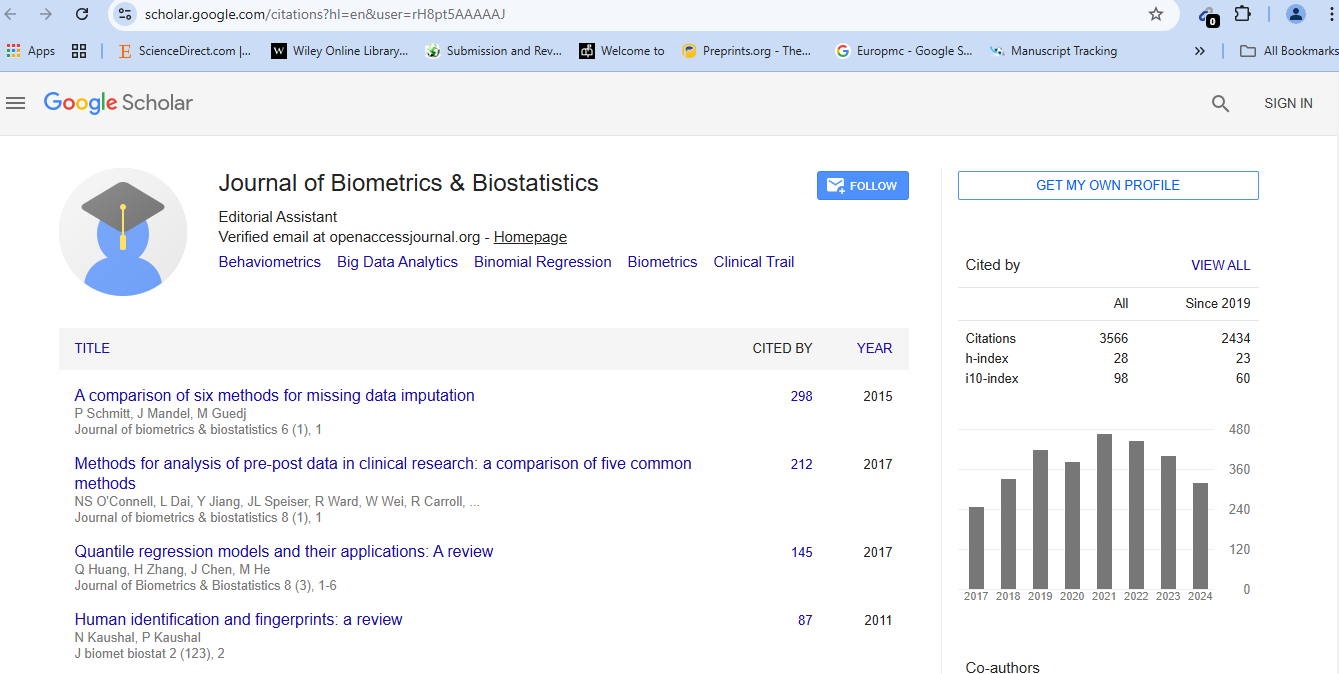
Journal of Biometrics & Biostatistics received 3496 citations as per Google Scholar report