Short Communication - (2025) Volume 14, Issue 2
Received: 01-Apr-2025, Manuscript No. jeom-26-188163;
Editor assigned: 03-Apr-2025, Pre QC No. P-188163;
Reviewed: 17-Apr-2025, QC No. Q-188163;
Revised: 22-Apr-2025, Manuscript No. R-188163;
Published:
29-Apr-2025
, DOI: 10.37421/2169-026X.2025.14.526
Citation: Wei, Chen. ”Structure’s Impact: Business Performance, Strategy, And Efficiency.” J Entrepren Organiz Manag 14 (2025):526.
Copyright: © 2025 Wei C. This is an open-access article distributed under the terms of the Creative Commons Attribution License, which permits unrestricted use, distribution and reproduction in any medium, provided the original author and source are credited.
The fundamental impact of organizational structure on business performance is a widely acknowledged phenomenon, influencing crucial aspects such as communication, decision-making, and resource allocation, all of which directly contribute to operational efficiency [1].
Organizational structures, particularly in their adaptability, play a pivotal role in the success of entrepreneurial ventures, enabling quicker responses to dynamic market shifts and fostering innovation through decentralized decision-making and cross-functional collaboration [2].
The architecture of an organization significantly dictates the efficacy of information flow, a key determinant in the speed and quality of decision-making processes. Structures that minimize communication barriers and promote transparency generally lead to improved operational outcomes [3].
Furthermore, the design of organizational structures profoundly affects employee engagement and, consequently, productivity. Empowered and decentralized structures tend to cultivate higher employee morale and involvement, leading to enhanced efficiency [4].
In the realm of technology firms, the dichotomy between mechanistic and organic structures highlights varying impacts on innovation and efficiency, with organic models proving more adept at fostering adaptation and creativity in dynamic environments [5].
Matrix organizational structures, while offering benefits in resource sharing and skill development, present complexities in reporting and decision-making, necessitating careful management to realize their efficiency potential [6].
The degree of decentralization within an organization is intrinsically linked to its operational efficiency, with a moderate approach often striking the right balance between local autonomy and strategic alignment to facilitate quicker problem-solving [7].
Formalization, a key characteristic of organizational structure, exhibits a dual nature; while it can enhance efficiency in routine tasks through consistency, excessive formalization may impede flexibility and innovation in more dynamic settings [8].
The extent of centralization in decision-making processes within an organizational structure is a critical factor influencing efficiency, as an imbalance can lead to bottlenecks and reduced responsiveness [9].
Ultimately, the congruence between a firm's organizational structure and its overarching business strategy is a significant driver of efficiency, optimizing operational effectiveness and resource utilization when aligned, and creating inefficiencies when mismatched [10].
The influence of organizational structure on how businesses operate is multifaceted, impacting communication channels, decision-making pathways, and the distribution of resources, all of which are direct determinants of overall efficiency. Flatter organizational designs can facilitate faster communication and more agile decision-making processes, whereas more hierarchical structures might offer enhanced control and greater specialization [1].
Research into the relationship between organizational structure and entrepreneurial achievement underscores the value of agile and adaptable frameworks, often seen in startups, which empower rapid responses to market fluctuations. Conversely, high levels of formalization and centralization, typical of larger, established corporations, can constrain this responsiveness. For burgeoning entrepreneurial endeavors, structures that champion cross-functional teamwork and decentralized decision-making are often more advantageous for driving innovation and achieving swift growth [2].
Information dissemination within an organization, heavily governed by its structural design, emerges as a critical element influencing its operational efficiency. Hierarchical arrangements can inadvertently create information silos and introduce delays, while network or team-based structures tend to promote more seamless and timely information exchange. Studies confirm that organizations with structures designed to minimize communication impediments and foster transparency achieve better-informed decisions and enhanced operational velocity [3].
This body of research further explores how distinct organizational designs affect employee morale and output. Structures that promote decentralization and employee empowerment, granting individuals greater autonomy and influence, are generally associated with higher levels of engagement, which in turn leads to improved efficiency. Conversely, rigid, top-down structures can be demotivating, fostering a less productive work environment [4].
Within the technology sector, the comparative effects of mechanistic versus organic organizational structures on innovation and efficiency are examined. Mechanistic structures, characterized by strict formalization and centralization, prove less effective in rapidly evolving environments that demand swift innovation. Organic structures, by contrast, offer greater flexibility and decentralization, facilitating quicker adaptation and more significant creative output, thereby boosting overall business efficiency [5].
The implementation of matrix organizational structures is investigated for its impact on project efficiency. While these structures can enhance resource sharing and skill development across diverse projects, they also introduce potential complications related to reporting lines and decision-making authority. The findings suggest that achieving the efficiency benefits of matrix designs critically depends on effective implementation, clear role definitions, and robust communication protocols [6].
The degree of decentralization within an organizational structure is explored for its impact on operational efficiency. While complete decentralization might lead to disorganization, a moderate level of decentralization, empowering local decision-making and accelerating problem resolution, typically enhances efficiency. The research also emphasizes the necessity of aligning the extent of decentralization with a firm's strategic objectives and industry context [7].
The role of formalization within organizational structure and its subsequent effect on business efficiency is also a subject of study. Highly formalized structures, defined by stringent rules and procedures, can contribute to consistency and error reduction, thereby improving efficiency in predictable, routine tasks. However, excessive formalization can limit adaptability and hinder innovation, leading to inefficiencies in dynamic and unpredictable environments [8].
The influence of decision-making centralization, a core component of organizational structure, on efficiency is examined. Evidence suggests that while a degree of centralized authority is essential for strategic coherence, excessive centralization can result in significant decision-making delays and diminished responsiveness, consequently impacting overall efficiency negatively [9].
Finally, research investigates the critical alignment between organizational structure and business strategy as a key driver of efficiency. When a company's structure effectively supports its strategic goals, it leads to enhanced operational effectiveness and more efficient resource utilization. Conversely, a misalignment between structure and strategy can foster internal friction, create inefficiencies, and ultimately impede the achievement of strategic objectives [10].
Organizational structure significantly impacts business performance, affecting communication, decision-making, and resource allocation, all of which are crucial for efficiency. Agile and adaptable structures are beneficial for startups, fostering innovation and rapid growth, while hierarchical structures offer control. Effective information flow, facilitated by structures that minimize barriers, leads to better decisions. Employee engagement and productivity are enhanced in decentralized, empowered structures, while rigid top-down models can be detrimental. Organic structures in tech firms promote innovation and adaptation better than mechanistic ones. Matrix structures require careful management for efficiency. Moderate decentralization balances autonomy with strategic alignment. Formalization can improve efficiency in routine tasks but hinder flexibility. Centralization is necessary for strategic coherence, but excessive levels create bottlenecks. Ultimately, a strong alignment between organizational structure and business strategy is essential for maximizing operational effectiveness and resource utilization.
None
None
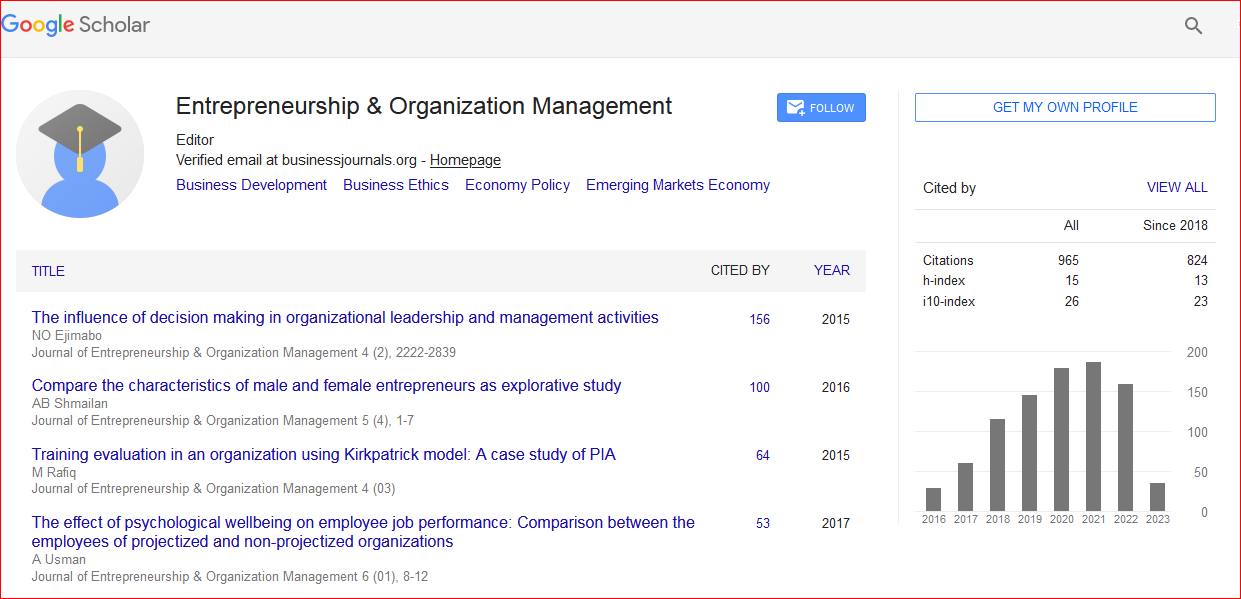
Entrepreneurship & Organization Management received 1115 citations as per Google Scholar report