Commentary - (2025) Volume 15, Issue 6
Received: 01-Dec-2025, Manuscript No. mccr-25-178191;
Editor assigned: 03-Dec-2025, Pre QC No. P-178191;
Reviewed: 17-Dec-2025, QC No. Q-178191;
Revised: 22-Dec-2025, Manuscript No. R-178191;
Published:
29-Dec-2025
, DOI: 10.37421/2161-0444.2025.15.808
Citation: Grant, Oliver M.. ”Structure-Based Drug Design: From Targets to Therapeutics.” Med Chem 15 (2025):808.
Copyright: © 2025 Grant M. Oliver This is an open-access article distributed under the terms of the Creative Commons Attribution License, which permits unrestricted use, distribution and reproduction in any medium, provided the original author and source are credited.
Structure-based drug design (SBDD) represents a paradigm shift in medicinal chemistry, leveraging the three-dimensional architecture of biological targets to rationally engineer novel therapeutic agents. This sophisticated approach involves detailed analysis of protein or nucleic acid binding sites to identify critical molecular interactions. Subsequently, computational or experimental methods are employed to design molecules that exhibit optimal binding and modulate target activity effectively. The impact of SBDD on drug discovery has been profound, significantly accelerating lead optimization processes and reducing reliance on extensive, often inefficient, empirical screening efforts [1].
The contemporary landscape of SBDD is characterized by the synergistic integration of computational tools and experimental techniques. High-resolution structural data, crucial for guiding design, is routinely obtained through techniques such as X-ray crystallography and cryo-electron microscopy. This structural information then fuels molecular modeling, virtual screening, and docking studies, which are instrumental in predicting binding affinities and identifying promising drug candidates. Furthermore, advancements in artificial intelligence and machine learning are continuously enhancing the predictive capabilities of these computational methodologies, paving the way for more sophisticated molecular designs with improved efficacy and a reduced incidence of off-target effects [2].
A particularly effective strategy within the SBDD framework is fragment-based drug design (FBDD). This approach focuses on identifying small molecular fragments that exhibit weak binding to a target. These fragments are then systematically elaborated or linked together to construct high-affinity drug candidates. FBDD is especially valuable for targets possessing shallow or featureless binding sites, where traditional high-throughput screening of larger molecules may prove less successful. Key experimental techniques underpinning FBDD include nuclear magnetic resonance (NMR) spectroscopy and X-ray crystallography, which are vital for characterizing fragment binding [3].
Complementing fragment-based approaches, de novo drug design offers a distinct computational strategy for generating novel drug molecules. This method involves constructing drug candidates atom by atom directly within the three-dimensional binding site of a target protein. It is particularly useful when no existing ligands or detailed structural information about the binding site is available, or when the objective is to explore entirely novel chemical space. Sophisticated algorithms are employed to generate and evaluate potential molecules based on their predicted interactions with the target, with the ultimate goal of optimizing both binding affinity and overall drug-like properties [4].
Structure-activity relationship (SAR) studies are inherently intertwined with SBDD, forming a feedback loop that drives iterative refinement of drug candidates. By understanding how specific modifications to a molecule's chemical structure influence its biological activity, researchers can systematically improve lead compounds. Structural information provides indispensable insights into the molecular underpinnings of these SARs, enabling more informed and rational design decisions aimed at enhancing potency, selectivity, and pharmacokinetic profiles [5].
Central to the successful application of SBDD is the critical initial step of target validation. This process ensures that the selected biological target is indeed implicated in the disease pathology and that modulating its activity will yield a therapeutic benefit. Structural biology plays a pivotal role in elucidating the target's function and identifying accessible, "druggable" sites, thereby guiding subsequent SBDD efforts towards achieving biologically relevant and clinically meaningful outcomes [6].
Allosteric modulation has emerged as a highly attractive therapeutic strategy, and SBDD is fundamental to its discovery and development. Allosteric sites, which are distinct from the primary orthosteric binding site, often present unique opportunities for achieving high target selectivity and fine-tuning biological activity. Detailed structural analysis is crucial for identifying these allosteric pockets and designing molecules that can bind specifically to them, thereby influencing target function through subtle conformational changes [7].
The persistent challenge of drug resistance in treating various diseases necessitates innovative approaches, and SBDD can be instrumental in overcoming these hurdles. By designing novel inhibitors that effectively target mutated forms of proteins or by developing compounds that circumvent existing resistance pathways, SBDD offers a promising avenue. These designs are often guided by structural information detailing the resistant targets themselves, allowing for the creation of next-generation therapeutics [8].
Protein-protein interactions (PPIs) are increasingly recognized as significant drug targets, particularly in challenging therapeutic areas such as oncology and infectious diseases. SBDD plays a crucial role in the design of small molecules or peptides capable of disrupting or stabilizing these complex interactions. The often flat and extensive interfaces characteristic of PPIs present substantial design challenges, demanding advanced structural and computational methodologies for effective targeting [9].
The utility of SBDD is progressively extending beyond the design of traditional small molecules to encompass the development of biologics, including antibody-drug conjugates and novel protein therapeutics. A thorough understanding of the structural basis of target binding and immune system interactions is indispensable for designing these complex therapeutic modalities. Moreover, the fundamental principles of SBDD are actively being adapted for the rational design of nucleic acid-based therapeutics, further broadening its impact [10].
Structure-based drug design (SBDD) fundamentally relies on the detailed three-dimensional structural information of a biological target to inform the design of novel therapeutic agents. This strategy involves a thorough analysis of the binding site within a protein or nucleic acid, pinpointing key molecular interactions that are essential for target function. Based on this structural understanding, medicinal chemists and computational scientists design molecules that are optimized to fit within the binding site and modulate the target's activity. The adoption of SBDD has led to a significant acceleration in the drug discovery process by enabling a more rational and efficient approach to lead optimization, thereby reducing the need for extensive and often serendipitous empirical screening [1].
The contemporary application of SBDD is deeply integrated with a spectrum of computational and experimental methodologies. High-resolution structural data, indispensable for guiding the design process, is readily acquired through advanced techniques such as X-ray crystallography and cryo-electron microscopy. This structural information serves as the foundation for computational tools like molecular modeling, virtual screening, and docking studies, which are employed to predict the binding affinities of potential drug candidates and to identify the most promising molecules. The ongoing advancements in artificial intelligence and machine learning are further augmenting the predictive power of these computational methods, enabling the sophisticated design of molecules possessing enhanced efficacy and a reduced likelihood of causing off-target effects [2].
A highly successful methodology within the SBDD paradigm is fragment-based drug design (FBDD). This technique involves the identification of small molecular fragments that demonstrate weak but specific binding affinities to a biological target. These initial fragments are then systematically elaborated or linked together to construct molecules with significantly higher binding affinities, ultimately leading to potent drug candidates. FBDD is particularly advantageous when dealing with targets that have shallow or undifferentiated binding sites, scenarios where traditional high-throughput screening of larger molecules might yield suboptimal results. Key experimental techniques that are central to FBDD include nuclear magnetic resonance (NMR) spectroscopy and X-ray crystallography, which are crucial for characterizing the binding of these molecular fragments [3].
In addition to fragment-based approaches, de novo drug design represents another powerful computational strategy for creating novel drug molecules from scratch. This method entails building drug candidates atom by atom directly within the three-dimensional confines of a target protein's binding site. This approach is particularly valuable in situations where there is a lack of known ligands or detailed structural information about the binding site, or when the exploration of entirely novel chemical space is desired. Sophisticated algorithms are utilized to generate and score potential molecules based on their predicted interactions with the target, with the primary objective of optimizing both binding affinity and inherent drug-like properties [4].
Structure-activity relationship (SAR) studies are fundamentally and inextricably linked to SBDD, forming a critical feedback loop in the drug discovery process. By meticulously analyzing how structural modifications to a molecule influence its biological activity, researchers can systematically refine lead compounds towards improved therapeutic profiles. The structural information derived from SBDD provides crucial insights into the molecular basis of these SARs, thereby enabling more informed and scientifically rational design decisions aimed at enhancing a drug candidate's potency, selectivity, and pharmacokinetic characteristics [5].
A fundamental prerequisite for the successful implementation of SBDD is the rigorous validation of the biological target. This crucial early step ensures that the chosen target is indeed causally implicated in the pathology of the disease being targeted and that modulating its activity will translate into a demonstrable therapeutic benefit. Structural biology plays an indispensable role in elucidating the target's precise function and in identifying specific, "druggable" sites on its surface, thereby guiding subsequent SBDD efforts towards achieving scientifically sound and clinically relevant outcomes [6].
Allosteric modulation represents a highly attractive and increasingly important therapeutic strategy, and SBDD is a vital tool in the discovery of allosteric modulators. Allosteric sites, which are distinct from the primary orthosteric binding site, often offer unique opportunities for achieving high target selectivity and for fine-tuning the biological activity of a target. Detailed structural analysis is essential for identifying these distinct allosteric pockets and for designing molecules that can bind to them specifically, thereby influencing target function through subtle, induced conformational changes [7].
The development of resistance to existing therapeutic agents remains a significant challenge in the management of numerous diseases, necessitating continuous innovation in drug design. SBDD can play a pivotal role in overcoming these resistance mechanisms. This is achieved by designing novel inhibitors that can effectively target mutated forms of proteins responsible for resistance or by developing compounds that can circumvent established resistance pathways. These advanced designs are frequently guided by structural information of the resistant targets themselves, enabling the creation of effective countermeasures [8].
Protein-protein interactions (PPIs) are increasingly being recognized as important and tractable drug targets, particularly in complex diseases such as various forms of cancer and infectious diseases. SBDD is of paramount importance for the rational design of small molecules or peptides that can effectively disrupt or stabilize these critical interactions. The interfaces involved in PPIs are often characterized by their complex, large, and relatively flat surfaces, which present significant challenges for traditional drug design approaches, thus requiring sophisticated structural and computational methodologies [9].
The scope of SBDD is continually expanding beyond the design of conventional small molecules to include the development of advanced biologics, such as antibody-drug conjugates and novel protein-based therapeutics. A comprehensive understanding of the structural basis governing target binding and potential immune responses is essential for the successful design of these complex therapeutic modalities. Furthermore, the core principles of SBDD are being actively adapted and applied to the rational design of nucleic acid-based therapeutics, further demonstrating the versatility and broad applicability of this approach [10].
Structure-based drug design (SBDD) uses the 3D structure of biological targets to create new drugs, improving efficiency and reducing trial-and-error screening. It integrates experimental techniques like X-ray crystallography with computational methods such as molecular modeling and virtual screening. Fragment-based drug design (FBDD) identifies small molecular fragments that bind weakly and elaborates them into potent drug candidates, particularly useful for difficult targets. De novo design builds molecules atom by atom within the target's binding site, exploring new chemical space. SBDD is closely linked to structure-activity relationship (SAR) studies, which use structural insights to refine drug properties. Target validation is a critical first step, ensuring the target's relevance to disease. Allosteric modulation, facilitated by SBDD, offers new therapeutic strategies by targeting distinct binding sites. SBDD also aids in overcoming drug resistance by designing molecules against mutated targets and is crucial for targeting protein-protein interactions. Its applications are expanding to biologics and nucleic acid-based therapies.
None
None
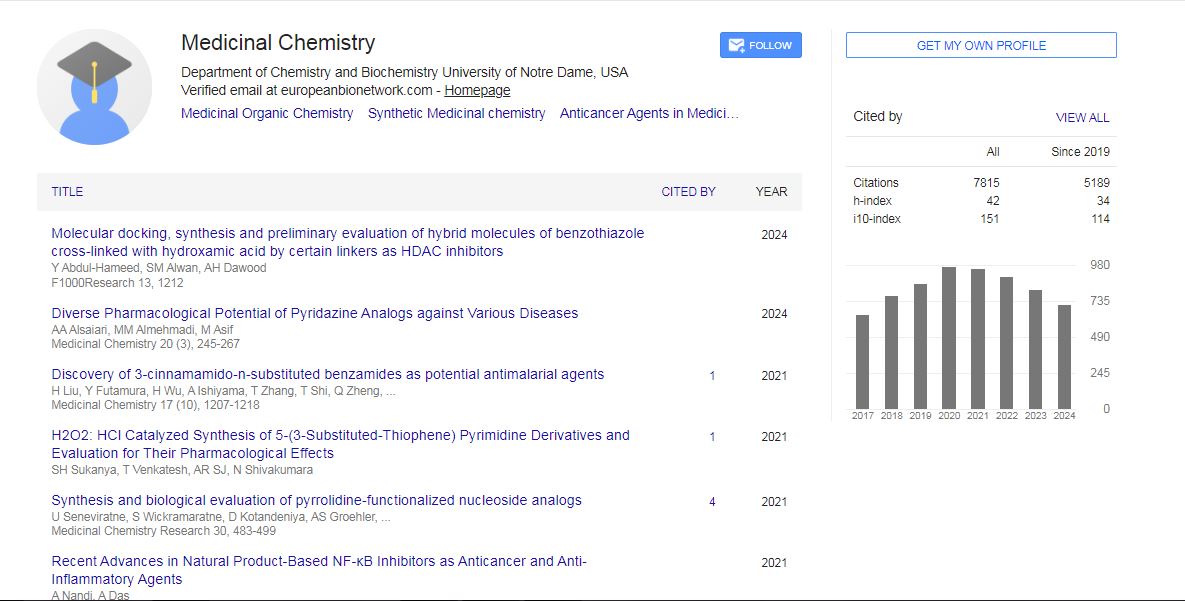
Medicinal Chemistry received 6627 citations as per Google Scholar report