Brief Report - (2025) Volume 15, Issue 5
Received: 30-Sep-2025, Manuscript No. jmcj-25-176910;
Editor assigned: 02-Oct-2025, Pre QC No. P-176910;
Reviewed: 14-Oct-2025, QC No. Q-176910;
Revised: 21-Oct-2025, Manuscript No. R-176910;
Published:
28-Oct-2025
, DOI: 10.37421/2165-7912.2025.15.639
Citation: Feldmann, Markus L.. ”Strong Reporting: Backbone of Credible Science.” J Mass Communicat Journalism 15(2025):639.
Copyright: © 2025 Feldmann L. Markus This is an open-access article distributed under the terms of the Creative Commons Attribution License, which permits unrestricted
use, distribution and reproduction in any medium, provided the original author and source are credited.
This guide outlines the Transparency and Openness Promotion (TOP) Guidelines, offering practical advice for journal editors and publishers. It emphasizes making research more transparent and reproducible, covering aspects like data citation, code sharing, and preregistration. Adopting these guidelines helps enhance the integrity and utility of scientific reporting [1].
The CONSORT 2023 statement provides an updated guideline for reporting parallel group randomized trials. It details a minimum set of items necessary for clear and complete reporting, aiming to improve the transparency and quality of published trial results. Following these standards ensures readers can understand and critically appraise trial findings [2].
This article explores the ethical considerations crucial for effective data visualization. It highlights how visual representations of data can influence interpretation and decision-making, emphasizing the need for clarity, accuracy, and avoidance of misleading displays. Ethical reporting through visualization is vital for conveying reliable information [3].
This systematic review examines the state of reproducibility, transparency, and reporting practices across various research fields. The authors identify common challenges and recommend strategies to improve the rigor and trustworthiness of scientific findings. Better reporting is a cornerstone for enhancing research integrity and replicability [4].
The COREQ 2023 update offers an improved checklist for reporting qualitative research. This guideline helps researchers ensure all essential aspects of qualitative study design, conduct, analysis, and findings are clearly communicated. Adhering to COREQ enhances the transparency and comprehensiveness of qualitative research reporting [5].
This systematic review examines ethical reporting practices within medical research. It identifies key ethical dilemmas and proposes best practices to ensure research is conducted and reported responsibly. Emphasizing ethical reporting is fundamental for protecting participants and maintaining public trust in scientific endeavors [6].
The PREPARE guidelines offer recommendations for planning research and experimental procedures involving animals to achieve reporting excellence. These guidelines promote better animal welfare and improve the quality and reproducibility of preclinical research. Comprehensive reporting in animal studies is crucial for scientific rigor and ethical accountability [7].
This qualitative study investigates how research is communicated for policy impact, specifically in public health. It identifies factors that facilitate or hinder the translation of evidence into policy. Effective reporting in this context requires understanding the needs of policymakers and tailoring communication strategies to achieve practical influence [8].
This systematic review explores the landscape of automated scientific report generation, identifying current capabilities and future directions. It shows how automation can enhance efficiency and consistency in reporting, while also highlighting the challenges and ethical considerations involved in such techniques. The goal is to streamline the reporting process without compromising quality [9].
This scoping review investigates reporting biases in observational studies, detailing various forms of bias that can distort findings. It underscores the importance of transparent and complete reporting to mitigate these biases and ensure the reliability of study conclusions. Understanding and addressing reporting biases is essential for robust evidence synthesis [10].
Here's the thing, enhancing the integrity and utility of scientific reporting is a central focus in contemporary research. Various guidelines are crucial for promoting transparency, openness, and reproducibility. The TOP Guidelines, for instance, offer practical advice for journal editors and publishers, emphasizing essential practices like data citation, code sharing, and preregistration to ensure research is more transparent and reproducible [1]. This aligns with broader efforts to improve the rigor and trustworthiness of scientific findings across fields, where better reporting is consistently identified as a cornerstone for enhancing research integrity and replicability [4].
Specific reporting guidelines are vital across different research methodologies. For parallel group randomized trials, the CONSORT 2023 statement provides an updated guideline detailing the minimum set of items needed for clear and complete reporting, ultimately improving the transparency and quality of published trial results [2]. Similarly, in qualitative research, the COREQ 2023 update offers an improved checklist. This helps researchers clearly communicate all essential aspects of study design, conduct, analysis, and findings, thereby enhancing the transparency and comprehensiveness of qualitative research reporting [5]. For studies involving animals, the PREPARE guidelines provide recommendations for planning experimental procedures, aiming for reporting excellence. These guidelines not only improve the quality and reproducibility of preclinical research but also promote better animal welfare, underscoring the necessity of comprehensive reporting for scientific rigor and ethical accountability [7].
Ethical considerations are interwoven throughout the reporting process. This includes careful thought for data visualization, where visual representations can significantly influence interpretation and decision-making. Emphasizing clarity, accuracy, and avoiding misleading displays is crucial for conveying reliable information ethically [3]. Moreover, ethical reporting in medical research is fundamental. A systematic review on this topic identifies key dilemmas and proposes best practices to ensure research is conducted and reported responsibly, protecting participants and maintaining public trust in scientific endeavors [6].
Beyond methodology-specific guidelines, the broader challenges and impacts of research communication are also critical. Reporting biases in observational studies, for example, can distort findings. A scoping review on this subject highlights the importance of transparent and complete reporting to mitigate these biases and ensure the reliability of study conclusions, which is essential for robust evidence synthesis [10]. Furthermore, research is not always confined to academic circles; communicating research for policy impact, especially in public health, demands an understanding of policymakers' needs. Tailored communication strategies are necessary to effectively translate evidence into practical influence [8].
Looking to the future, the landscape of scientific reporting is evolving. Automated scientific report generation is an area of active exploration, with current capabilities and future directions being systematically reviewed. While automation can enhance efficiency and consistency, it also brings challenges and ethical considerations. The overarching goal remains to streamline the reporting process without compromising quality, ensuring scientific communication remains both effective and responsible [9].
Here's the thing about scientific reporting: it’s all about making research clear, trustworthy, and repeatable. Different guides help with this, like the TOP Guidelines, which push for openness and reproducibility through things such as data citation and code sharing [1]. For specific study designs, the CONSORT 2023 statement sets standards for parallel group randomized trials, ensuring people can properly assess trial findings [2]. Similarly, the COREQ 2023 update improves how qualitative research gets reported, making sure key aspects of study design, analysis, and findings are communicated effectively [5]. And for animal studies, the PREPARE guidelines are there to promote animal welfare and boost the quality of preclinical research reporting [7]. Beyond specific guidelines, ethical considerations are a big deal. Whether it's data visualization, making sure visuals don't mislead [3], or ethical reporting in medical research to protect participants [6], responsibility is key. A systematic review confirms that better reporting is essential for overall research integrity and replicability [4]. There are also challenges to tackle, like reporting biases in observational studies, which demand transparent reporting to ensure reliable conclusions [10]. Even communicating research for policy impact, especially in public health, needs tailored strategies to influence decisions [8]. Looking ahead, automated scientific report generation shows promise for efficiency, though it comes with its own set of ethical considerations [9]. What this really means is, strong reporting practices are the backbone of credible science.
None
None
David M, Brian AN, Elizabeth I. "Transparency and Openness Promotion (TOP) Guidelines: A Practical Guide for Journal Editors and Publishers".Perspect Psychol Sci 18 (2023):215-227.
Indexed at, Google Scholar, Crossref
Kenneth FS, Douglas GA, David M. "CONSORT 2023 statement: updated guideline for reporting parallel group randomized trials".BMJ 383 (2023):p1906.
Indexed at, Google Scholar, Crossref
Carolina DdM, Michael BM, John EB. "Ethical considerations for data visualization".BMJ Glob Health 6 (2021):e007624.
Indexed at, Google Scholar, Crossref
Daniel MH, Peter KM, Lars EH. "Reproducibility, transparency, and reporting in research: a systematic review".J Clin Epidemiol 134 (2021):138-151.
Indexed at, Google Scholar, Crossref
Elizabeth HHF, Andrew CJ, Jane CSH. "COREQ (COnsolidated criteria for REporting Qualitative research) 2023: improved checklist for reporting qualitative research".Int J Nurs Stud 144 (2023):104523.
Indexed at, Google Scholar, Crossref
Elena DP, Marisa LT, David MR. "Ethical reporting in medical research: a systematic review of the literature".Res Ethics 16 (2020):1-15.
Indexed at, Google Scholar, Crossref
Penny H, Carola RASvD, Malcolm RM. "PREPARE (Planning Research and Experimental Procedures: Animals: Recommendations for Excellence) guidelines".Lab Anim 54 (2020):11-20.
Indexed at, Google Scholar, Crossref
Rebecca PA, Jonathan DB, Elizabeth AC. "Communicating research for policy impact: a qualitative study of evidence-based policy making in public health".Health Res Policy Syst 17 (2019):68.
Indexed at, Google Scholar, Crossref
Lukas DS, Michael HW, Katharina ER. "Automated generation of scientific reports: A systematic review and future directions".J Biomed Inform 135 (2022):104212.
Indexed at, Google Scholar, Crossref
Andrea CT, Charlene SG, Melissa HB. "Reporting biases in observational studies: a scoping review".J Clin Epidemiol 118 (2020):143-155.
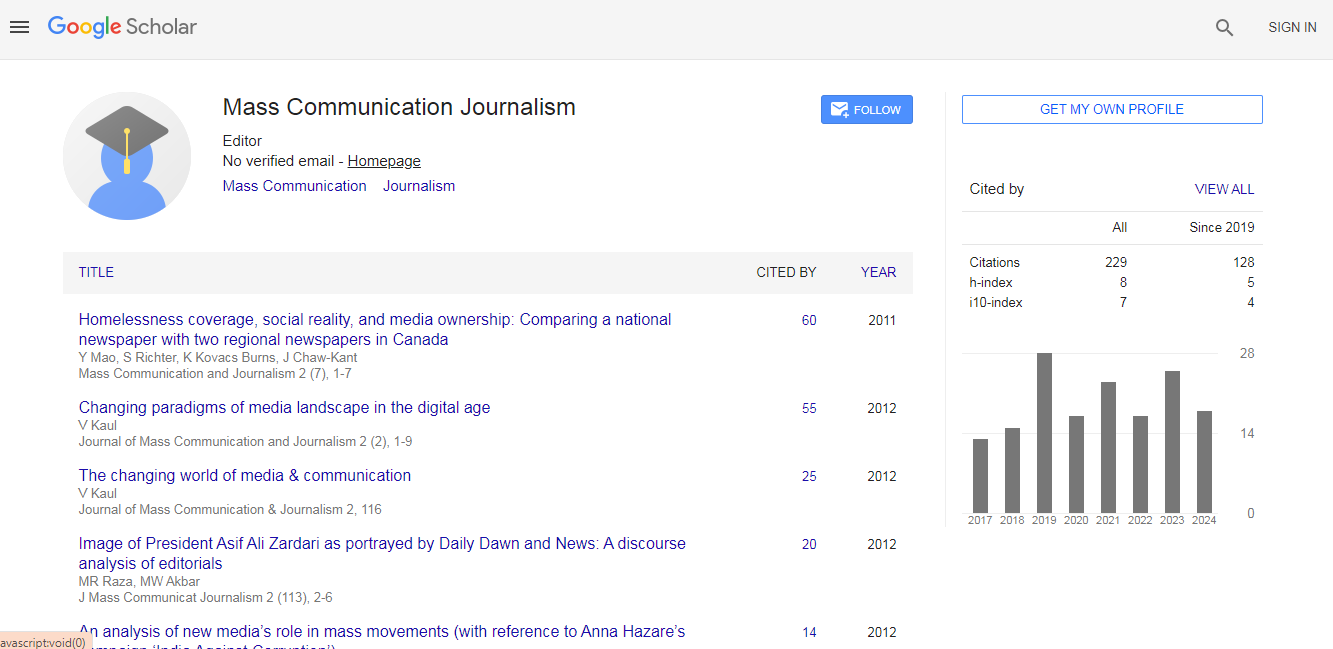
Journal of Mass Communication & Journalism received 205 citations as per Google Scholar report